Highlights of the Kingdom Economy Conference

I am really glad I got the chance to attend The Evolving Church: Kingdom Economy conference on Saturday at People’s Church.  This is the first time I’ve been able to attend an event put on by Epiphaneia, and it definitely lived up to my expectations.    The strength of the event was definitely the outstanding speakers.   I was drawn in by the chance to hear William Cavanaugh, but went away wanting to hear more from pretty much every one of them.

Maybe the most significant thing about the Evolving Church conferences is the way they bring significant thinkers from the academic world into dialogue with the local church.  This doesn’t happen nearly enough.   I posted some thoughts on this problem in relation to theological education a few weeks ago.    With Karl Barth, I see theology as an activity of the Church.  It could be described as the activity by which “the Church, in accoardance with the state of its knowledge at different times, takes account of the content of its proclamation critically, that is, by the standard of Holy Scripture and under the guidance of its confessions.” [Dogmatics in Outline, p. 1]  If this is true, the mutual isolation that currently exists between the life of the church and theological research is deeply problematic, both for professional theologians and for the Church as a whole.   It would also seem, on the basis of this definition, that events like Kingdom Economy could be considered more theological than many academic conferences, where the topics and papers presented are often very far removed from the life of the Church.

I couldn’t begin to summarize all the things that were said on Saturday, but I thought I’d offer a few quotes that have stuck with me.

“Shakespeare is country music.” David Dark. I could have listened to David Dark all day.  He made me wish I was more familiar with English literature.  But the point of this quote was that “literature” doesn’t mean really intimidating stuff that makes you feel inadequate – it is “the poety of the people,” and “that which expands the talk-aboutable.”  He wanted to focus primarily on “the classics,” works which are called classics precisely because of their enduring popularity, not because of their obscurity.  He painted a picture of our engagement with literature is part of a process of redemptive questioning, testing, and re-appropriating a stock of images and words from our culture.   There are times when an “explanation” could be a form of false witness, an inadequate testimony to God’s truth, which might be better expressed in poetry or narrative – something which, rather than giving a definitive, propositional answer, induces further questioning and searching (we might note here that the form of scripture itself testifies to this need for poetic and narratival witness to divine revelation).  I’m sure I haven’t adequately expressed his perspective, but I was quite moved by what he had to say, and I”m hoping at some point I’ll get a chance to read some of his work.

“Consumerism is not about having more, it is about having something else.” William Cavanaugh.  I read Being Consumed last year and was thoroughly impressed with the way that Cavanaugh used traditional theological voices such as Augustine and Aquinas to critique consumerist culture and economic practices.  His presentation and workshop were based on the book, so I was glad to be reminded of some of the more significant points he made there.  In his workshop he was talking about how we assume that consumerism produces an inordinate attachment to “things,” when really it pushes us to detachment from the material world.  We are detached from products because we are detached from the process of production (we don’t make our own stuff anymore) and from the producers (who are often working under deplorable conditions in far off places).  The result is that we’re not at all attached to the things we buy.  Once we have one thing, we just want other things – consumerism is about shopping not about actually valuing and holding on to the things we buy.   Much more could be said about this book…maybe later.

“To be a Christian is to be drawn into a story you did not want to be a part of…drawn into wanting to be bound to that which you despise.” J. Kameron Carter.   Somehow I came away appreciating Carter’s contrast of Avatar and District 9, even though I’m one of about five people on earth who haven’t seen either of these movies.   His point here had to do with the aesthetics of the two films.  Both make you want to become the “other,” but in Avatar, you are drawn into wanting to be one of the Na’vi because you see them as beautiful.  By contrast, in District 9, you are drawn into wanting to be bound to the “prawns”, which are hideous and revolting.  Carter spun this out as a kind of incarnational aesthetic – redemption coming through being bound to that which you despise.  I wonder where Gran Torino fits on this spectrum?

“Instead of following Jesus Christ you end up buying into certain brands…but they all started out as genuine movements of the Holy Spirit.” Becky Garrison. I found Garrison’s talk really funny, and I thought it shed light on a really problematic aspect of Christian culture.  Garrison is a satirist, and the idea of “Christian satire” certainly raises some interesting questions.  My friend Ian had a discussion with Garrison about this over on his blog.  He raises some really good questions about whether or satire, as a genre, is a helpful way for Christians to speak to one another.   He may be right, but I thought Becky’s talk showed that she is aware of the potential dangers of what she does.  That’s why I included the two quotes above.   I’m not sure how much time passed between her saying those two things, but she did say both.  The problem is not with big-name authors, but with the way that authors are themselves promoted and branded and marketed to the hilt. It’s a question about the system.  Granted, it is hard to separate the system from the people involved.  That’s why, towards the end of her talk, Garrison said,  “Beware of crossing the line from satirizing the subject to slamming the soul…beware of moving from smashing an idol to destroying the Church.”   That’s a difficult line to walk, for sure.

“It’s hard to tell the guy who got a free BMW for Easter that he is called to die.” Chris Seay.  Seay’s talk was mostly about righteousness.  While we tend to think of righteousness as being about upright personal behaviour, he offered the alternative way of thinking about it in terms of “shalom.”  There aren’t good and bad people, he said, there is “shalom” and there is “broken shalom.”  We need to understand righteousness as God bringing his shalom into the world – that will push the Church to rush into the broken places of the world.  It sounds like his church in Houston embodies this idea.  The quote I’ve chosen isn’t so much about that, but I thought it was hilarious.  In critiquing the typical “bait-and-switch” technique of trying to get people to come to church, Seay noted that a church in Houston had offered over $2M in prizes this Easter in order to get people to show up.  The prizes included luxury items like BMWs.  That’s where the above quote came from – we’re not inviting people to follow Christ in bringing God’s shalom into the world if we entice them to come by offering great benefits.   Another gem:  “The evangelion has become an infomercial.”

I’m really thankful to the guys at Epiphaneia for holding these events – and I’m encouraged that so many people show up!

I would definitely be attending the Eighth Letter conference this October, but I’m going to be out of town.   If you are able to go, I’d highly recommend it.
more on moralism, via internet monk

This morning I read this 2005 re-post from Internet Monk – a great piece on how assurance is undermined by contemporary evangelical spirituality.  Part of the issue is the moralism I was on about in my last post:

Much of evangelical preaching today is focused on moralism of various kinds, constantly pointing the Christian to what he/she ought to be doing. Serious preaching on discipleship often directs the Christian to a variety of duties, ministry needs and pressing obligations for any true follower of Jesus. For sensitive consciences, it can seem that the Christian life is about being a “good” person, doing “good” things in a hurting world, imitating Jesus so others can see Jesus in you.

Many contemporary preachers are busy describing the Christian life as a life where the Christian finds his/her destiny and fulfills his/her dreams. Follow the principles for success and purpose, and experience God’s best for your life. But what if you are failing? Suffering? Constantly falling short? Such emphases can undermine assurance when the Christian is told the outcome of the Christian life is practical, real-world results.

I think the sincere and laudable desire to be “relevant” and give “life-applications” is at the root of much of  this moralistic preaching.  We want to give people a “so what” point at the end of the sermon, so we end questions like: “What about you? Are you doing your best with [insert sermon topic]?”

The bottom line of many sermons is “you need to do more.”  Usually the “more” is about one of three things: personal Bible study, personal prayer life, and witnessing to others.   All are important aspects of Christian life, but the problem is that our worship services, and our sermons, are designed to climax at this point of “life application.”  It is the point toward which the rest of the service points.  So the main thing that we are saying each Sunday is, “we need to be doing this or that,” rather than a proclamation of the victory of Christ. Our spirituality is focused too heavily on our state as Christians, and not enough on the constant re-presentation of the saving acts of God.  Making self-examination the foundation will lead us to either despair (if we are honest) or presumption (if we think we really are doing enough!).  Our actions, the things we “do” as Christians, come as a grateful response to God’s prior action “for us and for our salvation.”   Often times it seems that we are putting the cart before the horse by our strong emphasis on what we should be doing.

Moralistic Therapeutic Deists

Christian Smith, Notre Dame sociologist and author of some significant books on youth in North America’s churches, uses the term “moralistic therapeutic deists” to describe the default religion of our time.  Christianity Today had an interview with Smith in their October issue, in which they discussed his new book on “emerging adulthood,” Souls in Transition.  He’s got some really interesting things to say about young adults and the Church. I wish the book had been published earlier, as I’d already finished up my young adult project for the SA when Souls in Transition hit the shelves.  For example, his typology of emerging adults might have got me thinking in different ways about how I might have summarized my interviews.  He breaks down the population of young adults as follows (found on p. 36 of the print edition on CT but not in the online article):

  • Committed traditionalists (15%)
  • Selective adherents (30%)
  • Spiritually open (15%)
  • Religiously indifferent (25%)
  • Religiously disconnected (5%)
  • Irreligious (10%)

Maybe in another post I’ll speculate as to how these categories play out among young adults in The Salvation Army.

Right now I’m interested in this idea of “moralistic therapeutic deists”, because I think it is a great description of the default religion of our day. While Smith’s research indicates that some young adults are questioning the moralistic therapeutic deist framework, it still remains the dominant form of religious practice:

With Soul Searching, you found that most U.S. teens are Moralistic Therapeutic Deists (MTD). They believe in a benevolent God unattached to a particular tradition who is there mostly to help with personal problems. Are emerging adults still MTDS?

Moralistic Therapeutic Deism is still the de facto practiced religious faith, but it becomes a little more complicated for emerging adults. They have more life experience, so some of them are starting to ask, “Does MTD really work? Isn’t life more complicated than this?” MTD is easier to believe and practice when you are in high school.

It’s good that today’s young adults are questioning popular religion, but the majority still practice their religion within a moralistic therapeutic framework.  By “the de facto practiced religious faith” Smith means the “cultural Christianity” of North America, but we shouldn’t think that by this he means Christianity of “the culture” as opposed to Christianity found in the churches.  It’s the pop Christianity of both Church and culture – not found in all churches but certainly preached and practiced in many.  Moralistic therapeutic deism is the default framework through which Christians interpret their lives and their faith.

So what is “moralistic therapeutic deism”?  (These are my thoughts, not Smith’s; I’m trying explain his terminology in terms of what I see in the culture.)

Moralistic: religion is basically about being a good person.  This could be taken in a number of directions. For example, a moralist religion might envision God as rewarding “good Christians” for their good actions.  They might support the popular notion that people who are basically good are going to go to heaven.   This doesn’t mean that young adults believe in absolute moral standards.  They are more likely to think of morality in relative terms, as this recent Knights of Columbus poll of Catholic millenials shows (82% say morals are relative).  Yet somehow “being a good person” remains the foundation of religious practice, even while a plurality of competing moral visions are accepted. The problem with moralism is not that it supports a moral vision, but that it makes morality the foundation of religion, rather than the saving action of God in Christ.  Salvation includes transformation, and of course it includes moral transformation.  But our moral behaviour is the result of God’s action. God’s action does not come in response to our moral behaviour.  North American churches are full of moralism.

Therapeutic: religion takes on the form of pop psychology.  In other words, God is there to help me get through my day (see my reference to the personal assistant God in a previous post).  Or, God is there to help me “reach my potential,” and “become a better me.”   Religion as therapy is about personal fulfillment, and meeting “my needs.”   God is domesticated and placed “at our service” as we journey on the road to personal “success” – whether that be in business, family life, or (as above) becoming a good religious person.  This kind of therapeutic Christianity often takes the form of psychological strategies or practical “life skills” by which we can attempt to manage our personal lives.

[I do think salvation has a therapeutic dimension, but not in the contemporary psychological sense of therapy. Wesley’s soteriology is often described as “therapeutic” as opposed to forensic.  This means that he saw salvation as entailing a process of healing as well as a declaration of justification.  Salvation is not simply about being declared righteous in Christ, but about being conformed to his likeness and renewed in the image of God.  This includes the re-directing of our desires toward their intended godly ends.   The key difference here is that the “therapy” in this case is christologically determined, and not based on a program of “self-fulfillment.”  In fact, “self-fulilment” would be the opposite of the divine therapy that the Spirit works in conforming us to Christ’s likeness.  My daily “needs” are not necessarily right and good.  Since I am totally depraved, I don’t actually know what my “needs” are.  The things I think I “need” may in fact be deadly poison.  The gospel doesn’t meet my pre-conceived needs; the “medicine” it provides also tells me what my true sickness is.  God’s mercy never comes independently of his judgment.]

Deism: This is not the same as the deism of the seventeenth and eighteenth centures, which saw God as an uninvoled creator, who got the ball rolling with creation and then just let the world take its mechanically determined course.  Moralistic therapeutic deism involves a generic concept of God, unattached to a particular religious tradition.   This God is benevolent and involved in creation, indeed he’s involved in the everyday ins and outs of our lives.  But he’s a bit abstract.  He’s the nice old guy in the sky. In other words, this deism is a far reach from the historic Christian proclamation of the particular God revealed in Biblical history.

I think we need to be constantly challenging this framework. Precisely because moralistic therapeutic deism is “the de facto practiced religious faith,” we need to hear again and again that it is not the historic Christian gospel.   People come to their faith with this basic framework already in place, and if it isn’t challenged it will remain in place.  Worse, if we tailor our preaching to moralistic therapeutic deism (which I think we often do, unwittingly), we perpetuate a vision of Christianity which is, in my view, foreign to the biblical message.

This is where I think sociological research like Smith’s can be of immense value.   Sociology is a descriptive rather than a normative discipline.  In other words sociology attempts to tell us how things are, not how they ought to be. It tells us how people behave, attempting to summarize patterns and, at times, discern causes of particular patterns of behaviour.  The Church doesn’t take its direction from sociological trends, but from the authoritative witness of scripture.  However, in understanding these trends, we can understand where people are coming from when they encounter the Christian message (including Christians themselves).   If we know that moralistic therapeutic deism is the default religion of North Americans, and we know that it is contrary to basic aspects of the gospel, how can we not respond by challenging these default assumptions?

Pastors as wannabe executives

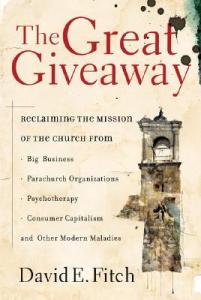
There’s a really interesting post here from Dave Fitch, entitled “Stuck between Mohler and McLaren.”   By coincidence I was reading through his chapter on “Leadership” in The Great Giveaway yesterday, which covers some similiar ground.    At first I thought he was referencing Johann Adam Möhler, and I was really intrigued…but it’s Al Mohler (less interesting to me personally, but much more representative of the contemporary church!).

The thesis in this chapter of The Great Giveaway is that the contemporary pastorate has capitulated to models of leadership found in the business world, which are fundamentally oriented toward “effectiveness” in getting results, rather than on faithfulness to Jesus Christ.  This leads to conflict resolution strategies that are high handed and autocratic.  The pastor needs to decide on a solution in order for the ministry to maintain its effectiveness (which usually means numerical growth).   If people don’t get on board, they are standing in the way of the “success” of the ministry.

I’m really connecting with what Fitch has to say, as it sums up and connects some ideas that have been rolling around in my head for some time.   Most books on Christian leadership are simply parroting the latest trendy ideas from the world of management.   What’s worse is that they throw in the odd scripture verse and “spiritualize” the ideas they’re selling, which means that the pastors who buy this stuff are taking that back to their churches believing that they’ve got divine authority on their side as they try to implement these so-called “biblical” strategies.   Not that insights from the business world have absolutely no value.  They might be helpful as tools to aid in Church leadership, if used selectively within a larger biblical and theological framework.  But they should not have the defining role that they have in the contemporary evangelical world.  So whether it’s “mission statements,” “visioning,” “strategic planning,” or more recently, “branding,” churches are embracing contemporary management techniques wholeheartedly as if they were gospel truth.   People who don’t get on board then are “problems” to be managed (at best), or (at worst) hinderances to the Spirit.   If it seems like I’m exaggerating here, I’m not.  I know a person who was told that their practical questions about church finance were “of the devil.” 

For all the diversity of contemporary Canadian society, it seems like we’re getting worse at handling conflict in our churches.  Everywhere you look there is  a local congregation that is being torn apart by some scandal or another.   Perhaps it is (as Fitch suggests in his book) connected to the individualistic outlook  of modernity, which encourages each one of us to think that we are completely autonomous centres of decision-making power, and that each one of us must arbitrate for ourselves between competing truth claims.   The locus of authority, for modernity, is the reasoning self, and the presumption is that “reason” will lead us to the truth through the exercise of our intellectual faculties.  Of course this is a bit of a charicature, but it pretty much sums up the way it works on a practical level.  And perhaps that has something to do with the interminable splintering of denominations and congregations in modern protestantism.   If we all believe that we ourselves are the final arbiters of truth in matters of dispute, then why would we back down when faced with an opposing view?

The question is whether postmodern understandings of self, truth, and knowledge move us any closer to a more healthy resolution of these problems.   It would seem that postmodern sensibilities are helpful in de-bunking the conflict-ridden assumptions of modernist epistemology, but not as helpful in offering constructive solutions.   No one person can claim a certain enough hold on truth to impose it upon an entire community.  So people of my generation are less likely to get hot under the collar about a dispute within our local church, thinking that we’re the ones who’ve got the “true” answer.  But then again, we might just stop caring at all, and become apathetic in the face of conflict, as it would seem as if no final resolution is possible.  What is needed is a normative standard to replace the reasoning autonomous self.  The standard may not be “universal” in the way that some moderns claimed “reason” was universal, but it can nevertheless be authoritative within the community for whom it is adopted.  

What I like about Fitch’s approach is that he always finds his way back to biblical depictions of church life as the normative standard.   So in the post referenced above, the answer to conflict in the Church is based on Matthew 18.   What is shocking about this model is that so few churches actually try to live this out.  We turn instead to the world of management theory and dress it up in spiritual language as if that were the “biblical” way of being Church.  Why is this?  Has the model that Fitch upholds been tried and found wanting?  Not in my experience.  More likely it is the fact that is just plain messy and “inefficient,” and therefore doesn’t fit with the corporate approach to leadership that we’ve embraced.

The longest church name in the history of the world

This is a church that has a storefront in our neighbourhood.  The St. Francis National Evangelical Spiritual Baptist Faith Archdiocese of Canada.   Personally I like the acronym printed on the window below, the “St. Francis N.E.S.B.F.  Archdiocese of Canada.”

It makes you wonder about this history of this group.  How on earth did they come up with that name?   At first glance it seems like they’d have something to appeal to just about every kind of Christian.

  • St. Francis – well he appeals to everyone, but especially to Catholics
  • National – that appeals to established Church types
  • Evangelical – obviously appeals to…
  • Spiritual – maybe the charismatics?
  • Baptist – of course…

Some of these things don’t normally go together, notably “St. Francis” and “Baptist,” which makes it all the more interesting.   I found a website for the church, which explains that they are a group from Trinidad.  They seem charismatic – they are also called “shouters,” and the have three hour worship services – and they mix elements of Protestant Christianity with African religion.   It’s not clear from their site exactly what that looks like.   They themselves aren’t exactly clear on their origins.

What is interesting to me about this group is that they are charismatic, but they don’t seem to downplay the significance of ritual and symbol in their faith.   Actually their website lists candles, bells, swords, flags, uniforms and a whole host of other items as significant in their worship.    Most charismatically-oriented protestants (we could expand that to include most evangelicals) are wary of any kind of ritual.  They’ve got some obviously “catholic” elements in their worship (one page on the website has prayers of the saints), but they speak in tongues and have street preaching missions.

Then again, if you know the story of St. Francis and the mendicant friars, you’ll know that these things are not so distinct from one another after all.  Francis was the ultimate charismatic.  He was also completely committed to the Catholic faith, and to the task of preaching the gospel.   Maybe the St. Francis N.E.S.B.F people are on to something.  It’s the history of division in the Church since the Reformation that has caused us to see the various terms that go into their name as being at odds with one another.   The names that we have given to our denominations are there precisely to distinguish us from the other denominations and traditions.   Our particular denominational identities then become filters for the discernment of what is good, acceptable, and true.   For example, in my tradition, if someone says something is “Wesleyan” that automatically makes it acceptable, but if it’s “Calvinist” people assume it is wrong, without even really thinking about it.  Although strong denominational identities are fading fast, most of us have been formed in communities that make these kind of distinctions all the time. “St. Francis” and “Evanglical” seem an odd pairing to a contemporary evangelical, because St. Francis is seen as a Catholic figure. But actually Francis lived during what is rightly called an “evangelical revival,” a real flowering of the gospel, which included radical forms of discipleship, self-denial, and evangelistic preaching missions.   I really don’t know much about the St. Francis N.E.S.B.F., so I wouldn’t want to hold them up as a model of anythying, but maybe the fact that they seem to have developed in obscurity has allowed them to hold these things together without worrying that they were crossing traditional boundaries.

Benedict XVI on the unholy holiness of the Church

A favourite quote from the current pope, on how the church’s holiness must be patterned after the holiness of Christ, which continually shocks and surprises us, cutting against the grain of our human expectations of “purity”:

“On the contrary, this holiness expressed itself precisely as mingling with the sinners whom Jesus drew into his vicinity; as mingling to the point where he himself was made “to be sin” and bore the curse of the law in execution as a criminal – complete community of fate with the lost (cf. 2 Cor. 5:21; Gal. 3:13). He has drawn sin to himself, made it his lot and so revealed what true “holiness” is: not separation but union, not judgment but redeeming love. Is the Church not simply the continuation of God’s deliberate plunge into human wretchedness; is it not simply the continuation of Jesus’ habit of sitting at table with sinner, of his mingling with the misery of sin to the point where he actually seeems to sink under its weight? Is there not revealed in the unholy holiness of the Church, as opposed to man’s expectation of purity, God’s true holiness, which is love, love which does not keep its distance in a sort of aristocratic, untouchable purity but mixes with the dirt of the world, in order thus to overcome it? Can therefore the holiness of the Church be anything else but the mutual support which comes, of course, from the fact that all of us are supported by Christ? I must admit that to me this unholy holiness of the Church has in itself something infinitely comforting about it.”

-Joseph Cardinal Ratzinger, Introduction to Christianity, p. 264-5.