 Within this perspective we can also include some of the literature on charisms and the religious life in the Roman Catholic tradition (a word of clarification for those who aren’t familiar with Catholic terminology: Catholics refer to the “orders” within Catholicism (Dominicans, Franciscans, Jesuits) as the “religious life”). Since Vatican II it has become increasingly common for religious to speak about their movements as having a particular charism which is to be preserved and cultivated for the good of the whole Church. Vatican II didn’t specifically apply the term “charism” to religious life in this way, but Perfectae Caritatis §1 speaks of the various gifts (variis donis) that are evident in the variety of forms of religious life, and also exhorts the religious to preserve the “spirit of founders.” Subsequently, however, both Paul VI and John Paul II used the term specifically in relation to the religious life. See Evangelica testificatio §11, 12; Mutuae relationes §11, 13; Redemptionis donum §15.
Surprisingly, there has been little in-depth critical theological reflection done on the implications of applying the biblical idea of charisms to religious life. The most extensive treatment can be found in a short book by John Lozano, a Claretian Father and theologian, entitled Foundresses, Founders, and their Religious Orders (1983). Lozano’s discussion of the role of religious life as charismatic reforming movement comports well with the more general framework provided by Snyder and Sullivan, that is, viewing charisms as an enlivening force which renews the institutional life of the Church, like “lava” pushing against the “hard crust” of established institutions.
But when these charisms erupt at the surface, from the interior where the Spirit of Pentecost is burning like lava, they must necessarily push against the hard crust which has been hardening for centuries. The People of God are not just a charismatic reality (although they are a charismatic reality essentially), but also an institutional entity. The Church has its firm structures and its ministers, people whom God certainly helps in their care for his people, but people who are likewise conditioned by a certain mentality (61).
 However, Lozano specifically gives attention to how such charismatic activity becomes itself institutionalized in religious families, and specifically to the question of how a charism can be said to be “transmitted” via such an institution – a question which has not received sufficient attention. It should be noted, however, that Rahner does deal with this question in The Dynamic Element in the Church (58-62), as discussed in a previous post. Lozano argues that, strictly speaking, a charism cannot be transmitted, but must come directly from God.
The charism, as we have said, always comes directly from the Lord. It is not given by the Church, by any member of the Church (including founders and foundresses), or by the religious community The Lord, by means of his Spirit, gives it to each individual… (76)
In a broader sense, however, the charism is transmitted by the particular religious institute in that the community becomes a context where that particular charism is cultivated, deepened, and actualized by the stable structures (i.e., the rule, constitutions, spiritual theology and practices) of the institute.
The gift received by the father or mother, and directly from God by their followers, is collectively cultivated, proposed in spiritual doctrine to new generations, deepened and actualized. Its principle elements, the aim of the Institute or the “primordial concern” of the community, are described in the Constitutions, the form of life and spiritual environment are also described in them, as a point of consideration and source of light and nourishment for successive generations. In this less proper sense, the charism is transmitted (76).
Religious join a particular institute, then, “because we realize that our vocation essentially coincides with that of its members and with the aims which this institution pursues” (75).
The picture that emerges from this perspective, then, is that of a vocational diversity in the church, evidenced in the various movements of reform and renewal which have at their root a particular charism. The fruitfulness, functionality, and vitality of the movements depends on their continual interpretation and actualization of that charism in their own institutional structures.
This in fact became the basis for a program of renewal of the religious life after Vatican II. Perfectae Caritatis §2b speaks of this in terms of “loyal recognition” and “safekeeping” of “the spirit of the founders,” which give the various communities “their own special character and purpose.” Elizabeth McDonough summarizes the relevant papal documents relating to this renewal, and drawing upon them, identifies a set of presuppositions which underlie this perspective. If religious communities are in fact based upon a particular charism given to the Church, then existing communities must ask themselves a) if they indeed have a charism; b) if they know what their charism is; and c) if they are prepared to strive to live accordingly. If their answer to any of those questions is in the negative, the religious community will not survive. (McDonough, “Charisms and Religious Life,” in The Church and the Consecrated Life, 135).
 How much of this thinking could be transferred to protestant reform movements? Can we speak, for example, of a Methodist charism, or a Salvation Army charism, or a Christian and Missionary Alliance charism? I think, historically speaking, we can easily make the case that these movements all started out in a way similar to a Catholic order: they were not trying to be “churches,” but instead trying to live out a very specific vocation within the Church. They brought their particular charism to the Church, and the reaction was, as Lozano describes it, somewhat volcanic. But do these groups remain focused on their founding charism today? Is this still a helpful way to understand their place in the universal Church? To what extent can an independent protestant movement sustain a focus on a particular charism, once it starts to take on “churchly” functions (one or two generations down the road)?




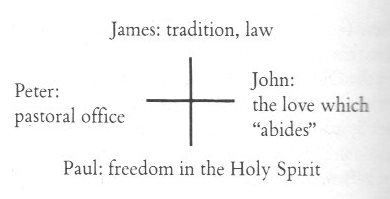

 In this way the charismatic element in the church is passed on through institutional means, which are courageously received and approved by the Church, as the charismatic movement in question submits to her authority and law. This aspect of “regulation” of the Spirit is, for Rahner, an essential part of the reform movement’s vocation, in which the charismatic element of the Church shows that it truly belongs to the Church and its ministry. Speaking of submission to the Church’s regulation, Rahner writes, “It is precisely here that it is clear that the charismatic element belongs to the Church and to her very ministry as such” (59).

 In scholarly circles this discussion begins with debate over the constitution of the earliest Christian communities. Rudolph Söhm was responsible for bringing the discussion of charisms into modern scholarship (found in his Kirchenrecht, published in 1892). Söhm was a lawyer, and the original reason for his investigation of primitive Christianity was occasioned by a dispute with fellow jurists regarding the status of civil law in Christian marriage ceremonies. This set him on the path of researching the history of canon law, and the necessary corollary discipline of church history. Söhm argued against the prevailing “voluntary association” consensus among protestant scholars in the 1880s, positing instead that the earliest Christians viewed their communities as drawn together and constituted by the charisms of the Spirit, meaning that they understood the Church as a spiritual entity which was beyond all human law. The contrast here is between the church constituted by the consent of the members in a democratic “free association” sense, and the church as constituted by the charismatic action of the Sprit.
 Söhm’s interpretation of the early Church had a profound influence in the early twentieth century, though it was not blindly accepted. Adolf von Harnack agreed that the primitive church was charismatic, but proposed that there had originally non-charismatic leadership as well, identifying the charismatic leaders with itinerant preachers and prophets who exercised a universal ministry, and the non-charismatic with the local presbyters, bishops, and deacons (primarily in The Constitution & Law of the Church in the First Two Centuries). In the final analysis, Harnack followed the same line of thinking as Söhm in proposing that the non-charismatic leadership eventually overtook and excluded the charismatic leadership, thus pushing aside the originally charismatic element in the Church.


 James Pedlar