Theological Signs of the Times: Catholic – Evangelical Convergence?

789488I was privileged to receive my PhD this past Saturday at St Basil’s Church on the campus of St. Michael’s College here in Toronto.   After six years of hard work, and numerous hurdles to clear, it was nice to have that final piece of the puzzle and say that I am truly finished.

Honourary doctorates were given to two fine Catholic scholars, Father James K. McConica, CSB, and Father Robert M. Doran, SJ.   Doran, currently at Marquette and a former member of the faculty at Regis College, gave the address.  He focused on what he called “theological signs of the times” for Catholic theology in the 21st Century.   As he spoke I was struck at how two of the three major tasks he identified for Catholic theology could just as easily be said to be major tasks for evangelical theology at the present time.

The first point he raised was more specifically Catholic, and focused on the integration of major theological insights from the second half of the 20th century.  He focused on the work of Hans Urs von Balthasar, Bernard Lonergan, and Gustavo Gutiérrez:

“How does our discipline integrate Balthasar’s restoration of beauty as a transcendental and as the way in which the truth and goodness of God are disclosed to us, with Lonergan’s openness to modern science, modern critical-historical scholarship, modern philosophy, and the post-modern welcome of the religious “other”? That in itself is a tall order. But then there is the further and larger task of implementing that integrated intellectual vision in the service of the Church’s preferential option for the poor.”

While “integration” is an ongoing concern in evangelical theology (integrating theology and practice), clearly the kind of integration he is talking about here is more specific to Catholics, and involves a concern to bring integrate these important insights into the magisterial teaching of the chruch.

His second point, however, is one that remains a major issue in Western theology in general: the theology of the Holy Spirit:

“The need for a developed pneumatology is present already in the insistence of Vatican II and of Pope John Paul II that the gift of the Holy Spirit is present and active beyond the explicit boundaries of Christian belief. Those affirmations of the Council and of the Pope are doctrinal statements. Theology has yet to explain how this can be and to unravel the implications of these statements for the whole of Christian comportment in the contemporary world…”

St._Basil's_Church via wikimediaEvangelicals have likewise neglected the theology of the Spirit, and yet the increasing importance of the Pentecostal and Charismatic traditions in global Christianity is forcing all of us to give more attention to pneumatology.  Doran’s particular concern seems to be bringing pneumatology to bear on Catholicism’s inclusive understanding of the way in which the Spirit is at work in those who are not Christians.   As a Wesleyan, I immediately thought of the category of prevenient grace as my own tradition’s approach to this issue.  In Wesleyan thinking, God’s grace is basically understood as the loving presence of the Spirit.  Prevenient grace is our term for the grace of God which “goes before” and precedes personal faith.  Prevenient grace, we believe, is at work in all people, drawing them to Christ.  Wesleyans, therefore, certainly have a category for thinking along these lines.  However, much work remains to be done, especially in making the connections between prevenient grace and the  presence of the Holy Spirit more explicit.

Doran’s final point is one which has become almost a fixation for many evangelical theologians today:

“There is need…for our theology to become a theology of mission, and especially a theology of missio Dei, of divine mission as grounding all ecclesial mission. The mission of the Church participates in and carries forward the missions of the Holy Spirit and the Son. Every theological topic – God, Trinity, the Holy Spirit, the Incarnation, grace, revelation, creation, anthropology, original sin, personal and social sin, redemption, sacraments, church, social grace, praxis, resurrection, eternal life – has to be integrated into a theology of divine mission and of ecclesial mission as a participant in the missions of the Holy Spirit and of the Son.”

07_063161At Tyndale Seminary we have quite explicitly been attempting to do this very thing: to place the entire project of theological education in a missional framework.  We still have a long way to go – at least I know I do!  But Doran’s statement above could be taken up by our theology department with very little alteration as a statement of our current agenda.

Of course all of this needs a lot of unpacking, but I mention these broad themes because I was quite encouraged by Doran’s talk.  I strongly identified with his concerns and the challenges he believes Catholic theology is facing, and sense that many evangelicals are attempting to face the same issues, in our own way.  If these are indeed “signs of the times,” then they may be signs of what God is doing across the Evangelical-Catholic divide.

You can read Doran’s address here.

John Wesley on Animal Salvation

I must apologize for the lack of recent activity on this blog.  I’ve been quite busy writing lectures for two new courses this fall, as well as preparing a paper for the recent “New Creation” conference, jointly sponsored by Northeastern Seminary and the Canadian Evangelical Theological Association.

This post is adapted from one section of my paper at that conference, which focused on John Wesley’s mature theology of “new creation” – a central strand in his later thought, which brought together the personal, social, and cosmic dimensions of salvation.

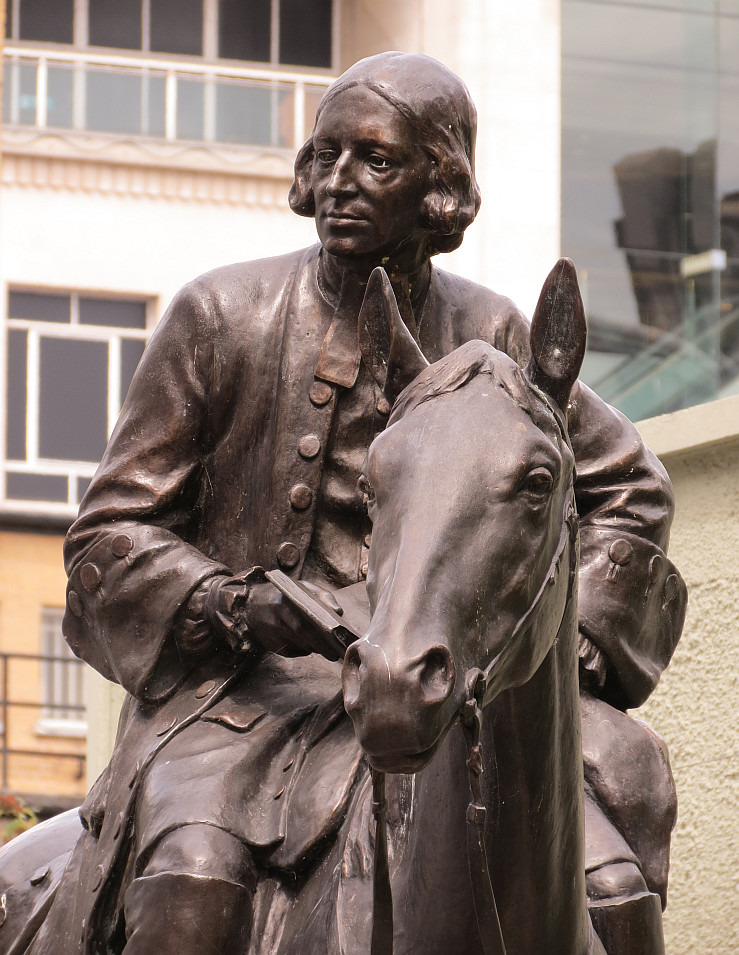
Wesley Statue at the New Room Bristol via Bob SpeelJohn Wesley had a lifelong interest in animal life, and it is well-known that he was an advocate for the protection of animals against abuse from humans.   But in the final decade of his life, the issue of animal suffering came increasingly into his view as a theological problem, and formed an integral part of his mature theology of the new creation.

Thus he begins his remarkable sermon “The General Deliverance,” written in 1782, with a quotation from Psalm 145:9 in the Book of Common Prayer: “his mercy is over all his works.”  Yet, Wesley asks,

“If the Creator and Father of every living thing is rich in mercy towards all; if he does not overlook or despise any of the works of his own hands, if he desires even the meanest of them to be happy according to their degree –how comes it to pass that such a complication of evils oppresses, yea, overwhelms them?” (Sermon 60, “The General Deliverance,” §1-2)

He answers the question by arguing that all animal suffering, including that which various species currently inflict upon one another to ensure their own survival, is the result of the fall.  Thus, before the fall, animal creation was “happy” and enjoyed a kind of “perfection” according to their kind, which was seen in their loving obedience to humanity, who as God’s vice-regents, were God’s appointed conveyors of blessings to all other creatures.  The obedience of animals to humanity, therefore, could be seen as bearing “some shadowy resemblance of even moral goodness” (§I.5.). In short, animals in the original creation were, Wesley suggests, at peace with humanity and with one another.

Yet, as a result of the fall, humanity’s relationship to God was disrupted, and therefore the blessings of God no longer flow through human stewardship to God’s creatures (§II.1).  After the fall, then, animals came to be at war with one another. It is because of sin that “an immense majority of creatures, perhaps a million to one, can no otherwise preserve their own lives, than by destroying their fellow-creatures!” (§II.3)  Moreover, humanity’s loving and kind stewardship of animal creation has been turned into an exploitative domination, and humanity has become such an enemy of animals that his cruelty surpasses that of a shark hunting its prey (§II.6). Wesley is unwilling to grant that such animosity and brutality is part of God’s original design for his creatures.

Peacable Kingdom by Edward Hicks via wikimedia commonsWhy would God allow animals to be subject to such vanities?  Surely, he reasons, God will one day restore animal creation to a state which is superior to that of the original creation. As they have been subjected to a degree of the corruption brought on by the fall, so also will they be liberated to experience “a measure of “the glorious liberty of the children of God”” in the new creation (§III.1).  This will entail a greater strength, swiftness, and understanding than each creature in its kind has possessed in the original creation, and, like human creatures, they “will be delivered from all irregular appetites, from all unruly passions, from every disposition that is either evil in itself, or has any tendency to evil” (§III.3). Therefore, as they had originally been able to evidence “a shadowy resemblance of even moral goodness” (§I.5), so in the new creation, “No rage will be found in any creature, no fierceness, no cruelty, or thirst for blood” (§III.3).

Working on the assumption of creation as a “great chain of being,” with humanity occupying a higher place in the chain, and creatures proceeding downwards in accordance with their likeness to the creator, Wesley speculates that all creatures might “move up” one level in the chain, and that some animals might therefore even join humanity in becoming “capable of God.”

“May I be permitted to mention here a conjecture concerning the brute creation What, if it should then please the all-wise, the all-gracious Creator to raise them higher in the scale of beings? What, if it should please him, when he makes us “equal to angels,” to make them what we are now, — creatures capable of God; capable of knowing and loving and enjoying the Author of their being? If it should be so, ought our eye to be evil because he is good?  However this be, he will certainly do what will be most for his own glory” (§III.6).

Lest we think this was a one-time indulgence on Wesley’s part, he ventures the same speculation in his 1785 sermon “The New Creation” (§17).

As I said, these reflections on the place of non-human creatures in God’s plan of redemption are one important aspect of Wesley’s late thinking about the “new creation.”  Some of these ideas might seem strange at first, but in fact they cohere well with Wesley’s overall concern to defend the character of God as just, merciful and loving.  In that sense, we can see deep connections here between how he resolves the issue of animal suffering and his rejection of the Calvinist understanding of predestination: both are rooted in his understanding of the character of God (see my earlier posts about predestination and the character of God here and here).

Great Resources from Asbury’s Seedbed

Just a quick post today to point you towards the great resources that are being produced by Seedbed, a site that Asbury Theological Seminary has set up.  Seedbed features blog posts and videos of Asbury faculty discussing a variety of topics relevant to ministry and theology – and doing so in a way that is accessible to a general church audience.  Former Tyndale professor Howard Snyder is one of the featured bloggers, and in posts like this one, he continues to challenge evangelicals to take creation stewardship seriously as an integral aspect of Christian mission.

One of the best features of Seedbed is their video series, “Seven Minute Seminary,” which features Asbury scholars giving concise but substantial talks.  This week Ben Witherington III discusses why he is a Wesleyan.

It’s great to see Asbury producing these excellent teaching materials.  I’d say seedbed is a wonderful example of a seminary trying to bridge the church/academia divide.  I hope other schools follow suit.

Mystical and Missional: Elaine Heath on Phoebe Palmer

Heath Naked Faith the Mystical Theology of Phoebe PalmerI’ve thoroughly enjoyed reading Elaine Heath’s Naked Faith: the Mystical Theology of Phoebe Palmer (Eugene OR: Pickwick, 2009).  Palmer had a massive influence in Wesleyan circles and beyond in the nineteenth century, but, as Heath notes, she has been largely forgotten or marginalized – even within her own tradition.   She certainly hasn’t been taken seriously as a theologian, though Thomas Oden sounded an enthusiastic call for the retrieval of her voice in his introduction to the collection of her writings he edited for publication (Phoebe Palmer: Selected Writings (New York: Paulist, 1988)).  John Farina, general editor of the series “Sources of American Spirituality,” of which the Oden volume was a part, briefly located Palmer in “that great mystical stream that runs like a golden river down through the ages” in his general introduction to the book, noting especially the interest in Catherine of Genoa in Palmer’s circles.  Heath has taken up this idea and written a book that attempts to both offer an interpretation of Palmer’s thought as an expression of mystical theology, and to hold out “Saint Phoebe” as a guide for the renewal of contemporary Methodism.

Palmer, for her part, would have resisted the “mystical” label, but Heath shows, through a discussion of the mystical tradition, that Palmer’s resistance was really to the antinomian perversions of the mystical tradition which she encountered (35ff).  Heath identifies mysticism as “the radically transformative experience of the Divine that is described by the great Christian mystics and saints throughout the ages” (41).  She also notes that genuine Christian mysticism will be Trinitarian, ecclesial, and transformational (42).

While a great deal could be said about the reception of mysticism in Protestant circles, and the degree to which John Wesley himself embraced some aspects of mystical theology at various points in his life (Heath deals with these issues), I was particularly taken by the way in which she connected mysticism with Christian mission.

Phoebe PalmerFor Palmer, the primary way this was expressed was in her own calling to a ministry of preaching and teaching, which followed immediately upon her “day of days” experience of sanctification.  Her profound mystical experience, then, became the source of an unprecedented (for a woman) ministry which had massive influence on the history of the Methodist, Holiness, and Pentecostal traditions.  Even those experiences of “union” with God that make some Protestants nervous, Heath contends, impel the mystic to service, rather than retreat from the world (as many suppose):

“The fruit of unitive experiences is a powerful desire in the mystic to help all people experience salvation and sanctification.  This desire partly originates in visions of the mysic being made one with the Trinity, whose goal in the church is to seek and to save the lost. Thus the life of the mystic increasingly becomes one of humble service in the world” (59).

Heath also carefully distinguishes problematic mystical “Quietism” from a healthy sense of “quiet,” an active passivity that bears fruit in missional activity:

“The result of true mystical passivity is an increase of strength and spiritual energy, an increase of love for God and neighbour so that the individual is increasingly alive to God in the community and world as the process of passivity progresses” (75).

Interestingly, in some other reading I recently found Henri Nouwen making a similar claim: “Mysticism is the opposite of withdrawal from the world. Intimate union with God leads to the most creative involvement in the contemporary world” (The Genesee Diary155).

Heath’s work seems to break new ground on several fronts: a sustained interpretation of Palmer as a mystical theologian, a retrieval of her theology by distinguishing it from the ways in which it was distorted by her later followers, and a contribution to research into the mystical aspect of Wesleyan spirituality – and I could go on.

Phoebe Palmer via cyberhymnalI think it is particularly important as a contribution to contemporary discussions of the “missional” character of the church.  I’ve sometimes worried in the past that some strands of missional thinking are anti-ecclesial, and create a false dichotomy between the church’s inner life (thinking here in terms of spirituality) and its mission.  In other words, the church is not only sent into the world, but also gathered together, and it is in the gathering that we are centred on the particular identity of the God of the gospel, who then sends us out.   Heath’s work on mysticism and mission helps to bridge this perceived gap between “inner” life its fruit in “outward” activity.  There is a strong connection between the arguments in this book and the account of the new monasticism in Longing for Spring, which Heath co-wrote with Scott Kisker (see my review here).  I still need to do some further reading of my own on mystical spirituality, as it is not an area with which I’m familiar, but my initial reaction to Heath’s work on Palmer is to give it a hearty endorsement.   Next on my list is her 2008 book, The Mystic Way of Evangelism.

Fifth Annual Wesley Studies Symposium at Tyndale Seminary

Richard Watson via wikimedia commonsOnce again this year Tyndale Seminary is hosting a Wesley Studies Symposium.   This symposium aims not only to promote Wesleyan scholarship in the Canadian context, but also to help build a network of people interested in Wesleyan theology and history.

Although this is an academic event, we purposely blur the lines a bit between scholarship and ministry, in part because it is thoroughly Wesleyan to integrate theology and practice.  So we typically have a nice mix of academics, graduate students, and practitioners in attendance.

The Symposium is scheduled for Tuesday March 12, and we have another interesting lineup of papers covering a range of topics and disciplines.   The papers to be presented this year are:

  • “Rediscovering Discipleship as a Pathway to Ekklesial Reformation – Wesley did!!” by Cliff Fletcher (Pastor, Whitby FMC / DMin graduate, Gordon-Conwell).
  • “The Importance of Richard Watson’s Theological Institutes for Methodist History,” by Barry Hamilton (Northeastern Seminary).
  • “Leading with the Ear: The Church as a Listening Community,” by Aaron Perry (Pastor, Centennial Road Standard Church / PhD Candidate, Regent University).
  • “The Character of God Revealed by The Incarnate Word in the Theology of John Wesley,” by Niven Harrichand (ThM graduate, Tyndale).
  • A Book Panel on Witnesses of Perfect Love: Narratives of Christian Perfection in Early Methodism, by Amy Caswell [Panelists TBA]

After dinner we will have a guest lecture by Donald E. Burke (President, Booth University College, Winnipeg) on “Salvation for Both Worlds: Contours of a Wesleyan/Biblical Social Theology.”

Registration is free, and you can sign up here. Please spread the word about this event among those who might be interested.

A “greater effusion of the Holy Spirit”: Isaac Hecker’s hopes for renewal

Hecker via wikimedia commonsIn one of William Booth’s songs, he famously penned the line, “We want another Pentecost.”   Booth and his holiness movement counterparts placed a heavy emphasis on the Holy Spirit in their preaching, teaching, praying, and worshipping – an emphasis that David Rightmire has termed a “pneumatological priority” (see his article in the most recent Wesleyan Theological Journal and his book, Sacraments and The Salvation Army).

As I’ve noted here before, my dissertation compares the Booth and Isaac Hecker, the founder of the Paulist Fathers, a Roman Catholic movement from the same time period.   Although the two men are quite different in many ways, Hecker’s theology could also be said to evidence a certain “pneumatological priority.”

Hecker was possessed by a life-long quest for the renewal of human society.   He came to believe that societal renewal could only be achieved if individuals were renewed, and that such individual renewal could only come through religion.  As a devout Catholic, he believed that the Catholic faith was the one true religion, and therefore placed the Catholic Church at the heart of his vision for social renewal.

His particular emphasis on the direct work of the Holy Spirit in the lives of individuals, however, was somewhat unique among Catholic authors of his day.  While he drew on traditional Catholic sources, his particular way of emphasizing the Spirit’s direct work went against the grain of the majority of Catholics in his day, and raised some eyebrows.   He put the Spirit’s work in the individual Christian at the centre of his vision of renewal.  As John Farina has summarized, for Hecker, “The cure for the world’s problems was Spirit-filled individuals” (An American Experience of God: The Spirituality of Isaac Hecker, 150).

Hecker via bustedhaloHowever, unlike Booth, Hecker was keen to safeguard against potential fanaticism by grounding the immediate work of the Spirit upon individuals in the external authority of the church, which he also credited to the Spirit’s presence.

These twin emphases are abundantly clear in his book The Church and the Age.  Of individual renewal by the Spirit, Hecker writes:

The renewal of the age depends on the renewal of religion. The renewal of religion depends upon a greater effusion of the creative and renewing power of the Holy Spirit. The greater effusion of the Holy Spirit depends on the giving of increased attention to His movements and inspirations in the soul. The radical and adequate remedy for all the evils of our age, and the source of all true progress, consist in increased attention and fidelity to the action of the Holy Spirit in the soul (The Church and the Age, 26).

The other side of the Spirit’s two-fold action, however, is found in the church’s external authority.

The action of the Holy Spirit embodied visibly in the authority of the Church, and the action of the Holy Spirit dwelling invisibly in the soul, form one inseparable synthesis; and he who has not a clear conception of this twofold action of the Holy Spirit is in danger of running into one or the other, and sometimes into both, of these extremes, either of which is destructive of the end of the Church (Ibid., 33).

Hecker 2 via wikimedia commonsOf course, most Protestants will note that individual discernment of the Spirit’s voice often comes into conflict with the discernment of those in ecclesial authority.  Church life is often filled with these types of conflict, and this raises questions about Hecker’s claim of an “inseparable synthesis” between the Spirit’s action in individuals and in the church’s authority structures.   When push comes to shove, how do we know which side is really hearing the voice of the Spirit?  As we would expect, Hecker takes the traditional Catholic line:

From the above plain truths the following practical rule of conduct may be drawn. The Holy Spirit is the immediate guide of the soul in the way of salvation and sanctification; and the criterion, or test, that the soul is guided by the Holy Spirit, is its ready obedience to the authority of the Church. This rule removes all danger whatever, and with it the soul can walk, run, or fly, if it chooses, in the greatest safety and with perfect liberty, in the ways of sanctity (Ibid., 35).

In spite of his clear affirmations of the ultimate authority of the church over individual believers, Hecker was still accused of leaning too much towards Protestantism by some of his contemporaries.  While these concerns were probably overblown (as we might expect in the nineteenth century, given the state of Protestant-Catholic relations), he certainly shared a “pneumatological priority” with William Booth and his contemporaries, and some of his writings seem to point to a desire for “another Pentecost.”

Distinguishing Wesleyan and Fundamentalist approaches to Scripture

Al Truesdale, a Nazarene theologian, has posted an interesting article on “Why Wesleyans Aren’t Fundamentalists” over at Holiness Today (ht Kevin Jackson).

Some excerpts:

God himself, not information about him, is the primary content of revelation. God manifests himself, his person, his “Name,” and his will in all the earth. He reveals his “glory” as Creator and Savior, the proper end of which is our worship of and obedience to him. God declares his Name particularly by creating a people who, in covenant with him, will bear redeemed witness to his holiness, his love, his Kingship, and his faithfulness. The Bible uniquely and definitively tells the story of God’s self-disclosure and of humankind’s response. But not everything in the Bible is essential to God’s self-disclosure.

For Wesleyans, knowing the truth is primarily a matter of knowing God, of being transformed and gifted by him, and of being placed in his kingdom service. Thinking of knowing the truth as principally a matter of assent to a body of divine knowledge or propositions strikes Wesleyans as once-removed from knowing him who is the “Way, the Truth, and the Life.”

It’s worth a read.  Although Wesleyans have never taken a fundamentalist approach to scripture, I find that on the popular level it has infiltrated many of our churches.

Albert Orsborn on The Salvation Army and the World Council of Churches

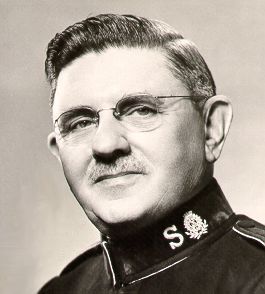
orsborn via salvationarmy.org.auI’ve been doing some reading today on The Salvation Army’s relationship to the World Council of Churches in the mid-20th century.  Salvationists didn’t really do a lot of reflection on the doctrine of the church prior to the late 20th century, but one of the ways in which Salvationists were pushed to reflect upon their ecclesial status was through their involvement in the WCC.   The Salvation Army was a founding member of the Council, and remained a full member until 1981 (the story on their withdrawal from full membership is interesting as well but needs a separate post).

In preparation for the first Assembly at Amsterdam in 1948, General Albert Orsborn engaged in consultation with Army leaders as to whether or not the SA should be involved in the life of the Council.  Though Orsborn declared that he did not want to impose his views on his advisors, he circulated a memorandum which concluded, “I do not wish my period of leadership to be associated with the gravitation of The Salvation Army nearer to church life in faith and order.” The advisory council to the General, however, responded in their report back to the General that “The advisory council has no hesitation in recommending that The Salvation Army continues its membership of the World Council of Churches.”  Orsborn went along with the consensus, though he continued to be resistant to the idea: “It occurs to me to wonder why we should participate in the Assembly…but the majority of our leaders think that we should be represented therefore I have told the chief to arrange it.” (Quotes taken from General Arnold Brown’s biography, The Gate and the Light: Recollections of Another Pilgrim, 232.)

Orsborn, like generations of Salvationists before him, insisted that the Army was not a church, and this conviction seems to have been part of the reason he was concerned about WCC involvement.  For starters, the WCC is a fellowship of churches, and therefore membership implied that the Army was a church, and signalled that other churches (at least some of them) were willing to acknolwedge the Army to be a sister church.

He had occasion to offer some further reflections on the relationship between the movement and the WCC in an article written for The Officer magazine in 1954, just prior to his retirement.  The article as a whole struck a defensive tone, beginning with am apologetic for William Booth’s decision to keep the Army autonomous. “How wise he was!  Nothing has occurred which would justify us in revising the Founder’s decision”(Albert Orsborn, “The Army and the World Council of Churches,” in The Salvation Army and the Churches, ed by. John D. Waldron, 88).

After noting that “…we are almost universally recognized as a religious denomination by governments,” he asserted,

That is as far as we wish to go in being known as a church.  We are, and wish to remain, a Movement for the revival or religion, a permanent mission to the unconverted, one of the world’s great missionary societies; but not an establishment, not a sect, not a church, except that we are a part of the body of Christ called “The Church Militant” and we shall be there, by His grace, with “The Church Triumphant” (Ibid., 88-89).

Orsborn was thus continuing in the line of argument established in the movement’s early years: The Salvation Army is an independent mission, and a part of the universal church, but is not, itself, a church in the sense of a denomination.

orsborn via fsaofAs for Salvationist involvement in the Council, he continued to posture the Army defensively against perceived threats of ecumenical involvement.  “We are there to listen, and perhaps to learn. But we are not prepared to change or to modify our own particular and characteristic principles and methods”(Ibid., 89).  They ought not to seek “closer identification with the churches” he urged, because it was the Army’s autonomy that had been its strength.  He closed his article with list of areas where the Army was not willing to compromise in its involvement with the Council.

We do not favour organic unity with the churches…

We can accept no discussion and no challenge to our position on the sacraments…

We cannot allow the effective ordination (commission) of our officers, including women, to be challenged…

We are not prepared to change our doctrine…

We must preserve absolutely our world-wide missionary freedom…

We cannot allow ourselves to become involved in those so-called “social” questions which in reality are political…

We cannot join anything which may tend to curb our spirit of aggression…

We must agree to nothing which might give our people the idea that it is all the same with us whether they are loyal to the Army or not…

We must not join any aims and purposes which might have the effect of gradually changing the nature and aims of our training colleges (Ibid., 92-94)

The extent to which Orsborn went in outlining the limits of Salvationist participation in the ecumenical movement suggest that he was not alone in his concerns regarding where it might lead The Salvation Army.  I think many of his concerns were unfounded, though some proved to be true over time.   It may be that full membership in the WCC did contribute in some way to the main shift he was concerned about – “the gravitation of The Salvation Army nearer to church life in faith and order.”  Although Orsborn wasn’t willing to budge from the early Salvationist line of thinking about the Army’s non-churchly status, within a couple of decades that would begin to change.

Charisms and the Methodist approach to Christian Ministry

Recent ecumenical dialogue has turned to the theology of charisms as a way of building a common approach to Christian ministry.  As the landmark text Baptism, Eucharist and Ministry (1982) puts it:

the Holy Spirit bestows on the community diverse and complementary gifts. These are for the common good of the whole people and are manifested in acts of service within the community and to the world. They may be gifts of communicating the gospel in word and deed, gifts of healing, gifts of praying, gifts of teaching and learning, gifts of serving, gifts of guiding and following, gifts of inspiration and vision. All members are called to discover, with the help of the community, the gifts they have received and to use them for the building up of the Church and for the service of the world to which the Church is sent (§M5).

The benefit of this approach is that it both a) grounds Christian ministry in the activity of God (because the Spirit gives the gifts which enable the various ministries) and b) grounds the theology of ordained ministry in the broader context of the ministry of the whole people of God (since the gifts are given to all, and therefore all are given a vocation to ministry).

I would argue that this consensus that has emerged regarding the theology of ministry comports well with the approach to ministry that has been practised in the Methodist tradition throughout its history.  This approach involved candidates proceeding through various orders of ministry, beginning at the local level, depending on the evidence of their gifts as seen by the community of faith. The early Methodist tradition followed a “bottom-up” pattern of discerning gifts for ministry, in which “local preachers” were chosen to assist in preaching and teaching the gospel in one location, and local preachers who showed evidence of gifts chosen to serve as “helpers.” “Assistants” were chosen from among the helpers, to assist Wesley in the oversight of a given circuit of Methodist Societies (hence their title was changed to “Superintendent” after Wesley’s death).   That was the basic track to what would later become ordination.  Beyond that, there were other important roles, such as that of the class leader, who basically acted as a pastor and spiritual director to the members of their neighbourhood small group.

This bottom-up approach to ministry makes particular sense when considered from the perspective of oversight.  Charisms are not self-authenticating, and they need to be discerned in the context of Christian community.  Each charism is interdependent, and in a sense is limited by the other charisms, like the parts of the body are interdependent and limited by their relation with other parts of the body.  Among the gifts is the gift of oversight, and those who have this particular charism are called to help others in the community discern and faithfully exercise their own gifts.

All of this best takes place in the local Christian context, where people know each other and can see each one living out their gifts in the context of the body of Christ.  So, first and foremost, the discernment of a call to any kind of ministry, including the role of pastor or teacher, should begin at the grassroots level.

Now, the fact of the matter is that the Methodist approach to ministry did not develop on the basis of an extended theological reflection on the gifts of the Spirit.  It was not even the result of thoughtful planning.  Rather it emerged, as Henry Rack says, through “a series of accidents and improvisations” (Reasonable Enthusiast, 237).  Wesley improvised the order of his movement in response to the needs of the time, believing that matters of church order were subservient to the church’s mission:

“What is the end of all ecclesiastical order?  Is it not to bring souls from the power of Satan to God?  And to build them up in his fear and love?  Order, then, is so far valuable as it answers these ends; and if it answers them not it is nothing worth” (Letter to “John Smith,” June 25, 1746, in The Works of John Wesley, 26:206). 

In spite of Wesley’s “improvisational” approach, I would argue that the process that emerged is in fact quite consistent with a New Testament approach to gifts and ministries, and with the ecumenical consensus on these issues that has emerged in the past few decades.  Perhaps this was one of the ways in which divine providence was shaping the Methodist movement during its early years.

In praise of interlibrary loans

I am blessed to study at the University of Toronto, which has a world-class library system.   In fact, U of T’s libraries were recently ranked third among research libraries in North America, behind only Harvard and Yale.   The theological collections are strengthened by the fact that students have access to the libraries of the seven TST seminaries, as well as theological books held in Robarts Library, and special collections such as the Pontifical Institute of Medieval Studies library.   The U of T library system has just about everything you could need as a researcher.

However, when you get into a doctoral disssertation, you are often dealing with subjects that are so obscure that even U of T libraries can’t meet your needs.  That’s where interlibrary loans come in.

I think many students aren’t even aware of the amazing service that is available to them through interlibrary loans.    If my library does not have a particular book, but it can be found in another library (anywhere in the world), interlibrary loans will get it for me, free of charge.

I’ve received dozens of rare books through interlibrary loans in the past two years.  Most have come from North America, but the 1921 book Les Charismes De Saint-Esprit by Bernard Maréchaux was sent to me from Radboud University Nijmegen in the Netherlands!

Earlier this fall I was able to get a copy of the 1917 Paulist Constitutions, sent from the Catholic University of America.   Twice I have accessed a two-volume unpublished official history of the Paulists by James McVann, which came from the U.S. Library of Congress (I had to read that one on-site in the Thomas Fisher Rare Book Library).   Without interlibrary loans, I would have only been able to access those materials in Washington, either at the Library of Congress or the Paulist Archives.

Today I picked up an 1883 book attacking The Salvation Army, Read and Judge the (So-Called) Salvation Army, written by a Swiss Countess and translated from the French.  This one came from Duke Divinity School.

Every time I receive something on interlibrary loan, I say to myself, “I can’t believe this service exists.”  And I wonder how long it has been since anyone else has picked up this obscure book that I’m holding in my hands.  I guess I am a total geek, since I find interlibary loans so exciting, but I definitely wouldn’t have been able to do the research I’ve done without the help of the interlibrary loans staff.