Eschatological tensions and the question of the millennium

The mainstream theological tradition has been amillennial since Augustine, and therefore the question of the “millennium” (Rev. 20) has not been a matter of major concern for most major theologians.  Evangelical theology, however, has typically been very focused on this question.  So Donald Bloesch writes,

 “Apart from biblical inerrancy no doctrine has caused greater division in evangelical Christianity in the present day than the millennium.  Though the biblical references to a millennial kingdom are minimal, they have given rise to elaborate theologies based on the reality of such a kingdom.  Because the millennial hope has been a source of inspiration to Christians throughout the history of the church, impelling many toward a missionary vocation, it merits serious consideration.” Donald Bloesch, Essentials of Evangelical Theology (New York: Harper & Row, 1978), II: 189.

There are three basic positions on the millennium, along with one important variant on the premillennial position.

Amilliennialism: Revelation 20 is symbolic, not literal, so there will be no 1000 year reign of Christ on earth.  The millennium refers to Christ’s present rule during the church age. Christ has already bound Satan in the resurrection, though it is a relative binding.  Christ will return and the final judgment will follow.

Premillennialism: Christ returns before a literal 1000 year reign on earth in which he reigns directly over the world.  Tends to be pessimistic about the possibility of any cosmic or social redemption before Christ’s return – in fact, things will get worse and worse before the parousia.

Premillennial dispesationalism: divides salvation history into different “dispensations” in which God relates to people in different ways.  There are two parousias: the first at “the rapture” when Christ returns to remove the church from the world; then he returns again at the start of the millennium seven years later.

Postmillennialism: Christ will return after a millennial period in which his reign is exercised triumphantly on earth through the church.  The gospel will be taken to all nations, and will hold sway over the world.  Evil will still be present, but will be subdued by Christian influence during this golden age of the church.

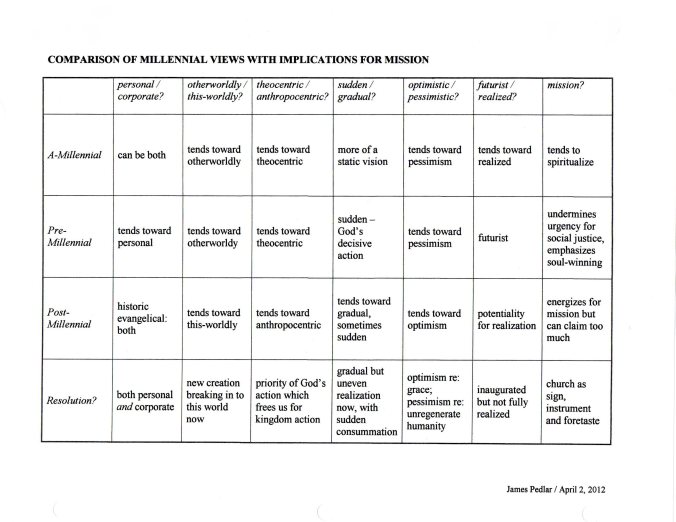
I was lecturing on this topic a couple weeks ago, and in an attempt to help students get a handle on these debates I proposed six different sets of tensions that are at work in eschatological debates. These could be seen as differing emphases within the various eschatological visions that have exercised influence in the church over the centuries. Each of these is a set of “poles” which could be seen as existing on a continuum, and any given theologian might tend more towards one pole or the other.

First, there is a tension between personal and corporate eschatologies. Any full-orbed eschatology will deal with both personal and corporate dimensions, but some tend to push more in one direction or the other. That is, some eschatologies focus more on the fate of the individual: the eternal destiny of the saved and unsaved; questions of how we will be judged; what the resurrection body will be like, and so on. On the other hand, some eschatologies are focused more on the corporate dimensions of God’s plan for the eschaton: the future kingdom of God; visions of social justice, the overcoming of inequalities; the reconciliation of different people-groups, and so on.

Secondly, there is a tension between otherworldly and this-worldly eschatologies. Those eschatologies which are more otherworldly will focus on the radical difference between the future kingdom and the present life. They will stress discontinuities between the world as we know it and the future which God has planned for us. On the other hand, this-worldly eschatologies will tend toward a more “realized” eschatology, and see the kingdom being formed here and now in various ways. They might be uncomfortable with heavenly visions and prophecies, and seek ways for eschatology to have impact in the world here and now.

Thirdly, there is a tension between theocentric and anthropocentric eschatologies. Eschatologies with more theocentric tendencies will emphasize God’s decisive intervention in world history, both in present anticipations of the kingdom and in its final consummation. Human beings are likely portrayed as having little real agency in ushering in God’s kingdom. Theocentric-tending eschatologies might also tend towards more deterministic views of history, stressing God’s control over world events. Those with more anthropocentric tendencies will stress the role of human agents in bringing the future kingdom to realization. Human beings, with God’s help, will be seen as capable of moving history toward its proper goal and the purpose for which God created it.

Fourthly, a related consideration would be the tension between sudden and gradual eschatologies. Some theologians emphasize a sudden and dramatic change that will take place at the end. In this view, we may not see any real “progress” towards the kingdom prior to that sudden, cataclysmic event. In fact, things might get worse before God suddenly intervenes to bring about the final consummation. On the other hand, others might emphasize gradual change and growth, leading to the kingdom. In extreme cases, some have supposed that there would be no dramatic change at the end at all, but a gradual development and progress until one day God’s kingdom is established on earth.

Fifthly we could talk about pessimistic and optimistic eschatologies. Here the optimism or pessimism relates to the degree to which the eschaton is breaking into the world today. Some have little hope for present realization of the eschatological kingdom, and instead look upon the world around us as a discouraging place which is wasting away. Others see signs of the kingdom and are optimistic that things really can improve here and now. Obviously those who have otherworldly, theocentric, and sudden eschatologies will likely tend towards pessimism, whereas those with this-worldly, anthropocentric, and gradual eschatologies will tend towards optimism.

Finally, there are futurist and realized eschatologies. Obviously, echatologies with more futuristic orientations will orient there hope to the coming consummation of the eschaton, and be less hopeful about the present age, whereas those whose eschatologies tend towards a more realized perspective might have less focus on the future hope, and more focus on hope for present transformation.

Using these sets of “tensions,” I’ve developed the following analysis of the millennial positions, with my suggestions regarding how potential strengths of each view could be integrated.  This probably needs further explanation in a separate post, but I’ll leave it here for now – comments and suggestions would be welcome.

Mission and Unity

I’ve recently published an article in Missio Dei: Tyndale Seminary’s Journal of Missional Christianity,  entitled “That the World May Believe: Mission and Unity.”   It’s not a long read, and not overly specialized, since Missio Dei is a journal aimed at all Christian leaders, not just academics.  The journal aims to utilize the expertise of faculty and friends of the Tyndale community in such a way as to help equip Christian leaders in their day to day participation in God’s mission.

The article begins with John 17, in which Jesus prays for the church to be one, “so that the world may believe that you have sent me.”  This text suggests that there is a strong connection between Christian unity and Christian witness.  However, Christians have never really been able to agree as to what Jesus was really saying when he prayed “that they may be one.”

The article proceeds with a discussion of seven different approaches to Christian unity: spiritual, visible, structural, doctrinal, service, mutual recognition, koinonia.   Some of these approaches are usually identified with one particular Christian tradition, but they are not mutually exclusive, and can be combined in various ways.

The second half of the article suggests that evangelicals in particular could re-examine their aversion to one of these approaches: visible unity.

I would also sug­gest that, in a post-Christendom con­text, it is time to re-examine evangelicalism’s char­ac­ter­is­tic aver­sion to con­cep­tions of “vis­i­ble unity.” In a pre­vi­ous era, when estab­lished state churches could insti­tute a kind of false unity by coer­cion, it made sense for evan­gel­i­cals to resist such con­cep­tions of “vis­i­ble” unity and stand up for our free­dom to assem­ble and wor­ship accord­ing to con­science. How­ever, we no longer live in a time when state power is aligned with one par­tic­u­lar denom­i­na­tion, and so the idea of a “vis­i­ble unity” need not carry those con­no­ta­tions. We have also rightly resisted approaches to unity which pushed towards the build­ing of a “super­church” with a cen­tral­ized bureau­cracy. But “vis­i­ble unity” need not be taken in this direc­tion, either.

To say that our unity ought to be “vis­i­ble” is sim­ply to say that the church’s unity must take shape in the world, as the church lives out its life in space and time. We can’t just pay lip-service to the unity we have been promised in Christ. In order for our unity to serve the pur­pose of wit­ness­ing to the world about Jesus, it must be a unity that is on dis­play for the world to see.

Head on over to Missio Dei to read the whole article, and while you’re there, check out the archives.

Israel and the Church: reclaiming the continuities

Generally speaking, most ecclesiological thinking has tended to overemphasize the discontinuity between ancient Israel and the church.  There are many reasons for this, some of which explicitly and intentionally emphasize the discontinuities, and some of which do so in an implicit way.  This overstress on the differences between Israel and church can lead to a static understanding of the church, which misses out on the dynamic, historical nature of the people of God, and thereby leaves us less sensitive to questions of renewal and reform.  I would suggest that thinking more intentionally about the continuities between the church and Israel can help to recover a more biblical understanding of the people of God.

My perspective on this question has been greatly influenced by George Lindbeck’s argument for an “Israel-like” view of the church.  I’m not going to summarize his work here (though maybe I should do that another time), but if you are interested in what he has to say, I would recommend reading the following two essays: “The Story-Shaped Church: Critical Exegesis and Theological Interpretation,” in Scriptural Authority and Narrative Interpretation (Philadelphia: Fortress Press, 1987), 161–78; and “The Church,” in The Church in a Postliberal Age (Grand Rapids: Eerdmans, 2003), 145-165.

First of all, why is it that Christian thinking about the church has overemphasized the discontinuities between Israel and church?  I would suggest four significant reasons, though their are probably more.
  • An idealized, platonic understanding of the church.  This is particularly true of ecclesiologies which place great stress on the “invisible church” (that is, the elect, known only to God) as the “real” church.  If the “real” church is invisible, then the historical, visible church can be undermined as “unreal” or unimportant.
  • A triumphalistic view of the church as holder of the keys to salvation.  If the church’s role in mediating salvation is stressed too much, such that the church itself is seen as possessing the fullness of the means of salvation (rather than serving as God’s instrument), then it becomes easy to play off the “triumphant” church against the unfaithfulness of Israel in the Old Testament.
  • Divisions among Christians leading to different groups claiming to be the “true” church.  The triumphalist tendency in the Christian church has only be exacerbated by divisions.  In a situation of division, ecclesiology has often become about proving that your church is complete and lacking in nothing, in comparison with other churches.  Again, this can easily lead to a presumption that we are above the failures of Israel.
  • Some forms of supersessionism and dispensationalism.  Obviously, supersessionism in all forms is going to stress the discontinuities between Israel and church, since supersessionists argue that the church as replaced Israel as God’s people.  The most extreme form would be dispensationalism, which, in arguing that Christians and Jews live under different “dispensations” of God, are able to justify strong discontinuities between the Israel and church.

So, what then, am I proposing regarding the continuities and discontinuities between Israel and church, scripturally speaking?  Clearly, from a Christian perspective, things have changed for the people of God post-resurrection.  But how much has changed, and what hasn’t changed?

First, what are the discontinuities between Israel and church?

  • Pentecost marks the beginning of a greater fullness of the Spirit, poured out upon all (Joel 2:28-32 / Acts 2).
  • Jesus Christ offers a more complete revelation of God than was available to the OT people of God (Jeremiah 31:31-34; Hebrews 1:1-4)
  • The church is given a universal mandate to evangelize the world (Matthew 28:16-20)
  • The sacrificial worship and priesthood of OT Israel are replaced by Jesus’ work on the cross (Hebrews 10)
  • The church is not intended to be a nation with a theocratic civil government, but a dispersed community of exiles, spread among every nation (1 Peter 1:1-2)

What are the continuities that I believe should be re-emphasized?

  • The church is still a historical and visible community of persons.
    • It is not an “idea”; the church is a real, living human community, with a history of ups and downs, successes and failures, faithfulness and apostasy (Acts 5; Revelation 2-3)
    • The church is still a communal entity. Though salvation is personal it is not individualistic.
    • The people of God can still be seen as a people on a journey – a pilgrim people headed towards the new creation (1 Peter 2:11)
  • The church is still subject to judgment under the lordship of Christ. This judgment is not only a future event, but is reflected in the church’s historical life, here and now. Judgment begins with the house of God (1 Peter 4:17).  NT Christians viewed OT history as their history, and took warning against unfaithfulness (1 Cor. 10).
  • The church is still a holy and priestly people, witnessing in word and deed to the world about the faithfulness of God (1 Peter 2:9-10).
  • The people of God still need a Saviour. The church is not, in itself, the fulfilment of Israel; Jesus Christ is the fulfillment of Israel; he is also the fulfillment of the church; we find fullness in him, not in ourselves (Eph. 1:3-10)

If we take these continuities to heart, several implications will follow.  These are thoughts which I try to keep in mind as I think theologically about the church.

  • Though the church enjoys a greater fullness of the Holy Spirit, we are still fallible and capable of unfaithfulness, as was ancient Israel (1 Corinthians).
  • Because the church is historical, it always exists in a particular time and place, as a particular community embedded as a bodily presence in a particular culture.  Being rooted in a specific time and place, then, is an essential aspect of the church’s identity.
  • Though Christ has taken our judgment upon himself, he still disciplines his people as their Lord, just as the people of Israel were disciplined.  That is to say, all forms of “triumphalism” should be rejected.  Being “in Christ” and having the Spirit’s presence does not imply automatic blessing – it may also mean judgment, rebuke, and discipline (1 Cor. 11:32).
  • Finally, we should expect to see periods of decline and renewal in church history, and we should attune ourselves to these dynamics.  This is part of our journey as the living, breathing, embodied, historical and visible people of God.

John Wesley on the Character of God

As a follow up to last week, I was asked to expand upon the rationale behind Wesley’s choice of the “loving Parent” model of God, as opposed to the “ruling monarch” model.    I suggested, following Randy Maddox, that the fundamental difference between Calvin and Wesley on predestination is not found in their respective views of the human condition, as is often thought, but in their understandings of the character of God.

Maddox writes,

…the Wesleys sensed their most basic disagreement with their opponents to lie in their respective defining models of God.  For the Calvinists, the defining model was a sovereign monarch…By contrast, Wesley more commonly employed the model of a loving parent (Responsible Grace56).

Why is it that Wesley favours the “loving Parent” model over the “ruling monarch” model?

First of all, Wesley favours the “loving Parent” model because wants to avoid abstracting God’s sovereignty from God’s loving and just character.  This is seen in his rejection of the voluntarist understanding of God’s goodness, which was favoured by the Reformers, and is part of a fundamental and longstanding theological debate concerning the character of God, and how we understand God’s goodness.   To put it in a nutshell, this debate can be summed up in a question: are God’s acts good simply because whatever God wills is good by definition, or are God’s acts good because they conform to “the good”?  In other words, is there a standard of “goodness” to which we can meaningfully expect God to conform, or must we insist on the radical freedom of God, such that he is not bound by any external criteria?

Wesley himself puts the question this way in Sermon 34, “The Original, Nature, Properties and Use of the Law.”

Is his will the original [that is, the origin] of right and wrong? Is a thing therefore right, because God wills it? Or does he will it because it is right? (§III.6)

The voluntarist position argues that things are good because God wills them, and that whatever God does is good by definition.  We are in no place to make judgments about whether or not God’s actions are good.  Roger Olson sums up the crassest version of this position in the phrase “God can do whatever he jolly well pleases.”

The non-voluntarist, or realist (recognizing that these terms can be used in different senses in the context of other debates), says that things are good because they are good, and that God’s actions are good because God’s eternal nature conforms to a real standard of goodness. For a non-voluntarist, God cannot do that which is evil.  God’s eternal nature is good, and even God cannot violate his own nature.

If you want to read more about this debate, check out these two posts by Roger Olson: “A much neglected basic choice in theology” and “More about the basic choice in theology

Wesley’s doesn’t wade into this debate in great depth in his writing, but when he does address it he is clear that he rejects the voluntarist position, because he believes it takes the question of God’s will in abstraction from the question of God’s character.  Continuing in Sermon 34, his comment is,

It seems, then, that the whole difficulty arises from considering God’s will as distinct from God: otherwise it vanishes away (§III.7).

In a later piece entitled “Thoughts upon God’s Sovereignty” he stresses that God’s sovereign work as Creator must not be played off against his work as a just Governor.  While, as a Creator, “he has acted, in all things, according to his own sovereign will,” in his role as Governor, he always acts in accordance with the rules of justice and mercy.  Remarking on the differences of circumstances that are found among people born into different nations around the world and at various points in history, Wesley states,

It is hard to say how far this difference extends; what an amazing difference there is, as to the means of improvement, between one born and brought up in a pious English family, and one born and bred among the Hottentots.  Only we are sure the difference cannot be so great, as to necessitate one to be good, or the other to e evil; to force one into everlasting glory, or the other into everlasting burnings.  This cannot be, because it would suppose to the character of God as a Creator, to interfere with God as a Governor; wherein he does not, cannot possibly, act according to his own mere sovereign will; but, as he has expressly told us, according to the invariable rules both of justice and mercy (in The Works of John Wesley, 3rd Edition, ed. Thomas Jackson, vol. 10, p. 362).

God’s character, in other words, is bound to real universal standards of justice and mercy.  Wesley rejects the Calvinist approach to predestination because he believes that their position violates God’s love and justice.

The “loving Parent” model of God offers a better way to understand God as one who “rules” but can, at the same time, always be trusted to act in a way that is just and loving towards his children.

Secondly, Wesley favours the “loving Parent” model of God because it supports a more robust understanding of grace-enabled human freedom.  The “ruling monarch” model suggests a sovereignty that is defined by the will of the monarch, who is not to be defied by his citizens.  On the other hand, a loving Parent’s authority over their child is not threatened by some degree of freedom in the child.

The Calvinist tradition often stresses that their understanding of predestination furthers the “glory of God,” by affirming a salvation which is unconditionally caused by God’s eternal predestination the elect.   Wesley would argue that leaving room for uncoerced human response does not detract from God’s glory, if the response is grace-enabled.   God’s “glory” is not the pure power of his will, but the glorious way in which he wills that which is just  and loving.

In connection with this point, Maddox helpfully suggests that Wesley views God’s sovereignty “fundamentally in terms of empowerment, rather than control or overpowerment” (p. 55).   He continues,

“While a sovereign monarch might technically be free to dispose of subjects as he or she sees fit, a loving parent would not even consider withholding potential saving aid from any child (i.e., unconditional reprobation or limited atonement).  On the other hand, truly loving parents also respect the integrity of their children.  Ulitmately, they would not impose their assistance against the (mature) child’s will (Resonpsible Grace, 56)

In short, Wesley favours the “loving Parent” model because he views God’s sovereignty primarily through the lens of love, rather than through the lens of the divine will.  The following passage  from Sermon 94, “On Family Religion,” highlighted by Maddox, offers a good conclusion to this discussion.  In this context, Wesley us offering parents an example regarding how they should teach their own children about God’s love, using the analogy of their own parental love and care:

But God (though you cannot see him) is above the sky, and is a deal brighter than the sun!  It is he that makes the grass green and the flowers grow; that makes the trees green, and the fruit to come upon them!  Think what he can do!  He can do whatever He pleases. He can strike me or you dead in a moment.  But he loves you; he loves to do you good.  He loves to make you happy. Should you not then love him!  you love me, because I love you and do you good.   But it is God that makes me love you.  Therefore you should love him (§III.6, emphasis mine).

John Wesley on Predestination

All his life, John Wesley stood within the tradition of English Arminianism, but from the early days of the Methodist revival, his position on predestination became a particularly important and divisive issue.  Of course, his relationship with George Whitefield was the background of the controversy, since Whitefield was a staunch Calvinist.  While they began their conversations about predestination in private, it wasn’t long before “pamphlet warfare” flared up as each side began to publish sermons and open letters advocating for their positions.  Wesley and Whitefield were able to reconcile to a certain extent, but the passionate and fiery debates made their mark on their relationship, and the Methodist movement as a whole.

The history of the controversy, which flared up three times during Wesley’s lifetime, is interesting in and of itself, but in this post I’m not going to go into those details.  Rather, I’m going to talk about two key areas of concern that motivated Wesley in his strident defense of the Arminian position, and then offer a basic summary of Wesley’s position.

The first key concern had to do with the character of God.   It is a mistake to think that Wesley’s rejection of unconditional election was rooted in an optimistic view of human nature, as opposed to a more robust Calvinist understanding of depravity.  Wesley agreed with the historic Calvinist position on total depravity.  As Randy Maddox writes,

“the fundamental difference between Wesley and his Calvinist opponents really lies more in their respective understandings of the nature of God than in their evaluation of the human situation.” (Responsible Grace, p. 55-56).

Wesley felt that the idea of absolute unconditional predestination by divine decree was inconsistent with God’s justice, as well as his love and goodness.

This fundamental difference can also be seen in the respective ways in which the Calvinist and Wesleyan traditions have approached the question of divine sovereignty.

Generally speaking, the Calvinist tradition has seen sovereignty through the model of a ruling monarch, whereas Wesley conceived of sovereignty primarily through the model of a loving parent.

The monarch’s power over his subjects is conceived primarily as an exercise of “will,” and hence the fact that some are saved while others are not is explained by recourse to a decision of the divine will for Calvinists.  On the other hand, the parent’s power over their children is conceived primarily as an exercise of love, and from this Wesleyan perspective it is inconceivable that a loving parent would eternally decree some of his children to life and others to death.

Wesley’s second key concern related to the character of the Christian life. Wesley worried about the pastoral effect of preaching a Calvinist approach to predestination, feeling that it would lead to antinomianism.  If salvation is unconditionally established by an eternal decree, why would any of us concern ourselves with obedience and discipleship?

Wesley felt the Calvinist approach undercut the pursuit of holiness, because the connection between God’s gift and our response is marginalized.  In his 1739 sermon, “Free Grace,” which ignited the first round of public controversy with Whitefield, Wesley wrote,

“So directly does this doctrine tend to shut the very gate of holiness in general, to hinder unholy men from ever approaching thereto, or striving to enter thereat.” Sermon 110 [number 128 in the older Jackson numbering], “Free Grace,” §11.

It was on the basis of these two areas of concern that Wesley advocated for his evangelical Arminian position on predestination, which can be outlined in the following six points:

  • Total depravity is affirmed by Wesley, meaning that the fallen human being is completely helpless and in bondage to sin.  This means, contrary to popular misconception, Wesley does not believe that fallen human beings have an inherent freedom of the will.
  • The atonement is universal in scope.  Christ’s death was sufficient to atone for the sins of the whole world, not only an elect few, as proposed by five-point Calvinism.
  • Prevenient grace is universally available to all, restoring a measure of freedom so that the human being can respond to God’s grace.  This is how Wesley could affirm that all human persons were free to respond to God’s grace – but note that the freedom which humans possess is a measure of freedom (not libertarian freedom) and is by grace, not an inherent endowment that is retained in fallen humanity.
  • Grace is resistible and can be rejected, to our own destruction.  God is actively drawing all people to himself, but his grace is not coercive.
  • Predestination is therefore based on God’s foreknowledge, not his will.  That is, God corporately predestines all those who respond in faith to salvation, and by foreknowledge he knows who will respond.  His foreknowledge does not cause their response.
  • Assurance of salvation is given by the Holy Spirit, who witnesses directly to our adoption as children of God through Christ, and is also confirmed indirectly by the fruit of the Spirit.

Why heresy matters

Salvationist.ca is running a series of articles I wrote for them on heresies in the early church.  The print version of the series is already completed (it ran from August to January), but they are rolling out the articles online now.

The point of the series was to describe why these heresies were rejected by the early church, but also to show how the process of struggling with each heresy helped to shape the development of orthodox Christian belief.  So I opened the first article by saying,

Believe it or not, Christians owe a lot to heretics. The word “heresy” comes from a Greek word meaning “choice.” A heretic is someone who chooses to believe something that is in contradiction to official church doctrine. But church doctrine has developed gradually over time, and some of the most important doctrinal developments were made precisely in order to exclude particular heresies.

My other agenda in the series was to show the ongoing relevance of ancient heresies, by suggesting ways in which “shadow versions” of each heresy show up repeatedly in the church’s life.

Knowing the history of heresy is important because heresies have a habit of cropping up again and again, sometimes in less obvious forms. Some psychologists argue that otherwise mentally healthy people struggle with so-called “shadow disorders”—mild forms of serious mental illnesses that show up in subtle ways most of us wouldn’t even recognize. Knowing the history of heresy will help us to identify the “shadow heresies” that may crop up in our own thinking and teaching from time to time.

While I think the study of heresy is very important, addressing heresy in the contemporary church can be a tricky issue, particularly in light of the wide diversity that exists within Christian theology today.  On the one hand, as I’ve suggested before, no one wants unlimited diversity of belief in the church, even though it is trendy in our culture to celebrate “diversity” in all its forms.  On the other hand, some people are too paranoid about heresy, and end up finding heretics lurking behind every corner.

For my part, I tried in this series to point out that early church heresies were excluded because they were perceived to pose a threat to the preaching of the gospel.  These were not merely academic debates, but part of the church’s ongoing struggle to remain faithful to Jesus Christ and to proclaim salvation truthfully.

These are very short articles, and I’ll confess that I often found it difficult to do justice to the issues at stake in such a short space.  If you are looking for theological nuance, you won’t find it in this series.  However, if you’re looking for a brief overview of early church heresies along with some comment on their ongoing relevance, I think you’ll find the series worth your time.

Head over to Salvationist.ca and you can read the introductory article, “Thank God for Heretics,” along with the articles on Pelagianism and Monophysitism.   I’ll add links here to the articles on Gnosticism, Modalism, and Arianism as they are posted.

Why “developing a personal relationship with Jesus” might be a bad idea

One of the most common catchphrases you will hear in evangelical Christian circles is “developing a personal relationship with Jesus.”   It’s a phrase that gets used often as a way to underscore the importance of having a living faith, rather than a faith that is merely based on assent to certain ideas, or participation in certain church practices.   Often it seems, in my experience, that “buidling a personal relationship with Jesus” is the proposed solution to innumerable problems and challenges facing Christians today.

I’m a little bit skeptical of the phrase, because, for starters, I’m skeptical of anything that is proposed as solution for all my problems.   Secondly, I wonder what people mean when they talk about a “personal relationship with Jesus.”  The phrase is so over-used that I think people don’t stop to think about what they are saying.

When most people talk about their “personal relationship” with Jesus, it seems to imply something like a relationship between two best friends.  Often “developing your personal relationship” means “spending time” with Jesus in prayer and personal Bible study.   For most people I think they see this as kind of  like having some “getting to know you” time with God.

If this is a true reflection of what evangelicals mean by “developing a personal relationship with Jesus,” I think it can be problematic.

I worry that evangelicals can let a kind of “works righteousness” in through the back door by placing so much emphasis on personal devotion.   It seems to cast the relationship in a rather one-sided way; it seems it’s up to us to “develop” a relationship with God.  I think the gospel says something quite different: God reaches out and establishes a relationship with us, even while we are rebellious sinners who don’t care at all about him.   If our relationship with God is based on whatever we have “developed,” I think we’re in deep trouble.  That’s far too shaky a foundation.

I think we need to be clear that we do not put our trust in the relationship we have developed with Jesus – our trust is in Jesus himself.  This is another way of saying, we don’t trust our trust, because this comes at the question from the human side, and can end up leaving the impression that our relationship is something we develop and contribute to salvation. Faith is more radically outward-focused than that. We trust in Christ alone. We bring nothing to the table, even if we’ve been a Christian for decades.

So, to have “personal” faith is not so much about being on familiar terms with Jesus, in the way we might conceive of a personal relationship which develops between friends (although trusting in Christ alone will likely lead towards something like that over time); it is personal because we, as persons, trust in the person of Christ.

If our personal relationship with Christ “develops,” it’s not so much that we develop it, but that it develops in us by the Spirit as we put our trust daily in Christ alone – that is, as we continue to trust that Christ will be faithful to us, even as our meagre devotion to him remains tainted by sin.

So, I think, if I was to use this over-used phrase, I would want to be very clear that the personal relationship we have with Jesus is the fruit of our outwardly-focused trust in the person of Christ, rather than the foundation.  This is a subtle distinction, but I think it is an important one.

encountering God in the darkness

A couple of time a year when I was in seminary we would have “Quiet Days,” which were basically half-day retreats that third year students had to attend.  It was in the music of one of these Quiet Days that I experienced God speaking.

Two different pieces of music were played that day, and we were to meditate or pray while we listened.  I was not particularly connecting with the first piece – a Christian pop song – but the mournful sounds of a choral adaptation of Barber’s Adagio for Strings resonated with me immediately.  There is a certain reverence about the piece, but it also gives you the eerie sense that you are confronting something very dark. I noticed that this feeling struck a particular chord within me, and that I felt a deep connection to God in that confrontation with darkness.  I am talking about a kind of existential moment, a standing at the edge of “the abyss,” contemplating the futility of human efforts, the radical corruption of human desires, the “nothingness” of human existence and achievement.

I have faced depression on a couple of occasions in my life, and I believe that those experiences changed me profoundly.   I am not a particularly mournful or pessimistic person, but, I still pause in those “existential moments,” and feel an incredible resonance within me.  It is very difficult to describe.  The words of Ecclesiastes 1:8 spoke so clearly to my experience at the height of my depression:

All things are wearisome;
more than one can express;
the eye is not satisfied with seeing,
or the ear filled with hearing.  

While I don’t struggle with that feeling regularly, I have never really left it behind, and the brief moments when that weariness has resurfaced in my life have been some of the most profound encounters I have had with myself, and with God.

Aside from the music, I remember connecting with the Psalms we read that day, and with the practice of praying the Psalms, which I have done since experiencing the daily offices in my first year at Wycliffe.  During my depression, I was comforted to find an expression of my experience in Ecclesiastes, and in a similar way I have found it liberating to be able to pray with the emotion found in the Psalms.  Strange as it may seem to some, I find that I feel closest to God in those moments when I contemplate the loneliness and futility of human life with honesty. Somehow I know that God is there, because, as the Psalmist prayed, Christ also prayed, “My God, my God, why have you forsaken me?” In God the Son’s decent into that “abyss” of human darkness, he established his true presence in the God-forsaken places of this world. I am, therefore, surprisingly comforted when I find myself in such a place, knowing that, in spite of the profound sense of darkness I feel, he is indeed there, and I, in Christ, can make the same cry with authenticity.

I do connect with God in feelings of joy and thankfulness, of course.  Often, however, the shallow “happiness” that is sometimes characteristic of evangelical worship fails to resonate with my experience.  There is an unfailing optimism (“Christians should be happy people!”) among many which is only possible when the problem of sin and suffering is gravely underestimated.  Coming to terms with human depravity was a watershed moment for me, not only in terms of understanding myself and God, but also in terms of understanding the broken world in which we live.  I am not in any way discouraged by the profound brokenness of the world, or by my own depravity, given the sufficiency of Christ’s work.  Rather, I feel a great sense of freedom in resting my hope in him alone.

I was particularly thankful during that Quiet Day, that I could experience that dark encounter once again, and still feel that powerful resonance within me.  I am thankful that I have not left that experience behind, though I am no longer confined by it.

Theology and the Laughter of the Angels

Two weeks ago I began teaching Systematic Theology II at Tyndale Seminary.   I suspect that not all of the students in the course are excited to be there, both because the class meets at 8:30 AM on Mondays, and because systematic theology is not everyone’s favourite subject.  Some of the students are probably only taking the class because they have to.  I told them, “That’s fine.  You don’t have to love systematic theology.  You don’t have to be excited about it.  But you do have to know the basics.”

I think anyone who wants to be a leader in the church needs to be familiar with the basics of Christian doctrine – how it has developed and why it is important.  Systematic theology is not idle speculation; it’s not about professors sitting in their offices thinking up topics for papers.  It’s about the gospel and the God of the gospel.  It’s about proclaiming that gospel faithfully and biblically.  It’s about seeing the big picture of how each doctrine relates to the others; and it’s also about learning the lessons of history, so that we are not doomed to repeat the theological mistakes of those who have gone before us.

Stanley Hauerwas makes an interesting observation about the nature of seminary training today.  He’s concerned that many people don’t take seminary training seriously enough, and he makes his point by comparing seminary and medical school.  He asks us to imagine if a future doctor got to medical school and said, “You know, I’m just really not into anatomy.  I’m not going to worry about that subject. I’m going to focus more on my bedside manner.”  What do you think the school administrators would say to that student?  They’d say, “It doesn’t matter if you’re not interested in anatomy.  It’s important.  If you want to be a doctor you’ve got to understand how the human body works!”

Likewise, leaders in the church need to be able to think theologically.  It’s important.   This means they need to know the basic doctrines, historical figures, schools of thought, and so on, but more than that, they need to be able to bring these resources to bear upon the questions they face in their own life and ministry, so that these questions can be thought through theologically, and not simply on the basis of other concerns, be they pragmatic, psychological, financial, etc..

It is often said that everyone is a theologian.  I think this is true.  Theology is, simply put, God-talk. We all talk about God, and in that sense, we are all theologians.  The question is, are we going to be good theologians or are we going to be hacks?  We don’t need everyone to be experts.  But just like we expect that doctors will know the difference between our heart and our stomach, church leaders need to know the difference between Christology and ecclesiology; they need to see how they relate to one another, and both our Christological and ecclesiological assumptions inform our practices.  Just like a doctor needs to be able to tell the difference between a healthy person and a diseased person, church leaders need to be able to tell the difference between orthodoxy and heresy.

Having said all that, it’s important to recognize that theology is not like anatomy.  God is not laid out on a slab for us to poke and prod and test and dissect.  Although God does make himself known to us through Christ and the Spirit, this is always a profound condescension on his part; he comes down to our level so that we can understand him with our limited human minds – but we have to always remind ourselves that God is bigger than any theological system.  He is greater than the greatest thing we can possibly imagine. and so we have to remain humble about our theology.  We can speak truthfully and faithfully about God but we can never speak exhaustively.

I ended my introductory remarks during our first class with this wonderful quote from Karl Barth.  I reminded them that Barth was the greatest theologian of the 20th century – many would say the greatest theologian since the Reformation.  He wrote prolifically.  His Church Dogmatics was up to six million words when he died – and he hadn’t finished it.  In spite of all this, Barth retained a wonderful humility, both regarding himself as a person and about his theological work.  I always try to keep this quote in mind as I think theologically:

“The angels laugh at old Karl. They laugh at him because he tries to grasp the truth about God in a book of Dogmatics. They laugh at the fact that volume follows volume and each is thicker than the previous one. As they laugh, they say to one another, “Look! Here he comes now with his little pushcart full of volumes of the Dogmatics!” And they laugh about the men who write so much about Karl Barth instead of writing about the things he is trying to write about. Truly, the angels laugh.”
Quoted in Robert McAfee Brown’s “Introduction” to Portrait of Karl Barth, by George Casalis, trns. Robert McAfee Brown. Garden City, NY: Anchor, 1964, p xiii.

“ekklesiophobia,” and Balthasar on the church’s particularity

Over at Reclaiming the Mission, David Fitch is blogging about “ekklesiophobia,” (he calls is “ekklesaphobia” but I prefer ekklesiophobia”) an issue he sees among people who are involved in the North American missional movement (a movement in which Fitch is involved).  The ekklesiophobia he’s describing is an unhealthy fear of any practices that are traditionally associated with being “church.”

He began his first post in the series in this way:

It happens on facebook when I give the slightest indication the church is God’s instrument in the world. It happens frequently when I am speaking and assert that God has empowered the church to extend Christ’s presence in the world. It happens when I coach church planters that are missionally oriented and ask them when they gather for worship. It happens when I engage my missional friends on one of the variants of the formula “missiology precedes ecclesiology.” It happens each time I meet someone who has been abused by the traditional church. Each time there is a out-sized reaction against organizing people into practices traditionally associated with being the church (this is especially true of the public worship gathering, or the ordination of clergy).

Read the rest here, and part two here.  More to come.

I’m glad to see someone flagging this as an issue.  The missional movement is making great contributions to the contemporary church in North America, and has started some important conversations which are spilling over its borders and engaging those who minister in more traditional denominational churches and structures.   But I’ve detected something like an ekklesiophobia in my own interactions with some of the misisonal literature (though I admit I’m not totally up to speed on it).   I sometimes worry that the church’s community life, manifested in things like weekly corporate worship, sacraments, and church fellowship, are treated as if they are barriers to mission (at worst), or (at best) simply a pragmatic means to the end of being the church “in the world” – something to be tolerated as a rejeuvenating exercise when such rejeuvenation is needed, but not a discipline to be attended to as part of the church’s essential vocation.

Of course, these critiques are based on the fact that corporate worship and fellowship can become barriers to mission, if the church becomes a kind of social club which is completely turned in upon itself and closed off from the world.   However, if this problem is met by an approach that avoids such “churchly” activity, it will create other problems – namely a vaccuum of Christian formation.   It is the church’s internal life that provides the basis for such formation, and therefore the church’s internal life is essential to the church’s being and well being.

All of this makes me think of the following quote from Hans Urs von Balthasar:

 The Church must be open to the world, yes: but it must be the Church that is open to the world.  The body of Christ must be this absolutely unique and pure organism if it is to become all things to all men.  That is why the Church has an interior realm, a hortus conclusus, fons signatus (a walled garden, a sealed spring), so that there is something that can open and pour itself out (from Truth is Symphonic, 100).

The church’s mission in the world cannot be played off against its internal life of regular worship, sacraments, catechesis, fellowship, and so on.  Being the church requires those practices.  The church needs to be in the world,  but as Balthasar says, it is the church that must be in the world.   Therefore, the church’s particularity, its apostolic strangeness, embodied in ecclesial practices, is an essential aspect of its mission.