Salvation, Ethics, and Human Freedom

The main source of discomfort with talk of “morality” in protestant theological circles is the issue of faith vs. works.  We are nervous that any talk of morals will lead to moralism, to a reliance on our moral behaviour as the ground of our standing before God.  Of course, the doctrine of justification excludes such a conception of human ethical behaviour.  Salvation is the gift of God, fully and completely, and even the faith by which we acknowledge our salvation must be said to be God’s gift, and not a human work.

So where does this leave the human agent.  Is there nothing for us to do?   I want to argue that the Christian life is an active life of free obedience.  But the key thing to remember is that this activity on the part of the Christian is not the ground of our salvation; rather our salvation, as the gracious gift of God, is the ground for our free obedience.  God’s action always precedes our action, but God’s action does not exclude our action, but rather opens up the space in which we can act as responsible agents, and directs us toward the responsible action which is proper to our existence as human creatures.

We are free to actively obey God precisely because that obedience does not merit our salvation; if it did, we would not be free to actively obey, we would be damned. I’m going to attempt to unpack that statement by way of a positive view of Salvation.  Just as we cannot talk of “freedom” without speaking the goal of human life, so also we cannot talk about “salvation” without speaking of salvation’s goal.  That is, salvation cannot be conceived in purely negative terms, as “salvation from” sin, death and the devil.  It is true that our salvation is a salvation from, but we must also consider salvation in positive terms, as salvation for communion with God and with our fellow human creatrues.

We can be more specific than this, however, because “communion with God and with our fellow human beings” could be seen as somewhat vague.  The direction of our salvation is anything but vague; it is concrete, specific, and particular; it is Jesus Christ himself.   He is “our wisdom, our righteousness, sanctification, and redemption,” and we are being conformed into his image.  Christ himself is the concrete direction toward which our salvation is oriented.  God has determined that he should have a free, responsible human covenant partner, and in his humanity, Jesus Christ is that true covenant partner. It is in his free obedience that we are enabled and called to respond to God with a free and active obedience of our own.

That is why salvation and ethics are inseparable: human action is not the ground of our salvation, but it is the goal of our salvation.  Salvation has a christologically determined direction; therefore it is ethical. We appropriate this free, active obedience in accordance with the mystery of salvation: it is a gift realized fully in Christ, and yet being realized in history as we are conformed to his likeness.   Thus, if we can speak of “growth in grace” in the sanctification process, we can also speak of “growth in free active obedience,” as we are conformed to Christ, and the Spirit continues to lead us into an ever-greater radical responsiveness corresponding to God’s radically free grace in Christ.

Karl Barth has described God’s freedom and ours in the following terms: “God’s freedom is his very own,” and “Man’s freedom is his as the gift of God.”  The human creature does not possess and inherent, directionless “freedom.” The Christian life is a life of freedom, not because we have an inherent “free will” or capacity for free moral decisions: rather, we are freed to respond freely to God’s grace because God, in his freedom, has chosen that it should be so, and acted to make it so in Jesus Christ. In our own power, we are not free; rather, we are exposed to the tyranny of our own will, with all of its disordered desires.  But God has determined that he would have a free covenant partner, and has acted in electing Jesus Christ as that free human partner.  Our being “in Christ,” our union with him, is the basis of our freedom, a freedom which is an echo and correspondence of his freedom.  This means that we only know what human freedom is by looking to Jesus Christ, as God’s truly free covenant partner.  Our understanding of freedom must be constantly measured against the the freedom of Jesus Christ as the truly free human creature.

This means that a “negative” account of freedom is obviously misguided.  The negative view of freedom posits that freedom is simply freedom from all external constraints and obligations.  To be free is to be an autonomous, unencumbered, self-directed agent, acting in accordance with our own desires.  In this context, any kind of structured moral obligation appears as an impingement on our freedom, and a burden which needs to be thrown off.  Such freedom, however, is illusory because it lacks a goal; it lacks positive content, and direction.  In other words, it is not freedom at all, but a form of slavery to our own misguided desires and impulses.

But this is true not only of supposed accounts of “free will;” it must also be emphasized that the Christian freedom we are discussing here as a freedom which is an effect of God’s grace is not a directionless negative freedom.  That is, human freedom in Christ is not simply a  freedom from negative influences, a freeing of our will which would then lead to a kind of regenerated “free will.”  Christian freedom is not a kind of “second chance” at free will, where God does his part in Christ and now leaves us to do our part with a newfound freedom.

The gift of freedom is directive: its end is conformity to Jesus Christ.  It is a freedom for this goal, a freedom for true humanity, in communion with God and with his creation.  We are therefore being made free human creatures as we are conformed to his image.  Our freedom does not precede God’s work in us and for us in Christ; it is not the ground but the goal of our salvation.

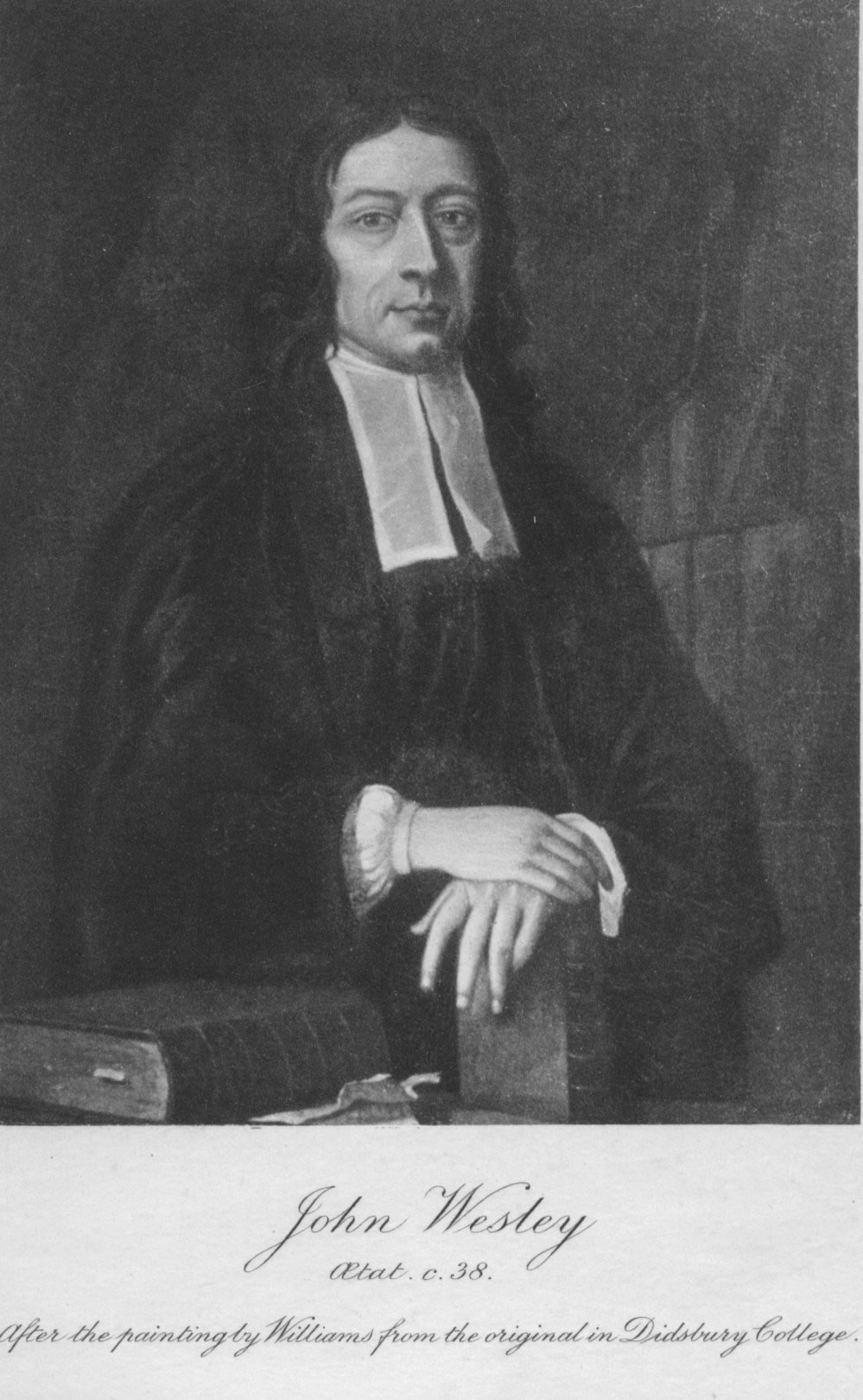
I would argue that this is an authentically Wesleyan position, although Wesleyans are often seen as aligning themselves with accounts of “free will.”   Certainly there are some Wesleyans who have argued in favour of a libertarian concept of free will, but I don’t think that is consistent with Wesley’s own views on the subject.   I’ll have to post separately on this question, to do it justice, but I believe it would be better to describe Wesley’s argument in terms of the freed will of the regenerate, rather than claiming “free will” for all humanity.

Three Quotes from William Booth on the Sacraments

People who have done research on The Salvation Army and the sacraments will probably be familiar with these quotes, but I find that a lot of people are surprised by some of the things that William Booth said about the Army’s non-observance of the sacraments.  So I’m just putting these three quotes out there, as a follow up to my last post.

First, from Booth’s official announcement that the SA would stop observing the sacraments (“The General’s New Year Address to Officers,” The War Cry, Janary 17, 1883):

Now if the sacraments are not conditions of salvation, and if the introduction of them would create division of opinion and heart burning, and if we are not professing to be a church, not aiming at being one, but simply a force for aggressive salvation purposes, is it not wise for us to postpone any settlement of the question, to leave it over for some future day, when we shall have more light?”

Moreover we do not prohibit our own people… from taking the sacraments. We say, ‘If this is a matter of your conscience, by all means break bread. The churches and chapels around you will welcome you for this.

Second, from a book Booth wrote in 1885 called Doctrines and Disciplines of The Salvation Army, Section 26, question 6 (I’m taking the quote from Roger Green, The Life and Ministry of William Booth (Nashville: Abingdon, 2005), 148):

Q: What is the teaching of Army on the subject of the Lord’s Supper? A: When such an ordinance is helpful to the faith of our Soldiers, we recommend its adoption.

Finally, a quote from an interview Booth gave in 1895 (again from Green, 148):

…I should like to emphasize the fact that this with us is not a settled question.  We never disclaim against the Sacraments; we never even state our own position.  We are anxious not to destroy the confidence of Christian people in institutions which are helpful to them.

Obviously, I’m putting these up to flag the provisionality of Booth’s position (and the total lack of mention of a divine calling NOT to observe the sacraments), and also his desire to avoid any theological controversy relating to the sacraments.  He may have been naive to think that not having sacraments would steer him clear of controversy!, but also note that he viewed this position as conditional in part on the Army’s claim that it was not a church. Most Salvationists today claim that the Army IS a church.

A Comparison of Salvation Story and the 2010 Handbook of Doctrine

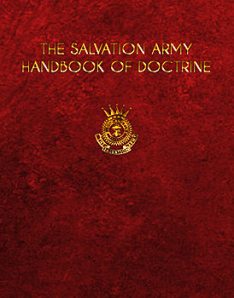
I’m working on a post for the Rubicon on the section of the new Salvation Army Handbook of Doctrine which deals with the sacraments.

In the preface to the new Handbook, General Shaw Clifton writes:

This 2010 Handbook of Doctrine retains the wording of the 1998 edition except for minor clarifications and stylistic changes. The principal aim has been to maximise user-friendliness, for example by reallocating the Bible references and inserting them into the main narrative at the relevant places; renumbering the chapters to match the numbers of the Doctrines; merging the main Handbook with the 1999 Study Guide into a single volume, removing outdated material from the latter and condensing some parts of it; revising certain Appendices and introducing three new study aids by way of Appendices 5, 6 and 9.

I guess the part on the sacraments falls under the category of “revising certain Appendices,” because there is clearly more going on here than “minor clarifications and stylistic changes.”

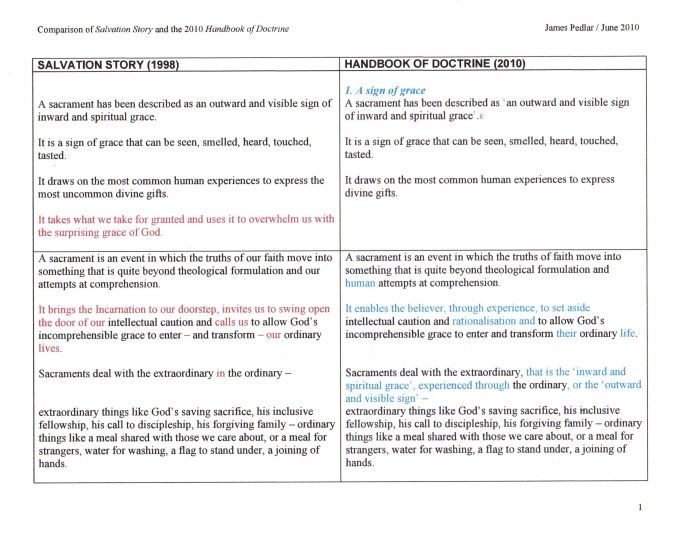
I’ve made a chart which puts the two texts side-by-side, so you can clearly see the changes that have been made to Salvation Story’s treatment of the sacraments (Salvation Story was the 1998 version of the Handbook).

I’ve got a pretty good idea how I’m going to structure the post – around two major points. But I’m interested in getting feedback from others.  Feel free to comment here, or email me (james [dot] pedlar [at] gmail [dot] com).

Here’s the chart in pdf: Comparison of Salvation Story and Handbook of Doctrine on Sacraments

If you want more context, you can find a pdf of Salvation Story here, and the Handbook of Doctrine can be downloaded here.

Eight Theses on Authority in the Church

I’ve been reflecting theologically on the problem of authority in the Church for a number of years now.  It is a notoriously difficult topic.  Disagreements over authority have been at the heart of many of the divisions in the Church since the Reformation, and questions of authority remain among the most difficult issues discussed in ecumenical dialogue.  

I became interested in the topic mostly because my own tradition (Salvation Army) has such an extremely hierarchical authority structure, and it seemed to me that its hierarchical structure was out of line with the Army’s otherwise egalitarian view of redeemed humanity.   For my master’s thesis I investigated the development of the SA’s governance, and found that it was supported by basically a utilitarian argument: there is no biblical model for church structure, therefore we can use whatever is most “effective,” and what could be more effective than organizing ourselves as an Army?    I would suggest that the argument no longer holds even on its own terms (that is, that the military structure is no longer “effective” in the way it may have been in the 1880s), and also that the presupposition on which it is built (that we are free to use whatever is most effective) is questionable at best.   If you want to know more about that I’ll be happy to send you my thesis.

The following theses are posted here as food for thought.  They certainly aren’t comprehensive, but I offer them as some basic principles to be kept in mind when thinking about questions of authority in the Church.   If you read between the lines you can see how my experiences with the Army’s structure are acting as an invisible foil for much of what I’m writing here.  However, I’ve tried to formuate these ideas into constructive propositions which should be applicable in any ecclesial context.

  1. Authority in the Church is, first and foremost, a theological issue.  As the people of God, we must always keep the Truine God in view as we think about our life together, whether we are addressing issues of faith or practice.  The theological question of authority must provide the normative specification for the practice of excercising authority, i.e., the ins and outs of how authority is exercised in the church.  We cannot bracket out theological questions in our discussion of authority, blindly adopting practices from the world of business or elsewhere, without measuring them against the character of God as the authority to which all other authorities must answer. 
  2. Jesus Christ is the head of the church and the ultimate authority to which every Christian and the church as a whole must answer.  We all answer to one Lord, who is the embodiment of truly human and truly divine authority.  Christ, as truly God and truly human, shows us the character of God and the character of our new humanity as it is intended to be.  His humanity is the standard towards which we strive. However, as we are all pilgrims moving towards the realization of this fully redeemed humanity, it must be absolutely maintained that Christ’s authority is unique.  Jesus is the one head of the church, no one can presume to encroach upon his authority. In the Church, his voice must be allowed to speak in a singular way, and all nations, cultures, ideologies, and persons (including Church leaders) must place themselves under this authority.
  3. The Scriptures contain the authoritative witness to Jesus Christ, and as such must always be allowed to speak over and against human authorities in the Church. The Bible is the normative source of our knowledge of Christ, and the medium through which God has graciously chosen to preserve the record of his self-revealing acts in history.  As such, the Scriptures are the uniquely inspired standard against which all claims concerning Jesus Christ – and therefore all claims regarding authority in the Church – must be measured.  The place of Scripture, as the standard for Christian faith, must be maintained in any system of authority.  All human authorities in the church must be answerable to the unique witness of Scripture. 
  4. The structures of authority in the Church ought to reflect the character of the Christian life.  It is not enough that leaders themselves display lives of holiness and integrity.   The structures and processes of authority should also be marked off as different from the authority structures and processes of the world.   Authority structures are not “neutral” tools that can be used for either good or evil ends, depending on the persons who are using them.  The structures themselves should foster and reflect the new life of the Spirit that is ours through Christ.   To take an extreme example, a totalitarian structure demeans the dignity of the persons who are subject to its authorities, such that even a benign dictator in a totalitarian system participates in something which is a counter-witness to the gospel.  
  5. The Holy Spirit guides the whole community of believers in following Jesus Chist as Lord. The Spirit enlivens, guides, and empowers the church in every aspect of its existence.  The Spirit was sent forth from the Father to the whole people of God, so that his people might have fellowship with him, as they are united in fellowship with one another.  Through worship, prayer, and the reading of Scripture together, the people of God are taught by the Spirit.  This gives the Church a fundamentally egalitarian character, but it does not mean that individual believers can disregard the voice of others. It is not an individualistic egalitarianism, but a communal egalitarianism, in which each member is dependent upon the others.  Precisely because God speaks to all believers through the Spirit, we must be wary of ‘lone ranger’ discernments of the Spirit’s voice.  Through their common fellowship of the Spirit, believers are able to test and determine what the Spirit is saying to the Church.
  6. Human authorities in the Church are guided by that same Spirit. Those set in positions of authority in the church are guided by this same Spirit, who is given to the whole Church.  Leaders must never presume that they have special access to God’s voice.  As they are enabled by the Spirit to lead the people, they must remember that they are part of the assembly that gathers before God’s throne to hear him speak. They do have a status that sets them apart from this assembly.  This is not to say that there is no distinction whatsoever between members of the Church.  However, it must always be remembered that the distinctions are matters of function, not status.  Church leaders have specific roles to play in the life of the congregation, and not everyone can fill those roles.  But they do not have a higher status in relation to their brothers and sisters.
  7. Human authority the Church must always be open to reform. The above should establish that human authorities in the church must approach their task with an attitude of humility and a constant openness to reform.  As no leader can perfectly discern the voice of the Spirit, no leader can ever fulfil their role in isolation from the discernment and reception of the people.  Neither can any body of Christians perfectly discern and embody God’s will on this side of the eschaton.  There will always be need for reform in the Church, and authorities must bear that need in mind at all times, remaining open to challenge and critique.
  8. Human authority in the church is not an end in itself, but is ordered towards its goal – the mission of God.   If authority in the church is primarily a function and not a status, then authorities must not presume that their authority is an end in itself – that simply protecting and preserving their authority is God’s work.  Human authority in the Church is a means to an end, and the end is the furtherance of the mission of God.   This is not the same as saying we should use “any means necessary,” because the means themselves are part of the Church’s witness to the gospel.  Rather, in saying that authority in the Church is ordered toward the mission of God, we put authority in its proper place, among the people of God, serving the mission of God.  An authority which sets itself up as an end in itself can become idolatrous.

The purpose of theological education

There’s a nice post from Ben Myers over at Faith & Theology on the purpose of theological education, which includes the following:

“What the church really needs is not cleverer or more relevant or more professional ministers, but women and men who know how to pray and how to bear witness. Nothing could be simpler; nothing more demanding. For true prayer and witness spring only from a life that has been formed in the way of discipleship – the way of Jesus Christ.”

What a great way of summing up the purpose of theological education.  But most people, including many who have had theological education, don’t see it this way.  Those training for ministry often struggle to integrate academic study into their faith.   I remember friends talking about this in seminary.  I’ve seen it in students that I’ve TAed for.  I’ve also heard some cadets from CFOT talk along the same lines.   Why is it that students have a hard time making the connections between the theological disciplines and the life of faith?   I think it is partly due to the fact that popular Christian culture is so ahistorical and anti-intellectual.  On the other hand, theological scholarship has gone the way of increasing specialization (along with other academic disciplines), to the point that many theologians spend most of their time communicating with a small circle of friends who are interested in the same obscure topics.  Philip Clayton recently posted a video on his website criticizing academic theology (including his own work) for this very reason. He may exaggerate a bit but the main point is valid. The kinds of discourse we encounter in our local church are so far removed from academic discourse that it becomes hard reconcile the two, so a lot people veer off in one direction or the other.   

How do we get beyond this?  Obviously there are people we could look to, say scholars who write for general audiences, like NT Wright, or pastors who put great effort into upholding theological integrity in their ministry, like David Fitch.    Students could probably put a little more effort into trying to integrate scholarship and faith, and teachers could certainly make an effort to show how theological questions are related to situations in the life of the Church.  I also think it reinforces the need for doing historical theology, and teaching doctrine from a historical perspective.   Why?  Because most of the great theologians in the history of the Church were pastors and leaders, and they wrote in response to real problems that were arising in the life of the Church as it struggled to live out its vocation in the world.  

Any other thoughts?  As an academic whose deeply concerned about strengthening the connections between scholarship and everyday Christian life, I’m open to suggestions.

Second Canadian Wesley Studies Symposium

Howard Snyder, chair of Wesley Studies at Tyndale Seminary, has been trying to encourage networking among Wesleyan theologians and pastors in Canada.  A few of us got together last spring for an informal Wesley Studies symposium, and we’re trying to make it an annual event.   So if you’re interested in Wesley and you can be at Tyndale on March 23, please let me know, because we’d love to have you there.

Second Annual Wesley Studies Symposium

Tyndale Seminary, Tuesday, March 23, 2010

9:00 a.m. – 7:30 p.m

Schedule / Agenda

8:45 a.m. Coffee – Information

9:00 a.m. Welcome – Introductions – Announcements – H. Snyder

9:15-10:15 Amy Caswell: “The Story of Christian Perfection: the Perfection Narrative of George Clark and Other Friends of John Wesley”

10:15-10:30 Break

10:30-11:20 Chad Short: “John Wesley and N. T. Wright in Dialogue”

11:20-12:15 Bob Munshaw: “‘Be Thorough, But Be in Haste’: Impetus and Self-Understanding of Mission in the Early Free Methodist Church”

12:15-1:00 Lunch (Courtesy of Tyndale Seminary)

1:00-1:50 Howard Olver: “A Theology for Reaching the City”

1:50-2:30 Updates on Wesley Research (Current & Proposed)

2:30-2:45 Break

2:45-3:30 James Watson: “Social Science Methodology for Multiethnic Church Planting”

3:30-4:15 Matt McEwen: “Wesley and the Environment: A Sacramental View” (provisional title)

4:15-5:00 Resources, Programs, New Publications, Etc. – Discussion

5:00-6:00 Free Time

6:00-7:30 Dinner, Denominational Presentations