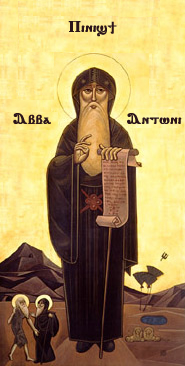
Typology of Views on Charismatic Movements: Conclusion

To recap, I’ve been presenting a series of posts on charismatic movements, outlining a typology of views, as follows:

  • Charismatic more fundamental than institutional (Leonardo Boff).

While this survey shows that there is a significant body of literature on the theology of charisms and charismatic movements (and a wide divergence of viewpoints), I would argue that numerous questions remain which need to be addressed.

Significantly, for the most part, the literature on charisms has not been significantly incorporated into discussions of unity and diversity.   Of course, Cullman’s argument attempts to do this, but I would argue that he has disassociated the biblical idea of charisms from its original vocational context and applied it too liberally to all confessions, thereby inappropriately justifying continued separation across the board.  Also, it is apparent throughout his argument that his major concerns are with the Roman Catholic, Orthodox, and magisterial protestant traditions, but he offers no criteria by which we should distinguish these separations as “legitimate” as compared with more recent protestant schisms.  Would he support, for example, the continual splintering of pentecostal and independent charismatic churches on the grounds of protecting their particular charism?

Further, his model suggests that there is a charismatic gift at the root of all church divisions.  While I believe there are many confessions or denominations in the Church today that began with such a misapprehension of charisms, this is certainly not the case in every situation.  It seems nonsensical to speak of the English reformation, for example, being rooted an unrecognized charism.  We might speak of Anglican charisms that developed in the subsequent history of Anglicanism, but if the separation of the Church of England from Rome was not rooted in a charism, we must question the validity of using such post-division gifts as a reason for continued structural separation.

Other uses of the idea of “gifts” as a way of discussing diversity in ecumenical documents have not delved into the biblical theology of charisms, nor asked questions about the appropriateness of applying the term to traditions / denominations / confessions.  Though the idea of “complementary gifts” has been a helpful way to build ecumenical bridges, it should not be used to construct a positive vision for ecclesial unity which justifies continued “separation.”

Where the idea of charisms has been incorporated in a more sustained way into a vision of the unity of the Church is in Catholic literature on the religious life, but little work has been done in attempting to apply the insights of this perspective to protestant reform movements. The comparison has sometimes been made, but not explored in much theological depth (See, for example, Outler’s remarks on Methodism as an “order,” in That the World may Believe, 54).

The weakness of some Catholic approaches, especially those which stress the complementarity of charism and institution, is that they are not helpful in interpreting the divisive history of renewal and reform movements in the life of the Church.  The question is of paramount importance, particularly for the many evangelical protestant denominations which began as reform, renewal, or missionary movements, with no intention of starting new “churches.”  In evangelical circles, partly because of the prevalence of free church ecclesiology, the tendency has been to emphasize the significance of the movements and downplay the importance of historical continuity.

All this is to say that I think significant work needs to be done on the topic of  “group” charisms, and how this concept  fits into the larger discussion about the limits of legitimate diversity in the Church.

Typology of Views on Charismatic Movements, Part 7: Charisms as Justification for Separation

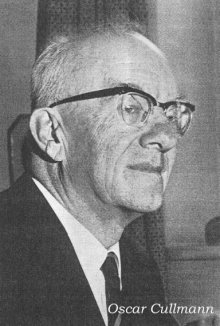
One final perspective on charisms which needs to be discussed here is found in Oscar Cullmann’s 1986 book Unity Through Diversity.  Cullmann’s fundamental thesis in this work is that “every Christian confession has a permanent spiritual gift, a charisma, which is should preserve, nurture, purify, and deepen, and which should not be given up for the sake of homogenization” (Unity Through Diversity, 9).  Cullmann is concerned that the frustration of some with an apparent lack of progress towards unity is based on a “false goal” and a false hope of homogenization, which has no basis in the New Testament (14). The goal of unity should rather be a “union of all Christian churches within which each would preserve its valuable elements, including its structure” (15).

In making this argument, Cullmann claims to be drawing upon Paul’s understanding of the Church, which is “entirely based upon this fundamental truth of the variety of charisms” (18).  Basing his argument on the Pauline texts that deal with the charismatic gifts, he argues that unity can exist through diversity, rather than in spite of diversity.  The function of the Spirit in Pauline community is to create diversity, and yet “this does not cause fragmentation, since every member is oriented to the goal of the unity of the whole body” (17).  While he acknowledges that the Pauline image of the body and its parts was not originally intended to apply to churches, he argues that it is consistent with the meaning of Paul’s charismatic theology, and that Paul does, in other places, ascribe various “gifts” to different churches.

I expected to hear more from Cullmann on this point, but his sole support is a reference Romans 1:11 as an example of Paul ascribing a “particular mission to each of the different churches.” He goes on to argue that Paul views the one church to be present in each local church, a point which he believes underscores the idea of a “union of churches” where all are given equal ecclesial status (17).

Cullmann insists that he is not suggesting that things should simple remain as they are between the churches.  He suggests that relations between the churches should proceed on the basis of attempting to speak frankly to one another about the charism or charisms that we see in each other’s traditions (19).  He also notes that there are often “peculiarities” or “distortions” of the charismatic gifts that need to be weeded out by careful self-examination (16).  For example, Cullmann identifies essential charisms of the Lutheran and Reformed traditions as “concentration on the Bible” and “freedom,” but notes that these are often found in their corresponding distorted form biblicism and anarchy (20).

What clearly sets Cullmann apart in his proposals is that he speaks of a charism as being at the root of “every confession,” and that he argues that separation and autonomy might be necessary in order for these charisms to be safeguarded. The sinful element in these historic divisions is not the fact that churches are separate, but the fact that the separations have been hostile, rather than peaceful.

But in order to preserve certain charisms in their pure form, it was perhaps also necessary hat completely autonomous churches came into being (the Orthodox and the churches that derived from the Reformation). This would not necessarily and as such have led to a hostile separation which would have excluded every kind of fellowship (koinonia), the “right hand of fellowship” could have been extended here too, despite the aspect of continuing separation, as at the apostolic council (cf. Gal. 2:9; Acts 15:1-31) (31).

What Cullmann is arguing for, then, is a unity in continued separation, in which churches would remain autonomous but share in fellowship through a council or other structure of some kind.

The main thing is the achievement of a koinonia that is a true unity through diversity.  However it is developed as a conciliar organization, it should, without itself being the church as the body of Christ, guarantee unity through the fact that it brings to expression and awareness that in each of the individual churches that belong to it, and with its particular charisms, confessional structure, faith and life, the ONE universal church is present (64).

I’ll finish off this series (finally!) with some concluding thoughts on the typology in my next post.

The Good Samaritan, by John Newton

Further to my previous post, here is a hymn by John Newton, reflecting on the same idea – that the parable of the Good Samaritan points us to Christ.  Taken from Olney Hymns (1779), Book 1, Hymn 99.

*

How kind the good Samaritan

To him who fell among the thieves!

Thus Jesus pities fallen man,

And heals the wounds the soul receives.

*

O! I remember well the day,

When sorely wounded, nearly slain;

Like that poor man I bleeding lay,

And groaned for help, but groaned in vain.

*

Men saw me in this helpless case,

And passed without compassion by;

Each neighbor turned away his face,

Unmoved by my mournful cry.

*

But he whose name had been my scorn,

(As Jews Samaritans despise)

Came, when he saw me thus forlorn,

With love and pity in his eyes.

*

Gently he raised me from the ground,

Pressed me to lean upon his arm;

And into every gaping wound

He poured his own all–healing balm.

*

Unto his church my steps he led,

The house prepared for sinners lost;

Gave charge I should be clothed and fed;

And took upon him all the cost.

*

Thus saved from death, from want secured,

I wait till he again shall come,

(When I shall be completely cured)

And take me to his heav’nly home.

*

There through eternal boundless days,

When nature’s wheel no longer rolls,

How shall I love, adore, and praise,

This good Samaritan to souls!

Christ as the Good Samaritan

In preparing for a sermon on the Good Samaritan, I came across some classic interpretations which see the parable as pointing to Christ.  Here are selections from three ancient doctors (courtesy of the Ancient Commentary on Scripture), and a 20th century giant:

Ambrose, from his Exposition of the Gospel of Luke, 7.73-84:

Jericho is an image of this world. Adam, cast out from Paradise, that heavenly Jerusalem, descended to it by the mistake of his transgression…He was greatly changed from that Adam who enjoyed eternal blessedness.  When he turned aside to worldly sins, Adam fell among thieves, among whom he would not have fallen if he had not strayed from the heavenly command and made himself vulnerable to them…he received a mortal wound by which the whole human race would have fallen if that Samaritan, on his journey, had not tended to his serious injuries. 7.73]
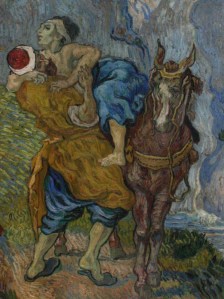
…Here the Samaritan is going down.  Who is he except he who descended from heaven, who also ascended to heaven the Son of Man who is in heaven?  When he sees half-dead him whom none could cure before, like her with an issue of blood who had spend all her inheritance on physicians, he came near him.  He became a neighbour by acceptance of our common feeling and kin by the gift of mercy.

…”And bound up his wounds, pouring in oil and wine.” That Physician has many remedies with which he is accustomed to cure.  His speech is a remedy.  One of his sayings binds up wounds, another treats with oil, another pours in wine.  He binds wounds with a stricter rule.  He treats with the forgiveness of sins.  He stings with the rebuke of judgment as if with wine.”

Since no one is closer than he who tended to our wounds, let us love him as our neighbour.  Nothing is so close as the head to the members.   Let us also love who is the follower of Christ, let us love him who in unity of body has compassion on another’s need.

Origen, Homilies on the Gospel of Luke, 34.3,9:

One of the elders wanted to interpret the parable as follows.  The man who was going down is Adam.  Jerusalem is paradise, and Jericho is the world. The robbers are hostile powers.  The priest is the law, the Levite is the prophets, and the Samaritan is Christ.  The wounds are disobedience.  The beast is the Lord’s body.  the pandochium (that is, the stable), which accepts all who wish to enter, is the church.  The two denarii mean the Father and the Son.  The manager of the stable is the head of the church, to whom its care has been entrusted.  The fact that the Samaritan promises he will return represents the Saviour’s second coming…
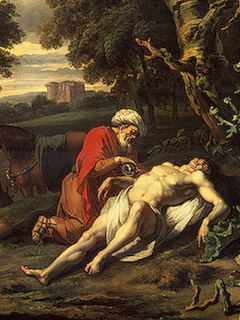
…the Samaritan, “who took pity on the man who have fallen among thieves, is truly a “guardian,” and a closer neighbour than the Law and the Prophets.  He showed that he was the man’s neighbour more by deed than by word.  According to the passage that says, “Be imitators of me, as I too am of Christ,” it is possible for us to imitate Christ and to pity those who “have fallen among thieves.”  We can go to them, bind their wounds, pour in oil and wine, put them on our own animals, and bear their burdens.  The Son of God encourages us to do things like this.  He is speaking not so much to the teacher of the law as to us and to everyone when he says, “Go and do likewise.” If we do, we will receive eternal life in Christ Jesus, to whom is glory and power for ages and ages.

Augustine, Sermon 179A.7-8:

Robbers left you half-dead on the road, but you have been found lying there by the passing and kindly Samaritan. Wine and oil have been poured on you.  You have received the sacrament of the only-begotten Son. You have been lifted onto his mule.  You have believed that Christ became flesh.  You have been brought to the inn, and you are being cured in the church.”That is where and why I am speaking.

…This is what I too, what all of us are doing. we are performing the duties of the innkeeper.  He was told, “If you spend any more, I will pay you when I return.  “If only we spent at least as much as we have received!  However much we spend, borthers and sisters, it is the Lord’s money.

Augustine, Christian Instruction 33:

God our Lord wished to be called our neighbour. The Lord Jesus Christ meant that he was the one who gave help to the man lying half-dead on the road, beaten and left by the robbers. The prophet said in prayer, “As a neighbour and as one’s own borther, so I did please” [cf 1 Cor 6.15]. Since the divine nature is far superior and above our human nature, the command by which we are to love God is distinct from our love of our neighbour.  He shows mercy to us because of his own goodness, while we show mercy to one another because of God’s goodness.  He has compassion on us so that we may enjoy him completely, while we have compassion on another that we may completely enjoy Him.

Karl Barth, Church Dogmatics I/2, III, §18, pp 418-419.

The question with which Jesus concludes the story is which then of the three (i.e., priest, Levite, and Samaritan) proved to be a neighbour to the man who fell among thieves? And the teacher of the Law himself had to reply: “he that showed mercy on him,” i.e., the Samaritan.  This man as such, as the one who showed mercy, is the neighbour about whom the lawyer was asking.  And that is the only point of the story, unequivocally stated by the text.

For the lawyer, who wants to justify himself and therefore does not know who is his neighbour, is confronted not by the poor wounded man with his claim for help, but by the anything but poor Samaritan who makes no claim at all but is simply helpful.

It is the Samaritan who embodies what he wanted to know.  This is the neighbour whom he did not know.   All very unexpected: for the lawyer had first to see that he himself is the man fallen among thieves and lying helpless by the wayside; then he has to note that the others who pass by, the priest and the Levite, the familiar representatives of the dealings of Israel with God, all one after the other do according to the saying of the text: “He saw him and passed by on the other side;” and third, and above all, he has to see that he must be found and treated with compassion by the Samaritan, the foreigner, whom he believes he should hate, as one who hates and is hated by God. He will then know who is his neighbour, and will not ask concerning him as though it were only a matter of the casual clarification of a concept.  He will then know the second commandment, and consequently the first as well.  he will then not wish to justify himself, but will simply love the neighbour, who shows him mercy.  He will then love God, and loving God will inherit eternal life.

…The Good Samaritan, the neighbour who is a helper and will make him a helper, is not far from the lawyer.  The primitive exegesis of the text was fundamentally right.  He stands before him incarnate, although hidden under the form of one whom the lawyer believed he should hate, as the Jews hated the Samaritans.  Jesus does not accuse the man, although judgment obviously hangs over him. Judgment is preceded by grace.  Before this neighbour makes His claim He makes His offer.  Go and do likewise means: Follow thou Me.

Signs that make me laugh: Creepy Doll is “Not For Sale”

To understand this post you’ve got to understand a bit about what it is like to work in a Thrift Store.

The job of sorting through people’s donations is interesting, but kind of like shopping at a garage sale – most of the stuff is junk, and you’ve got to be willing to sort through the garbage to find something good.  Actually, the odds of finding something good might be a bit lower than your average garage sale, because often people who have garage sales wait until their stuff is picked over, and then they donate it to The Salvation Army.

So once in a while you find something good.  But on very rare occasions, the staff and volunteers who are sorting through donations come across something so great, or so precious, that they decide to keep in on permanent display in the store, rather than selling it for a few bucks.

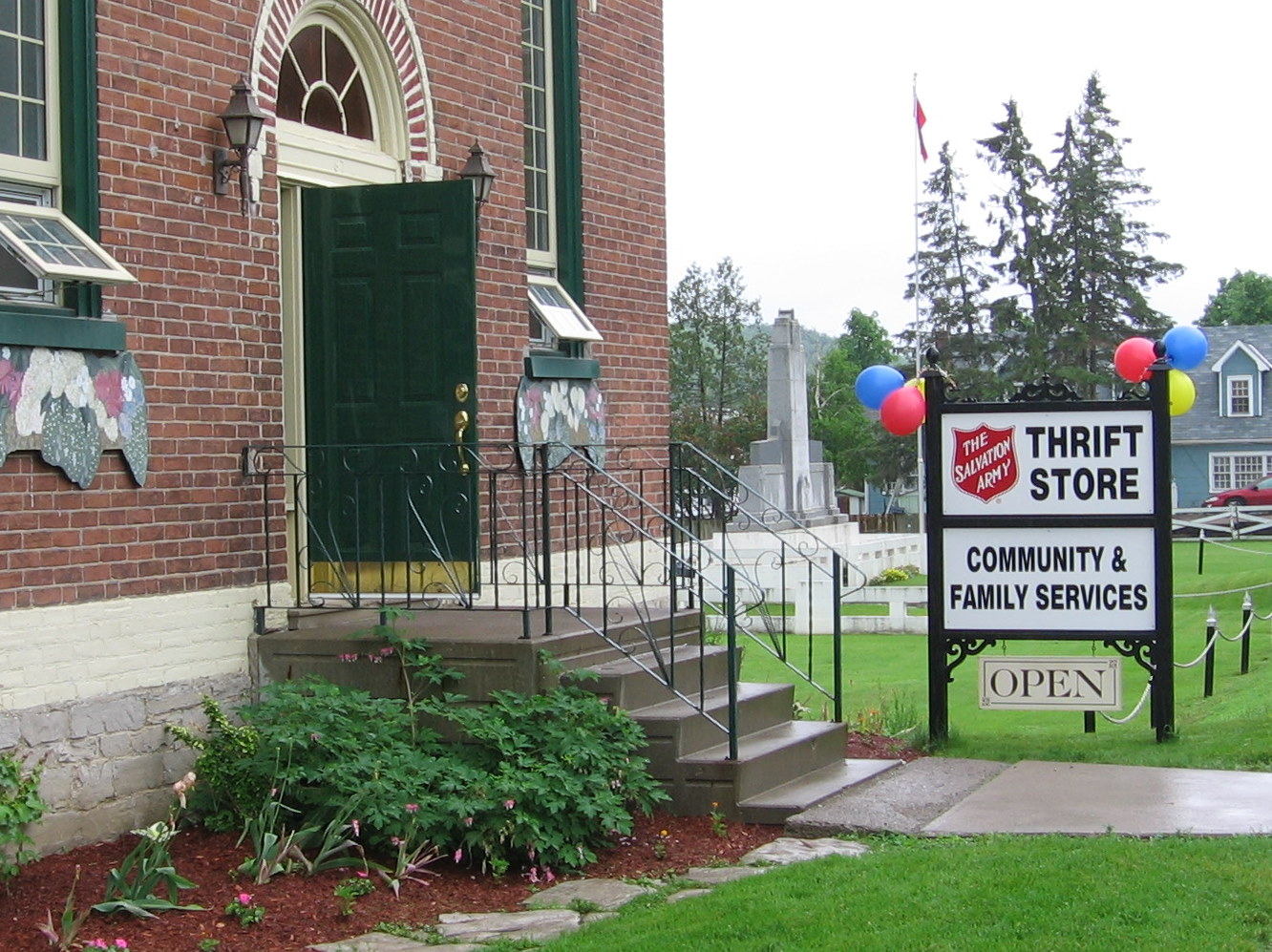
While I was working for The Salvation Army in the Quinte Region, we opened a new Thrift Store and Family Services facility in Campbellford.  It is a really cool buidling – formerly a baptist church, which was converted into a flower shop before it was leased to the Army (hence the painted flowers below the windows, which the landlord would not let us remove!).

During the grand opening, my brother happened to notice this doll sitting behind the counter, prominently marked “Not For Sale.”   I find it hilarious that someone thought this doll was so amazing that they just couldn’t bear to part with it.  You know what they say about one man’s junk…

If it was me, I would not want that doll staring at the back of my head while I worked the cash register.  I think it might give me nightmares.  It looks like something out of a horror movie.


Three Quotes from William Booth on the Sacraments

People who have done research on The Salvation Army and the sacraments will probably be familiar with these quotes, but I find that a lot of people are surprised by some of the things that William Booth said about the Army’s non-observance of the sacraments.  So I’m just putting these three quotes out there, as a follow up to my last post.

First, from Booth’s official announcement that the SA would stop observing the sacraments (“The General’s New Year Address to Officers,” The War Cry, Janary 17, 1883):

Now if the sacraments are not conditions of salvation, and if the introduction of them would create division of opinion and heart burning, and if we are not professing to be a church, not aiming at being one, but simply a force for aggressive salvation purposes, is it not wise for us to postpone any settlement of the question, to leave it over for some future day, when we shall have more light?”

Moreover we do not prohibit our own people… from taking the sacraments. We say, ‘If this is a matter of your conscience, by all means break bread. The churches and chapels around you will welcome you for this.

Second, from a book Booth wrote in 1885 called Doctrines and Disciplines of The Salvation Army, Section 26, question 6 (I’m taking the quote from Roger Green, The Life and Ministry of William Booth (Nashville: Abingdon, 2005), 148):

Q: What is the teaching of Army on the subject of the Lord’s Supper? A: When such an ordinance is helpful to the faith of our Soldiers, we recommend its adoption.

Finally, a quote from an interview Booth gave in 1895 (again from Green, 148):

…I should like to emphasize the fact that this with us is not a settled question.  We never disclaim against the Sacraments; we never even state our own position.  We are anxious not to destroy the confidence of Christian people in institutions which are helpful to them.

Obviously, I’m putting these up to flag the provisionality of Booth’s position (and the total lack of mention of a divine calling NOT to observe the sacraments), and also his desire to avoid any theological controversy relating to the sacraments.  He may have been naive to think that not having sacraments would steer him clear of controversy!, but also note that he viewed this position as conditional in part on the Army’s claim that it was not a church. Most Salvationists today claim that the Army IS a church.

A Comparison of Salvation Story and the 2010 Handbook of Doctrine

I’m working on a post for the Rubicon on the section of the new Salvation Army Handbook of Doctrine which deals with the sacraments.

In the preface to the new Handbook, General Shaw Clifton writes:

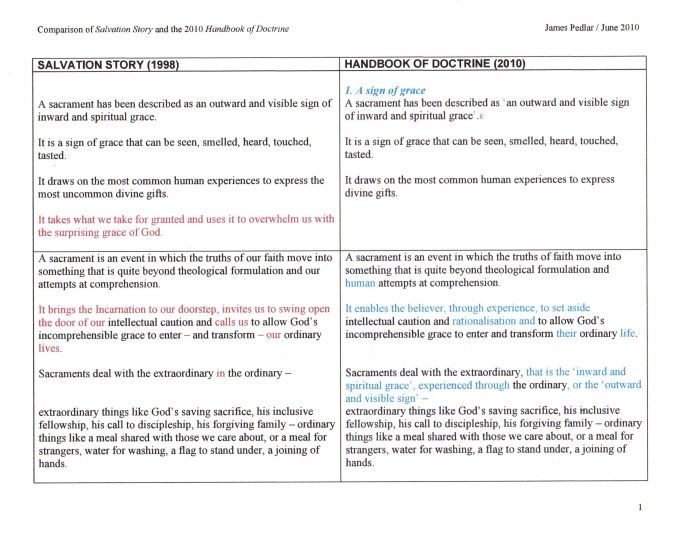
This 2010 Handbook of Doctrine retains the wording of the 1998 edition except for minor clarifications and stylistic changes. The principal aim has been to maximise user-friendliness, for example by reallocating the Bible references and inserting them into the main narrative at the relevant places; renumbering the chapters to match the numbers of the Doctrines; merging the main Handbook with the 1999 Study Guide into a single volume, removing outdated material from the latter and condensing some parts of it; revising certain Appendices and introducing three new study aids by way of Appendices 5, 6 and 9.

I guess the part on the sacraments falls under the category of “revising certain Appendices,” because there is clearly more going on here than “minor clarifications and stylistic changes.”

I’ve made a chart which puts the two texts side-by-side, so you can clearly see the changes that have been made to Salvation Story’s treatment of the sacraments (Salvation Story was the 1998 version of the Handbook).

I’ve got a pretty good idea how I’m going to structure the post – around two major points. But I’m interested in getting feedback from others.  Feel free to comment here, or email me (james [dot] pedlar [at] gmail [dot] com).

Here’s the chart in pdf: Comparison of Salvation Story and Handbook of Doctrine on Sacraments

If you want more context, you can find a pdf of Salvation Story here, and the Handbook of Doctrine can be downloaded here.

Typology of Views of Charismatic Movements, part 6: Institutional over Charismatic

As I said in my introduction to this series, it is hard to find anyone today who actually tries to make a theological argument for the priority of the institutional over the charismatic in the Church.

Historically, the obvious example of prioritizing the institutional over the chairsmatic is modern Catholicism, before Vatican II.   The Roman Catholic Church was conceived as a perfect society, meaning that the Church was a complete social system, and its various elements were instituted by God, so that it would lack nothing in its historical existence until the return of Christ.  The priesthood, all the sacraments, the hierarchy, even monasticism and the religious life, were said to be derived directly from Jesus Christ himself.  These institutions were therefore invested with divine authority, such that, any “charismatic” who arose outside the established order would be seen as problematic. As Johann Adam Möhler summarized this view, “God created the hiearchy and in this way provided amply for everything that was required until the end of time.”

Of course the problem with this perspective was that, for one, it was not historically accurate.  It embraces what Avery Dulles describes as a “regressive method” of theology, whereby the latest teachings of the Church are adopted “as if they have been present from the beginning” (Models of the Church, 32), since any change would be seen as an “innovation,” and would undermine the view that all had been provided for in the Church’s institutions (including the magisterium).  Clearly, the Church’s institutions have developed over time, and many innovations have been made along the way.  Among these innovations, we must include some which I would call “charismatic movements”: monasticism of various kinds, the mendicant orders, apostolic societies, and so on.  These are among Catholicism’s most treasured institutions, but in the modern “perfect society” scheme of ecclesiology, it would have been difficult to explain their origins, apart from rooting them somehow in the divine institution of Jesus Christ.

These ideas are pretty far removed from the life of the Church today, even for Roman Catholics. However, the “institutional over charismatic” mindset is by no means absent.  Institutionalism is a pervasive social phenomenon, and all of our churches (even those which are highly charismatic) have to wrestle with the challenges it brings.  Therefore, the natural tendency in any church tradition is to be sceptical of leaders and movements who arise from oustide the established order.  We could say that, though it is not argued for theologically, “institutional over charismatic” is the default operating perspective of most churches.

Clericalism is perhaps the best example.  Even in evangelical churches, which profess a strong doctrine of the “priesthood of all believers,” there is a tendency to view the pastors as “professional Christians,” and to exclude lay people from fulfilling many roles which they ought to be able to fulfill.  Those who have the gifts (charisms), should be freed to exercise them, but they are sometimes excluded simply by virtue of the fact that they are not clergy.

I grew up in a denomination (The Salvation Army) where the clergy are largely responsible for the business of the church.   It strikes me as rather odd that we should expect pastors to be business-savvy, when there are likely members of their congregation who are business men and women themselves.

I’ve noticed that a lot of other evangelical traditions tend to have a “pastoral prayer” at every service.   This is where the pastor stands up and leads the congregation in a long prayer prayer.   I suppose most people see this as harmless, but I think it promotes a clericalist mindset.  Why would we want the pastor to be the only who publicly prays during worship?  It sends the message, again, that pastors are the “professional Christians.” It is interesting that in the older traditions (Catholic, Anglican, Lutheran, etc.), which most evangelicals assume are more “clericalized,” the prayers are not led by the pastor, but by lay intercessors. In the SA, the officer often leads this prayer, but sometimes it is a layperson.

The problem is that we can’t go too far in the other direction.  We need institutions, including ordained ministry (in my opinion).  We need stable structures that endure over time, and provide a means for passing on the faith from one generation to the next in a way that retains the historic core of gospel teaching.  We cannot escape this need.   We must embrace the institutions of the Church, without absolutizing them, and thereby excluding any new wisdom that the Spirit might bring from unexpected places.  That means, in part, that the institutional authorities of the Church must be open to discerning and coordinating the charisms that arise among the people.

Signs that make me laugh: McLean Insurance – Free Pizza

I found this  sign in Perth on the weekend.   “McLean Insurance: GREAT RATES, Award-Winning Service, FREE Pizza.”  The three things everyone is looking for in an insurance company!

Would you make a decision on something as important as an insurance policy on the basis of an offer of free pizza?

I guess it would depend on how good the pizza was.   If it was from the Goodwood Oven, just up the street, I might be tempted!

Typology of Views of Charismatic Movements, Part 5 continued: Charismatic Enlivens Institutional

Within this perspective we can also include some of the literature on charisms and the religious life in the Roman Catholic tradition (a word of clarification for those who aren’t familiar with Catholic terminology: Catholics refer to the “orders” within Catholicism (Dominicans, Franciscans, Jesuits) as the “religious life”). Since Vatican II it has become increasingly common for religious to speak about their movements as having a particular charism which is to be preserved and cultivated for the good of the whole Church.  Vatican II didn’t specifically apply the term “charism” to religious life in this way, but Perfectae Caritatis §1 speaks of the various gifts (variis donis) that are evident in the variety of forms of religious life, and also exhorts the religious to preserve the “spirit of founders.” Subsequently, however, both Paul VI and John Paul II used the term specifically in relation to the religious life.  See Evangelica testificatio §11, 12; Mutuae relationes §11, 13; Redemptionis donum §15.

Surprisingly, there has been little in-depth critical theological reflection done on the implications of applying the biblical idea of charisms to religious life. The most extensive treatment can be found in a short book by John Lozano, a Claretian Father and theologian, entitled Foundresses, Founders, and their Religious Orders (1983). Lozano’s discussion of the role of religious life as charismatic reforming movement comports well with the more general framework provided by Snyder and Sullivan, that is, viewing charisms as an enlivening force which renews the institutional life of the Church, like “lava” pushing against the “hard crust” of established institutions.

But when these charisms erupt at the surface, from the interior where the Spirit of Pentecost is burning like lava, they must necessarily push against the hard crust which has been hardening for centuries.  The People of God are not just a charismatic reality (although they are a charismatic reality essentially), but also an institutional entity.  The Church has its firm structures and its ministers, people whom God certainly helps in their care for his people, but people who are likewise conditioned by a certain mentality (61).

However, Lozano specifically gives attention to how such charismatic activity becomes itself institutionalized in religious families, and specifically to the question of how a charism can be said to be “transmitted” via such an institution – a question which has not received sufficient attention. It should be noted, however, that Rahner does deal with this question in The Dynamic Element in the Church (58-62), as discussed in a previous post. Lozano argues that, strictly speaking, a charism cannot be transmitted, but must come directly from God.

The charism, as we have said, always comes directly from the Lord.  It is not given by the Church, by any member of the Church (including founders and foundresses), or by the religious community  The Lord, by means of his Spirit, gives it to each individual… (76)

In a broader sense, however, the charism is transmitted by the particular religious institute in that the community becomes a context where that particular charism is cultivated, deepened, and actualized by the stable structures (i.e., the rule, constitutions, spiritual theology and practices) of the institute.

The gift received by the father or mother, and directly from God by their followers, is collectively cultivated, proposed in spiritual doctrine to new generations, deepened and actualized.  Its principle elements, the aim of the Institute or the “primordial concern” of the community, are described in the Constitutions, the form of life and spiritual environment are also described in them, as a point of consideration and source of light and nourishment for successive generations.  In this less proper sense, the charism is transmitted (76).

Religious join a particular institute, then, “because we realize that our vocation essentially coincides with that of its members and with the aims which this institution pursues” (75).

The picture that emerges from this perspective, then, is that of a vocational diversity in the church, evidenced in the various movements of reform and renewal which have at their root a particular charism.  The fruitfulness, functionality, and vitality of the movements depends on their continual interpretation and actualization of that charism in their own institutional structures.

This in fact became the basis for a program of renewal of the religious life after Vatican II. Perfectae Caritatis §2b speaks of this in terms of “loyal recognition” and “safekeeping” of “the spirit of the founders,” which give the various communities “their own special character and purpose.” Elizabeth McDonough summarizes the relevant papal documents relating to this renewal, and drawing upon them, identifies a set of presuppositions which underlie this perspective. If religious communities are in fact based upon a particular charism given to the Church, then existing communities must ask themselves a) if they indeed have a charism; b) if they know what their charism is; and c) if they are prepared to strive to live accordingly.  If their answer to any of those questions is in the negative, the religious community will not survive. (McDonough, “Charisms and Religious Life,” in The Church and the Consecrated Life, 135).

How much of this thinking could be transferred to protestant reform movements?  Can we speak, for example, of  a Methodist charism, or a Salvation Army charism, or a Christian and Missionary Alliance charism?  I think, historically speaking, we can easily make the case that these movements all started out in a way similar to a Catholic order: they were not trying to be “churches,” but instead trying to live out a very specific vocation within the Church.   They brought their particular charism to the Church, and the reaction was, as Lozano describes it, somewhat volcanic.  But do these groups remain focused on their founding charism today?  Is this still a helpful way to understand their place in the universal Church?  To what extent can an independent protestant movement sustain a focus on a particular charism, once it starts to take on “churchly” functions (one or two generations down the road)?