Typology of Views on Charismatic Movements Part 1: Charismatic Opposed to Institutional

The first in my typology of views on “charismatic movements” deals with a perspective I’m calling “charismatic opposed to institutional.”  This viewpoint basically sees the charismatic element of the church as the “true” or “original”church, and the institutions as a corrupting, stifling force that squeezes out the charismatic life.  According to this perspective, then, “charismatic movements” would represent the re-emergence of primitive, Pauline Christianity.

In scholarly circles this discussion begins with debate over the constitution of the earliest Christian communities.  Rudolph Söhm was responsible for bringing the discussion of charisms into modern scholarship (found in his Kirchenrecht, published in 1892).  Söhm was a lawyer, and the original reason for his investigation of primitive Christianity was occasioned by a dispute with fellow jurists regarding the status of civil law in Christian marriage ceremonies.  This set him on the path of researching the history of canon law, and the necessary corollary discipline of church history.  Söhm argued against the prevailing “voluntary association” consensus among protestant scholars in the 1880s, positing instead that the earliest Christians viewed their communities as drawn together and constituted by the charisms of the Spirit, meaning that they understood the Church as a spiritual entity which was beyond all human law. The contrast here is between the church constituted by the consent of the members in a democratic “free association” sense, and the church as constituted by the charismatic action of the Sprit.

According to Söhm, leadership and direction of the community was provided by charismatic leaders (preachers, teachers, and bishops), and was not formalized into offices.  In Söhm’s views, such formalization of charismatic authority into offices came later as a failure and a retreat from the original organization of the Church. Leonardo Boff characterizes Söhm’s view by saying “Faith in the Gospel gave way to faith in divine law” (Church, Charism and Power, 68).

Söhm’s interpretation of the early Church had a profound influence in the early twentieth century, though it was not blindly accepted.  Adolf von Harnack agreed that the primitive church was charismatic, but proposed that there had originally non-charismatic leadership as well, identifying the charismatic leaders with itinerant preachers and prophets who exercised a universal ministry, and the non-charismatic with the local presbyters, bishops, and deacons (primarily in The Constitution & Law of the Church in the First Two Centuries).  In the final analysis, Harnack followed the same line of thinking as Söhm in proposing that the non-charismatic leadership eventually overtook and excluded the charismatic leadership, thus pushing aside the originally charismatic element in the Church.


Hans von Campenhausen provided a variation on this thesis, by identifying the non-charismatic leadership with Jewish Christianity, and the charismatic leadership with the Pauline communities.  The two models were later merged, and the error in Campenhausen’s reading of primitive church history was the investment of the offices with sacred significance, a move which, in effect, led to the exclusion of charisms (Ecclesastical Authority and Spiritual Power in the Church of the First Three Centuries).

For the most part, later 20th century scholarship has taken a more nuanced view of the relationship between the institutional and charismatic in the church (more on that in later posts).  But the idea remains common in the popular Christian imagination.   Of course, revivalist groups, and charismatic movements would often read early church history in this way.  Inevitably a new movement that does not fit well with established leadership structures will interpret those structures as a stifling form of opposition to the Spirit’s work.

The problem with this perspective, of course, is that no purely charismatic movement can exist for any period of time without developing stable institutional structures.  Once you set a time and place for a meeting, and decide who is on set up, who is leading the singing, etc., you have begun the process of institutionalization!  So, if this is true, what kind of a reading of church history does it provide?  The church’s history is one of continual decline, interrupted sporadically by spontaneous irruptions of real Christianity, which themselves inevitably degenerate into spiritless institutions.  The result is that much of Christian history, and the majority of Christians in the world at any given time, are written off as being part of a spiritually dead Church.

Are “institutional” structures completely devoid of the Spirit’s leading?  That cannot be, if a) we believe that Christ has promised to be with his Church to the end, and b) historical continuity of any kind involves institutional structures.  It is true that there often are tensions and struggles between charismatic movements and established structures, but setting up such a clear dichotomy between the two seems to oversimplify the situation. Therefore, conceiving the institutional aspect of the Church as fundamentally “opposed” to the charismatic is not satisfactory.

signs that make me laugh: “coffee lime”

I ventured off Danforth a bit to find this sign, at Pape and Floyd, just North of Mortimer.

What on earth does “Coffee Lime” mean?

Please, if you eat lime with your coffee, let me know, because I’d really like to understand this one.  As far as I know, those are two things that don’t go together at all.

I actually noticed this place a few years ago, and I thought it was hilarious because they seemed to be copying the font and colour scheme of Coffee Time (which is everywhere in Toronto).  Coffee Time has re-branded recently, so you might not think that Coffee Lime looks anything like Coffee Time.  But their old signs look something like this:

So you can see how I was wondering if Coffee Lime was simply an attempt to fool people into entering the place. Maybe they were hoping that customers would glance quickly at the sign and go in, thinking they were at a Coffee Time.  Does that sound like a ridiculous explanation?   Well it makes more sense to me than someone simply choosing to name their business Coffee Lime.

The big problem with my theory is that Coffee Lime is attempting a bit of re-branding of their own, with this new sign out front.  They still have a tribute-to-Coffee-Time sign on the side of the building.

My confusion about this place is not helped by the fact that there is now a hot dog on the sign.  I also think it is funny that they separated “iced” and “cappuccino” with a bullet.

Charismatic Movements in the Church

I’m introducing a new series of blog posts on the topic of “charismatic movements” in the Church.  When I speak of ” charismatic” movements,  I don’t necessarily mean pentecostal movements, but those movements of renewal and reform which rise up spontaneously in the Church, and centre around particularly gifted individuals, who operate outside existing authority structures.  Such movements have existed throughout the history of the Church, and have always had a rocky relationship with the established Church authorities.

I developed this rough timeline as a teaching tool for a course I was TAing earlier this year.  We could debate whether some of these movements are “charismatic,” but I would argue that they were all charismatic in origin, meaning that they sprung up around individuals who were perceived to be specially gifted (the basic meaning of “charism” being “gift”).   The timeline gets really selective when it comes to the modern era, because at that point I had to be selective.  I’m not claiming the timeline is exhaustive at that point, but I hope it is representative.  My main purpose in creating the timeline this way was to contrast “catholic” movements (meaning those who were eventually accepted by Church authorities as legitimate) with “non-catholic.”

I should add also that I’m not addressing the issue of “heresy” here, as some of the movements in question were definitely preaching a message which was outside the boundaries of historic Christian orthodoxy. I think most people would agree that the Bogomils and Cathars were heretical, but assessing the orthodoxy of other individual movements on the list would require more of a discussion than I want to get into.

One of the questions I’m studying for my dissertation concerns how we account for these movements theologically.  How do we know if a charismatic movement is truly of God?  What do these movements represent? A return to the primitive purity of the Church?  A form of fanaticism?  A revitalizing force?

I’ve developed a typology of positions on the question of the place of charismatic movements in the Church, and this typology will form the basis for my series of posts, each of which will discuss one or two representative theologians:

  • Charismatic opposed to institutional. Here the work of Rudolph Söhm and early 20th century scholars such as Adolf von Harnack is important.  The theory of these writers is that the church was originally charismatic, but this was stifled by emerging catholicism (institutionalism in his mind) in the 2nd century.  The emergence of stable authority structures was therefore a failure on the part of early Christianity.
  • Charismatic more fundamental than institutional. I’d summarize Leonardo Boff’s work in Church, Charism, and Power along these lines.  Charism is more fundamental than institution, because it gives rise to the institution and keeps it alive. Therefore the charismatic gifts of the Spirit should be the structuring principle of the church.
  • Charismatic in tension with institutional. Karl Rahner tries to hold the two structures in tension by arguing that there are both institutional and non-institutional charismata. A Legitimate opposition of forces in the life of the Church is inevitable and should be accepted.  Hans Urs Von Balthasar’s “christological constellation” also fits under this category.
  • Charismatic complementary to institutional. More recent ecumenical work has attempted to overcome the duality of charismatic movements and institutional structures by stressing the complementarity of the two.  Joseph Ratzinger also wrote along these lines in his discussion of lay movements in the Church, even going so far as to reject the dichotomy of charism/institution as inappropriate for ecclesiology.
  • Charismatic enlivens institutional. Others stress the role of charismatic movements as enlivening forces for the institutional church.  So Howard Snyder argues that both institutional structures and charismatic movements can be seen as normal and valid in the Church’s history.  I’ll also discuss Catholic theologies of “the religious life” (religious orders, etc.) under this category.
  • Institutional over charismatic. It’s hard to find anyone who actually argues for this theologically, but it is common on a practical level, so I’ll still attempt a post on this perspective.
  • Charismatic gifts as justification for separation. Oscar Cullmann’s book Unity Through Diversity makes the argument that different the “confessions” in the Church have their own unique charisms, which need to be preserved.  Therefore he argues that continued structural separation of the churches is justified, so that these diverse gifts can be preserved.  Many denominationalist theologies proceed on similar assumptions.

While the work I’ll be discussing is scholarly, the issue of finding a place for charismatic movements in the Church has immense practical implications, and I’ll attempt to draw these out.  This has been a perennial issue for the Church, and it remains an important problem today.  Think of the controversy surrounding “emergent” and whether it is a legitimate movement of reform or a heretical offshoot of genuine Christianity.  How are these “new expressions” of church related to the established Churches?

It is also an important question for people of evangelical heritage, because move evangelical denominations began as charismatic reform movements (not as denominations or “churches”).  Does that have implications for our understanding of the Church and the place of “denominations” as they now exist?  I think it does, and I’m hopeful that reflection on the history of charismatic movements, as well as theological reflection on the nature of the Church and where they fit, can provide some direction for our life together as we seek to give faithful witness in the post-Christendom context.

more on moralism, via internet monk

This morning I read this 2005 re-post from Internet Monk – a great piece on how assurance is undermined by contemporary evangelical spirituality.  Part of the issue is the moralism I was on about in my last post:

Much of evangelical preaching today is focused on moralism of various kinds, constantly pointing the Christian to what he/she ought to be doing. Serious preaching on discipleship often directs the Christian to a variety of duties, ministry needs and pressing obligations for any true follower of Jesus. For sensitive consciences, it can seem that the Christian life is about being a “good” person, doing “good” things in a hurting world, imitating Jesus so others can see Jesus in you.

Many contemporary preachers are busy describing the Christian life as a life where the Christian finds his/her destiny and fulfills his/her dreams. Follow the principles for success and purpose, and experience God’s best for your life. But what if you are failing? Suffering? Constantly falling short? Such emphases can undermine assurance when the Christian is told the outcome of the Christian life is practical, real-world results.

I think the sincere and laudable desire to be “relevant” and give “life-applications” is at the root of much of  this moralistic preaching.  We want to give people a “so what” point at the end of the sermon, so we end questions like: “What about you? Are you doing your best with [insert sermon topic]?”

The bottom line of many sermons is “you need to do more.”  Usually the “more” is about one of three things: personal Bible study, personal prayer life, and witnessing to others.   All are important aspects of Christian life, but the problem is that our worship services, and our sermons, are designed to climax at this point of “life application.”  It is the point toward which the rest of the service points.  So the main thing that we are saying each Sunday is, “we need to be doing this or that,” rather than a proclamation of the victory of Christ. Our spirituality is focused too heavily on our state as Christians, and not enough on the constant re-presentation of the saving acts of God.  Making self-examination the foundation will lead us to either despair (if we are honest) or presumption (if we think we really are doing enough!).  Our actions, the things we “do” as Christians, come as a grateful response to God’s prior action “for us and for our salvation.”   Often times it seems that we are putting the cart before the horse by our strong emphasis on what we should be doing.

Moralistic Therapeutic Deists

Christian Smith, Notre Dame sociologist and author of some significant books on youth in North America’s churches, uses the term “moralistic therapeutic deists” to describe the default religion of our time.  Christianity Today had an interview with Smith in their October issue, in which they discussed his new book on “emerging adulthood,” Souls in Transition.  He’s got some really interesting things to say about young adults and the Church. I wish the book had been published earlier, as I’d already finished up my young adult project for the SA when Souls in Transition hit the shelves.  For example, his typology of emerging adults might have got me thinking in different ways about how I might have summarized my interviews.  He breaks down the population of young adults as follows (found on p. 36 of the print edition on CT but not in the online article):

  • Committed traditionalists (15%)
  • Selective adherents (30%)
  • Spiritually open (15%)
  • Religiously indifferent (25%)
  • Religiously disconnected (5%)
  • Irreligious (10%)

Maybe in another post I’ll speculate as to how these categories play out among young adults in The Salvation Army.

Right now I’m interested in this idea of “moralistic therapeutic deists”, because I think it is a great description of the default religion of our day. While Smith’s research indicates that some young adults are questioning the moralistic therapeutic deist framework, it still remains the dominant form of religious practice:

With Soul Searching, you found that most U.S. teens are Moralistic Therapeutic Deists (MTD). They believe in a benevolent God unattached to a particular tradition who is there mostly to help with personal problems. Are emerging adults still MTDS?

Moralistic Therapeutic Deism is still the de facto practiced religious faith, but it becomes a little more complicated for emerging adults. They have more life experience, so some of them are starting to ask, “Does MTD really work? Isn’t life more complicated than this?” MTD is easier to believe and practice when you are in high school.

It’s good that today’s young adults are questioning popular religion, but the majority still practice their religion within a moralistic therapeutic framework.  By “the de facto practiced religious faith” Smith means the “cultural Christianity” of North America, but we shouldn’t think that by this he means Christianity of “the culture” as opposed to Christianity found in the churches.  It’s the pop Christianity of both Church and culture – not found in all churches but certainly preached and practiced in many.  Moralistic therapeutic deism is the default framework through which Christians interpret their lives and their faith.

So what is “moralistic therapeutic deism”?  (These are my thoughts, not Smith’s; I’m trying explain his terminology in terms of what I see in the culture.)

Moralistic: religion is basically about being a good person.  This could be taken in a number of directions. For example, a moralist religion might envision God as rewarding “good Christians” for their good actions.  They might support the popular notion that people who are basically good are going to go to heaven.   This doesn’t mean that young adults believe in absolute moral standards.  They are more likely to think of morality in relative terms, as this recent Knights of Columbus poll of Catholic millenials shows (82% say morals are relative).  Yet somehow “being a good person” remains the foundation of religious practice, even while a plurality of competing moral visions are accepted. The problem with moralism is not that it supports a moral vision, but that it makes morality the foundation of religion, rather than the saving action of God in Christ.  Salvation includes transformation, and of course it includes moral transformation.  But our moral behaviour is the result of God’s action. God’s action does not come in response to our moral behaviour.  North American churches are full of moralism.

Therapeutic: religion takes on the form of pop psychology.  In other words, God is there to help me get through my day (see my reference to the personal assistant God in a previous post).  Or, God is there to help me “reach my potential,” and “become a better me.”   Religion as therapy is about personal fulfillment, and meeting “my needs.”   God is domesticated and placed “at our service” as we journey on the road to personal “success” – whether that be in business, family life, or (as above) becoming a good religious person.  This kind of therapeutic Christianity often takes the form of psychological strategies or practical “life skills” by which we can attempt to manage our personal lives.

[I do think salvation has a therapeutic dimension, but not in the contemporary psychological sense of therapy. Wesley’s soteriology is often described as “therapeutic” as opposed to forensic.  This means that he saw salvation as entailing a process of healing as well as a declaration of justification.  Salvation is not simply about being declared righteous in Christ, but about being conformed to his likeness and renewed in the image of God.  This includes the re-directing of our desires toward their intended godly ends.   The key difference here is that the “therapy” in this case is christologically determined, and not based on a program of “self-fulfillment.”  In fact, “self-fulilment” would be the opposite of the divine therapy that the Spirit works in conforming us to Christ’s likeness.  My daily “needs” are not necessarily right and good.  Since I am totally depraved, I don’t actually know what my “needs” are.  The things I think I “need” may in fact be deadly poison.  The gospel doesn’t meet my pre-conceived needs; the “medicine” it provides also tells me what my true sickness is.  God’s mercy never comes independently of his judgment.]

Deism: This is not the same as the deism of the seventeenth and eighteenth centures, which saw God as an uninvoled creator, who got the ball rolling with creation and then just let the world take its mechanically determined course.  Moralistic therapeutic deism involves a generic concept of God, unattached to a particular religious tradition.   This God is benevolent and involved in creation, indeed he’s involved in the everyday ins and outs of our lives.  But he’s a bit abstract.  He’s the nice old guy in the sky. In other words, this deism is a far reach from the historic Christian proclamation of the particular God revealed in Biblical history.

I think we need to be constantly challenging this framework. Precisely because moralistic therapeutic deism is “the de facto practiced religious faith,” we need to hear again and again that it is not the historic Christian gospel.   People come to their faith with this basic framework already in place, and if it isn’t challenged it will remain in place.  Worse, if we tailor our preaching to moralistic therapeutic deism (which I think we often do, unwittingly), we perpetuate a vision of Christianity which is, in my view, foreign to the biblical message.

This is where I think sociological research like Smith’s can be of immense value.   Sociology is a descriptive rather than a normative discipline.  In other words sociology attempts to tell us how things are, not how they ought to be. It tells us how people behave, attempting to summarize patterns and, at times, discern causes of particular patterns of behaviour.  The Church doesn’t take its direction from sociological trends, but from the authoritative witness of scripture.  However, in understanding these trends, we can understand where people are coming from when they encounter the Christian message (including Christians themselves).   If we know that moralistic therapeutic deism is the default religion of North Americans, and we know that it is contrary to basic aspects of the gospel, how can we not respond by challenging these default assumptions?

Signs that make me laugh: “Cats, Eye Fashion”

I’ve come up with three possible interpretations of this sign.

a) this store sells an assortment of cats and eye glasses (as the punctuation would seem to indicate)

b) this store sells tiny eye glasses designed for cats (“Cats’ Eye Fashion”)

c) this store sells fashion items that would meet with the approval of a discerning cat (“Cat’s Eye Fashion”)

Option c) seems most likely, though I never knew cats had an eye for fashion. 

And that still doesn’t explain why they are the “trusted name in retail and wholesale.”  Who buys fashion wholesale?  Certainly not cats.

La-DI$COUNT has nothing on Cats, Eye Fashion.

Eight Theses on Authority in the Church

I’ve been reflecting theologically on the problem of authority in the Church for a number of years now.  It is a notoriously difficult topic.  Disagreements over authority have been at the heart of many of the divisions in the Church since the Reformation, and questions of authority remain among the most difficult issues discussed in ecumenical dialogue.  

I became interested in the topic mostly because my own tradition (Salvation Army) has such an extremely hierarchical authority structure, and it seemed to me that its hierarchical structure was out of line with the Army’s otherwise egalitarian view of redeemed humanity.   For my master’s thesis I investigated the development of the SA’s governance, and found that it was supported by basically a utilitarian argument: there is no biblical model for church structure, therefore we can use whatever is most “effective,” and what could be more effective than organizing ourselves as an Army?    I would suggest that the argument no longer holds even on its own terms (that is, that the military structure is no longer “effective” in the way it may have been in the 1880s), and also that the presupposition on which it is built (that we are free to use whatever is most effective) is questionable at best.   If you want to know more about that I’ll be happy to send you my thesis.

The following theses are posted here as food for thought.  They certainly aren’t comprehensive, but I offer them as some basic principles to be kept in mind when thinking about questions of authority in the Church.   If you read between the lines you can see how my experiences with the Army’s structure are acting as an invisible foil for much of what I’m writing here.  However, I’ve tried to formuate these ideas into constructive propositions which should be applicable in any ecclesial context.

  1. Authority in the Church is, first and foremost, a theological issue.  As the people of God, we must always keep the Truine God in view as we think about our life together, whether we are addressing issues of faith or practice.  The theological question of authority must provide the normative specification for the practice of excercising authority, i.e., the ins and outs of how authority is exercised in the church.  We cannot bracket out theological questions in our discussion of authority, blindly adopting practices from the world of business or elsewhere, without measuring them against the character of God as the authority to which all other authorities must answer. 
  2. Jesus Christ is the head of the church and the ultimate authority to which every Christian and the church as a whole must answer.  We all answer to one Lord, who is the embodiment of truly human and truly divine authority.  Christ, as truly God and truly human, shows us the character of God and the character of our new humanity as it is intended to be.  His humanity is the standard towards which we strive. However, as we are all pilgrims moving towards the realization of this fully redeemed humanity, it must be absolutely maintained that Christ’s authority is unique.  Jesus is the one head of the church, no one can presume to encroach upon his authority. In the Church, his voice must be allowed to speak in a singular way, and all nations, cultures, ideologies, and persons (including Church leaders) must place themselves under this authority.
  3. The Scriptures contain the authoritative witness to Jesus Christ, and as such must always be allowed to speak over and against human authorities in the Church. The Bible is the normative source of our knowledge of Christ, and the medium through which God has graciously chosen to preserve the record of his self-revealing acts in history.  As such, the Scriptures are the uniquely inspired standard against which all claims concerning Jesus Christ – and therefore all claims regarding authority in the Church – must be measured.  The place of Scripture, as the standard for Christian faith, must be maintained in any system of authority.  All human authorities in the church must be answerable to the unique witness of Scripture. 
  4. The structures of authority in the Church ought to reflect the character of the Christian life.  It is not enough that leaders themselves display lives of holiness and integrity.   The structures and processes of authority should also be marked off as different from the authority structures and processes of the world.   Authority structures are not “neutral” tools that can be used for either good or evil ends, depending on the persons who are using them.  The structures themselves should foster and reflect the new life of the Spirit that is ours through Christ.   To take an extreme example, a totalitarian structure demeans the dignity of the persons who are subject to its authorities, such that even a benign dictator in a totalitarian system participates in something which is a counter-witness to the gospel.  
  5. The Holy Spirit guides the whole community of believers in following Jesus Chist as Lord. The Spirit enlivens, guides, and empowers the church in every aspect of its existence.  The Spirit was sent forth from the Father to the whole people of God, so that his people might have fellowship with him, as they are united in fellowship with one another.  Through worship, prayer, and the reading of Scripture together, the people of God are taught by the Spirit.  This gives the Church a fundamentally egalitarian character, but it does not mean that individual believers can disregard the voice of others. It is not an individualistic egalitarianism, but a communal egalitarianism, in which each member is dependent upon the others.  Precisely because God speaks to all believers through the Spirit, we must be wary of ‘lone ranger’ discernments of the Spirit’s voice.  Through their common fellowship of the Spirit, believers are able to test and determine what the Spirit is saying to the Church.
  6. Human authorities in the Church are guided by that same Spirit. Those set in positions of authority in the church are guided by this same Spirit, who is given to the whole Church.  Leaders must never presume that they have special access to God’s voice.  As they are enabled by the Spirit to lead the people, they must remember that they are part of the assembly that gathers before God’s throne to hear him speak. They do have a status that sets them apart from this assembly.  This is not to say that there is no distinction whatsoever between members of the Church.  However, it must always be remembered that the distinctions are matters of function, not status.  Church leaders have specific roles to play in the life of the congregation, and not everyone can fill those roles.  But they do not have a higher status in relation to their brothers and sisters.
  7. Human authority the Church must always be open to reform. The above should establish that human authorities in the church must approach their task with an attitude of humility and a constant openness to reform.  As no leader can perfectly discern the voice of the Spirit, no leader can ever fulfil their role in isolation from the discernment and reception of the people.  Neither can any body of Christians perfectly discern and embody God’s will on this side of the eschaton.  There will always be need for reform in the Church, and authorities must bear that need in mind at all times, remaining open to challenge and critique.
  8. Human authority in the church is not an end in itself, but is ordered towards its goal – the mission of God.   If authority in the church is primarily a function and not a status, then authorities must not presume that their authority is an end in itself – that simply protecting and preserving their authority is God’s work.  Human authority in the Church is a means to an end, and the end is the furtherance of the mission of God.   This is not the same as saying we should use “any means necessary,” because the means themselves are part of the Church’s witness to the gospel.  Rather, in saying that authority in the Church is ordered toward the mission of God, we put authority in its proper place, among the people of God, serving the mission of God.  An authority which sets itself up as an end in itself can become idolatrous.

Last meal for a condemned man: I’m giving up meat for Lent

Yes, Samantha and I have decided to give up meat for Lent.   I don’t know what came over me, but for some reason I suggested it, and once it was in our heads we figured we had to go for it.  We’ve tried a few things in the past, but nothing this significant.   Once we gave up pizza, but we usually only eat pizza once a week, so it wasn’t a big deal.   Another time we gave up fast food, which seemed inconceivable  at the time, though by the end of Lent we realized that we were better off without it!

I’m not really sure what going without meat will be like.  If you don’t know, Samantha is a professional cook, and we normally eat pretty well.   We like good food, and we definitely like meat.   All the pictures on this post are of meals that we have made for ourselves at home.   I’m a barbeque guy, and I normally keep my grill going all winter long.  But the grill is going to have a break until April.    No need for steak knives, burger buns, or barbeque sauce.

From my perspective, the value of participating in some sort of fast for lent is that it keeps you mindful of Christ’s sufferings on the cross.  Not that I think my pathetic attempt at self-imposed suffering in any way participates in Christ’s sufferings; there’s no correspondence between my voluntary self denial and Christ’s suffering.   I also wouldn’t want to identify my self-punishment as connected in any way with the punishment for my sins.   Some Christians have viewed fasting and other spiritual disciplines this way, and that is part of the reason why many people are wary of fasting.  The debt for our sins has been sufficiently paid by Christ, and our self-discipline has nothing to add to his work on the cross.  But my simple lenten discipline acts as a reminder of Christ in the midst of my usual daily routine.  Every time I go to eat supper I’ll be reminded that I’m not eating meat, and I’ll be reminded that I’m doing this as a form of spiritual discipline, in preparation for the celebration of Christ’s death and resurrection.  That kind of constant reminder can’t be anything but helpful. 

The key is that we don’t think of our fasting as a kind of “achievement,”  or become confident in the rigour of our self-discipline.  If fasting reminds me of the cross (as I think it should), then it reminds me of my sin, and pushes me to place my hope in Christ’s victory, not my own religiosity, feeble as it is.

Let us beware…of fancying we merit anything of God by our fasting. We cannot be too often warned of this; inasmuch as a desire to “establish our own righteousness,” to procure salvation of debt and not of grace, is so deeply rooted in all our hearts. Fasting is only a way which God hath ordained, wherein we wait for his unmerited mercy; and wherein, without any desert of ours, he hath promised freely to give us his blessing.

-John Wesley, Sermon 27, “Sermon on the Mount, VII,” §IV.2 (on Matthew 6:16-18)

I guess I am in danger of falling under the condemnation of Christ for announcing my fast so publicly!    Maybe posting on my blog about fasting is the contemporary equivalent of the pious, disfigured faces that Jesus rebuked in the Sermon on the Mount (Matt. 5:16-18).   Hopefully what I have written guards against that interpretation of my motives!

Pastors as wannabe executives

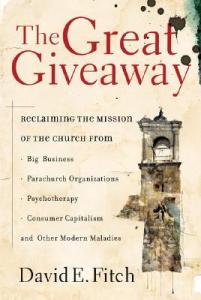
There’s a really interesting post here from Dave Fitch, entitled “Stuck between Mohler and McLaren.”   By coincidence I was reading through his chapter on “Leadership” in The Great Giveaway yesterday, which covers some similiar ground.    At first I thought he was referencing Johann Adam Möhler, and I was really intrigued…but it’s Al Mohler (less interesting to me personally, but much more representative of the contemporary church!).

The thesis in this chapter of The Great Giveaway is that the contemporary pastorate has capitulated to models of leadership found in the business world, which are fundamentally oriented toward “effectiveness” in getting results, rather than on faithfulness to Jesus Christ.  This leads to conflict resolution strategies that are high handed and autocratic.  The pastor needs to decide on a solution in order for the ministry to maintain its effectiveness (which usually means numerical growth).   If people don’t get on board, they are standing in the way of the “success” of the ministry.

I’m really connecting with what Fitch has to say, as it sums up and connects some ideas that have been rolling around in my head for some time.   Most books on Christian leadership are simply parroting the latest trendy ideas from the world of management.   What’s worse is that they throw in the odd scripture verse and “spiritualize” the ideas they’re selling, which means that the pastors who buy this stuff are taking that back to their churches believing that they’ve got divine authority on their side as they try to implement these so-called “biblical” strategies.   Not that insights from the business world have absolutely no value.  They might be helpful as tools to aid in Church leadership, if used selectively within a larger biblical and theological framework.  But they should not have the defining role that they have in the contemporary evangelical world.  So whether it’s “mission statements,” “visioning,” “strategic planning,” or more recently, “branding,” churches are embracing contemporary management techniques wholeheartedly as if they were gospel truth.   People who don’t get on board then are “problems” to be managed (at best), or (at worst) hinderances to the Spirit.   If it seems like I’m exaggerating here, I’m not.  I know a person who was told that their practical questions about church finance were “of the devil.” 

For all the diversity of contemporary Canadian society, it seems like we’re getting worse at handling conflict in our churches.  Everywhere you look there is  a local congregation that is being torn apart by some scandal or another.   Perhaps it is (as Fitch suggests in his book) connected to the individualistic outlook  of modernity, which encourages each one of us to think that we are completely autonomous centres of decision-making power, and that each one of us must arbitrate for ourselves between competing truth claims.   The locus of authority, for modernity, is the reasoning self, and the presumption is that “reason” will lead us to the truth through the exercise of our intellectual faculties.  Of course this is a bit of a charicature, but it pretty much sums up the way it works on a practical level.  And perhaps that has something to do with the interminable splintering of denominations and congregations in modern protestantism.   If we all believe that we ourselves are the final arbiters of truth in matters of dispute, then why would we back down when faced with an opposing view?

The question is whether postmodern understandings of self, truth, and knowledge move us any closer to a more healthy resolution of these problems.   It would seem that postmodern sensibilities are helpful in de-bunking the conflict-ridden assumptions of modernist epistemology, but not as helpful in offering constructive solutions.   No one person can claim a certain enough hold on truth to impose it upon an entire community.  So people of my generation are less likely to get hot under the collar about a dispute within our local church, thinking that we’re the ones who’ve got the “true” answer.  But then again, we might just stop caring at all, and become apathetic in the face of conflict, as it would seem as if no final resolution is possible.  What is needed is a normative standard to replace the reasoning autonomous self.  The standard may not be “universal” in the way that some moderns claimed “reason” was universal, but it can nevertheless be authoritative within the community for whom it is adopted.  

What I like about Fitch’s approach is that he always finds his way back to biblical depictions of church life as the normative standard.   So in the post referenced above, the answer to conflict in the Church is based on Matthew 18.   What is shocking about this model is that so few churches actually try to live this out.  We turn instead to the world of management theory and dress it up in spiritual language as if that were the “biblical” way of being Church.  Why is this?  Has the model that Fitch upholds been tried and found wanting?  Not in my experience.  More likely it is the fact that is just plain messy and “inefficient,” and therefore doesn’t fit with the corporate approach to leadership that we’ve embraced.

The longest church name in the history of the world

This is a church that has a storefront in our neighbourhood.  The St. Francis National Evangelical Spiritual Baptist Faith Archdiocese of Canada.   Personally I like the acronym printed on the window below, the “St. Francis N.E.S.B.F.  Archdiocese of Canada.”

It makes you wonder about this history of this group.  How on earth did they come up with that name?   At first glance it seems like they’d have something to appeal to just about every kind of Christian.

  • St. Francis – well he appeals to everyone, but especially to Catholics
  • National – that appeals to established Church types
  • Evangelical – obviously appeals to…
  • Spiritual – maybe the charismatics?
  • Baptist – of course…

Some of these things don’t normally go together, notably “St. Francis” and “Baptist,” which makes it all the more interesting.   I found a website for the church, which explains that they are a group from Trinidad.  They seem charismatic – they are also called “shouters,” and the have three hour worship services – and they mix elements of Protestant Christianity with African religion.   It’s not clear from their site exactly what that looks like.   They themselves aren’t exactly clear on their origins.

What is interesting to me about this group is that they are charismatic, but they don’t seem to downplay the significance of ritual and symbol in their faith.   Actually their website lists candles, bells, swords, flags, uniforms and a whole host of other items as significant in their worship.    Most charismatically-oriented protestants (we could expand that to include most evangelicals) are wary of any kind of ritual.  They’ve got some obviously “catholic” elements in their worship (one page on the website has prayers of the saints), but they speak in tongues and have street preaching missions.

Then again, if you know the story of St. Francis and the mendicant friars, you’ll know that these things are not so distinct from one another after all.  Francis was the ultimate charismatic.  He was also completely committed to the Catholic faith, and to the task of preaching the gospel.   Maybe the St. Francis N.E.S.B.F people are on to something.  It’s the history of division in the Church since the Reformation that has caused us to see the various terms that go into their name as being at odds with one another.   The names that we have given to our denominations are there precisely to distinguish us from the other denominations and traditions.   Our particular denominational identities then become filters for the discernment of what is good, acceptable, and true.   For example, in my tradition, if someone says something is “Wesleyan” that automatically makes it acceptable, but if it’s “Calvinist” people assume it is wrong, without even really thinking about it.  Although strong denominational identities are fading fast, most of us have been formed in communities that make these kind of distinctions all the time. “St. Francis” and “Evanglical” seem an odd pairing to a contemporary evangelical, because St. Francis is seen as a Catholic figure. But actually Francis lived during what is rightly called an “evangelical revival,” a real flowering of the gospel, which included radical forms of discipleship, self-denial, and evangelistic preaching missions.   I really don’t know much about the St. Francis N.E.S.B.F., so I wouldn’t want to hold them up as a model of anythying, but maybe the fact that they seem to have developed in obscurity has allowed them to hold these things together without worrying that they were crossing traditional boundaries.