Sixth Annual Wesley Studies Symposium at Tyndale Seminary

Registration is now open for Tyndale’s annual Wesley Studies Symposium, taking place on March 25 at Tyndale’s new Bayview Campus.

haykin_lg_sqThis year, in honour of the 300th anniversary of George Whitefield’s birth, we’ll be welcoming Dr. Michael Haykin as our keynote speaker.  I am very pleased that this distinguished Baptist historian has agreed to come and make a presentation to our symposium. His talk is titled, ““The Revived Puritan”: The Life and Piety of George Whitefield.”

Here is a bit more from our event page:

2014 marks the 300th anniversary of the birth George Whitefield, friend, partner-in-ministry, and sometimes theological enemy of John Wesley. Because the lives of these two men are so intricately intertwined with one another, we are going to feature a paper on Whitefield as our keynote address at the Wesley Symposium.

Dr. Michael Haykin is a leading Baptist historian, who has published on a wide variety of topics, from the Church Fathers to Jonathan Edwards. He studied at the University of Toronto, where he earned a BA at Victoria College, and an MRel and ThD in church history from Wycliffe College. In addition to his position at Southern Seminary he is Director of the Andrew Fuller Centre for Baptist Studies, and an Adjunct Professor at the Toronto Baptist Seminary, where he previously served as President. His many books include Jonathan Edwards: The Holy Spirit in Revival (Evangelical Press, 2005); The God who draws near: An introduction to biblical spirituality (Evangelical Press, 2007); and Rediscovering the Church Fathers: Who They Were and How They Shaped the Church (Crossway, 2011).

bayview-campus-frontOther speakers for this year’s event include Dr. Claire MacMillan (National Director, Church of the Nazarene, Canada) Rev. Leonard Chester (Archivist of the Brethren in Christ Church, Canada), Rev. Dan Sheffield (Director of Global and Intercultural Ministries, Free Methodist Church in Canada), Rev. Michael Tapper (PhD Candidate, St. Paul University), Rebecca Nicol (PhD Candidate, McMaster Divinity College), and Rev. Dale Harris (Pastor, The Freeway Free Methodist Church, Oshawa).  You can find more information about the paper topics here.  We will also have a book panel on Lift Up a Standard: The Life and Legacy of Ralph Horner, including presentations from myself and Dr. James Robertson, and responses from authors Rev. Laurence Croswell and Mark Croswell.

Visit this page to find more information and to register.

Theological Signs of the Times: Catholic – Evangelical Convergence?

789488I was privileged to receive my PhD this past Saturday at St Basil’s Church on the campus of St. Michael’s College here in Toronto.   After six years of hard work, and numerous hurdles to clear, it was nice to have that final piece of the puzzle and say that I am truly finished.

Honourary doctorates were given to two fine Catholic scholars, Father James K. McConica, CSB, and Father Robert M. Doran, SJ.   Doran, currently at Marquette and a former member of the faculty at Regis College, gave the address.  He focused on what he called “theological signs of the times” for Catholic theology in the 21st Century.   As he spoke I was struck at how two of the three major tasks he identified for Catholic theology could just as easily be said to be major tasks for evangelical theology at the present time.

The first point he raised was more specifically Catholic, and focused on the integration of major theological insights from the second half of the 20th century.  He focused on the work of Hans Urs von Balthasar, Bernard Lonergan, and Gustavo Gutiérrez:

“How does our discipline integrate Balthasar’s restoration of beauty as a transcendental and as the way in which the truth and goodness of God are disclosed to us, with Lonergan’s openness to modern science, modern critical-historical scholarship, modern philosophy, and the post-modern welcome of the religious “other”? That in itself is a tall order. But then there is the further and larger task of implementing that integrated intellectual vision in the service of the Church’s preferential option for the poor.”

While “integration” is an ongoing concern in evangelical theology (integrating theology and practice), clearly the kind of integration he is talking about here is more specific to Catholics, and involves a concern to bring integrate these important insights into the magisterial teaching of the chruch.

His second point, however, is one that remains a major issue in Western theology in general: the theology of the Holy Spirit:

“The need for a developed pneumatology is present already in the insistence of Vatican II and of Pope John Paul II that the gift of the Holy Spirit is present and active beyond the explicit boundaries of Christian belief. Those affirmations of the Council and of the Pope are doctrinal statements. Theology has yet to explain how this can be and to unravel the implications of these statements for the whole of Christian comportment in the contemporary world…”

St._Basil's_Church via wikimediaEvangelicals have likewise neglected the theology of the Spirit, and yet the increasing importance of the Pentecostal and Charismatic traditions in global Christianity is forcing all of us to give more attention to pneumatology.  Doran’s particular concern seems to be bringing pneumatology to bear on Catholicism’s inclusive understanding of the way in which the Spirit is at work in those who are not Christians.   As a Wesleyan, I immediately thought of the category of prevenient grace as my own tradition’s approach to this issue.  In Wesleyan thinking, God’s grace is basically understood as the loving presence of the Spirit.  Prevenient grace is our term for the grace of God which “goes before” and precedes personal faith.  Prevenient grace, we believe, is at work in all people, drawing them to Christ.  Wesleyans, therefore, certainly have a category for thinking along these lines.  However, much work remains to be done, especially in making the connections between prevenient grace and the  presence of the Holy Spirit more explicit.

Doran’s final point is one which has become almost a fixation for many evangelical theologians today:

“There is need…for our theology to become a theology of mission, and especially a theology of missio Dei, of divine mission as grounding all ecclesial mission. The mission of the Church participates in and carries forward the missions of the Holy Spirit and the Son. Every theological topic – God, Trinity, the Holy Spirit, the Incarnation, grace, revelation, creation, anthropology, original sin, personal and social sin, redemption, sacraments, church, social grace, praxis, resurrection, eternal life – has to be integrated into a theology of divine mission and of ecclesial mission as a participant in the missions of the Holy Spirit and of the Son.”

07_063161At Tyndale Seminary we have quite explicitly been attempting to do this very thing: to place the entire project of theological education in a missional framework.  We still have a long way to go – at least I know I do!  But Doran’s statement above could be taken up by our theology department with very little alteration as a statement of our current agenda.

Of course all of this needs a lot of unpacking, but I mention these broad themes because I was quite encouraged by Doran’s talk.  I strongly identified with his concerns and the challenges he believes Catholic theology is facing, and sense that many evangelicals are attempting to face the same issues, in our own way.  If these are indeed “signs of the times,” then they may be signs of what God is doing across the Evangelical-Catholic divide.

You can read Doran’s address here.

John Wesley on Animal Salvation

I must apologize for the lack of recent activity on this blog.  I’ve been quite busy writing lectures for two new courses this fall, as well as preparing a paper for the recent “New Creation” conference, jointly sponsored by Northeastern Seminary and the Canadian Evangelical Theological Association.

This post is adapted from one section of my paper at that conference, which focused on John Wesley’s mature theology of “new creation” – a central strand in his later thought, which brought together the personal, social, and cosmic dimensions of salvation.

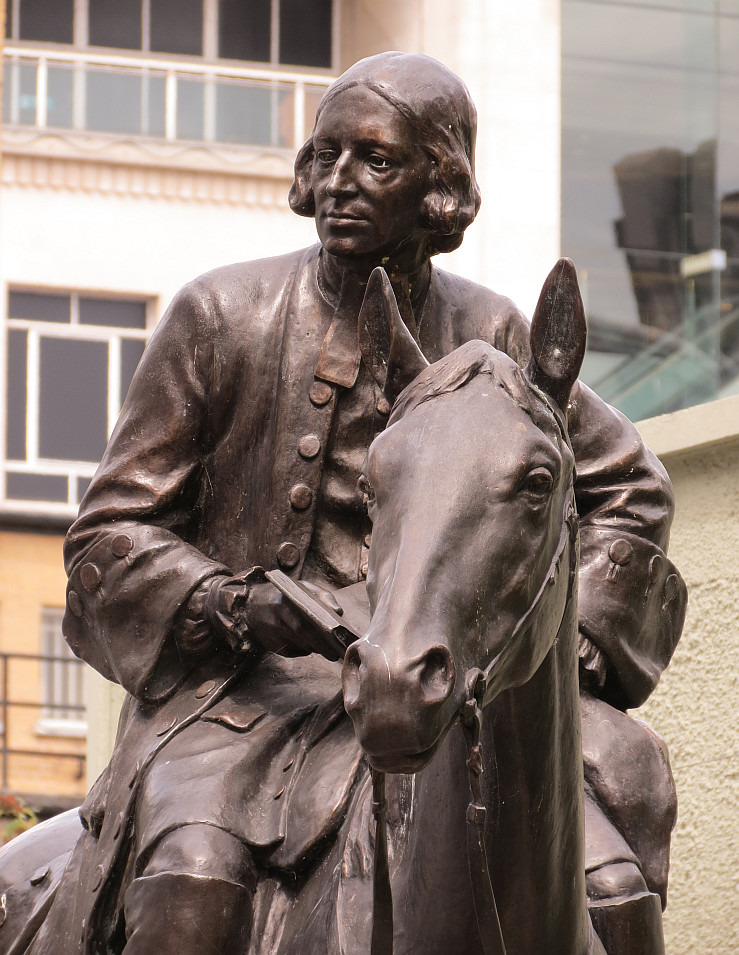
Wesley Statue at the New Room Bristol via Bob SpeelJohn Wesley had a lifelong interest in animal life, and it is well-known that he was an advocate for the protection of animals against abuse from humans.   But in the final decade of his life, the issue of animal suffering came increasingly into his view as a theological problem, and formed an integral part of his mature theology of the new creation.

Thus he begins his remarkable sermon “The General Deliverance,” written in 1782, with a quotation from Psalm 145:9 in the Book of Common Prayer: “his mercy is over all his works.”  Yet, Wesley asks,

“If the Creator and Father of every living thing is rich in mercy towards all; if he does not overlook or despise any of the works of his own hands, if he desires even the meanest of them to be happy according to their degree –how comes it to pass that such a complication of evils oppresses, yea, overwhelms them?” (Sermon 60, “The General Deliverance,” §1-2)

He answers the question by arguing that all animal suffering, including that which various species currently inflict upon one another to ensure their own survival, is the result of the fall.  Thus, before the fall, animal creation was “happy” and enjoyed a kind of “perfection” according to their kind, which was seen in their loving obedience to humanity, who as God’s vice-regents, were God’s appointed conveyors of blessings to all other creatures.  The obedience of animals to humanity, therefore, could be seen as bearing “some shadowy resemblance of even moral goodness” (§I.5.). In short, animals in the original creation were, Wesley suggests, at peace with humanity and with one another.

Yet, as a result of the fall, humanity’s relationship to God was disrupted, and therefore the blessings of God no longer flow through human stewardship to God’s creatures (§II.1).  After the fall, then, animals came to be at war with one another. It is because of sin that “an immense majority of creatures, perhaps a million to one, can no otherwise preserve their own lives, than by destroying their fellow-creatures!” (§II.3)  Moreover, humanity’s loving and kind stewardship of animal creation has been turned into an exploitative domination, and humanity has become such an enemy of animals that his cruelty surpasses that of a shark hunting its prey (§II.6). Wesley is unwilling to grant that such animosity and brutality is part of God’s original design for his creatures.

Peacable Kingdom by Edward Hicks via wikimedia commonsWhy would God allow animals to be subject to such vanities?  Surely, he reasons, God will one day restore animal creation to a state which is superior to that of the original creation. As they have been subjected to a degree of the corruption brought on by the fall, so also will they be liberated to experience “a measure of “the glorious liberty of the children of God”” in the new creation (§III.1).  This will entail a greater strength, swiftness, and understanding than each creature in its kind has possessed in the original creation, and, like human creatures, they “will be delivered from all irregular appetites, from all unruly passions, from every disposition that is either evil in itself, or has any tendency to evil” (§III.3). Therefore, as they had originally been able to evidence “a shadowy resemblance of even moral goodness” (§I.5), so in the new creation, “No rage will be found in any creature, no fierceness, no cruelty, or thirst for blood” (§III.3).

Working on the assumption of creation as a “great chain of being,” with humanity occupying a higher place in the chain, and creatures proceeding downwards in accordance with their likeness to the creator, Wesley speculates that all creatures might “move up” one level in the chain, and that some animals might therefore even join humanity in becoming “capable of God.”

“May I be permitted to mention here a conjecture concerning the brute creation What, if it should then please the all-wise, the all-gracious Creator to raise them higher in the scale of beings? What, if it should please him, when he makes us “equal to angels,” to make them what we are now, — creatures capable of God; capable of knowing and loving and enjoying the Author of their being? If it should be so, ought our eye to be evil because he is good?  However this be, he will certainly do what will be most for his own glory” (§III.6).

Lest we think this was a one-time indulgence on Wesley’s part, he ventures the same speculation in his 1785 sermon “The New Creation” (§17).

As I said, these reflections on the place of non-human creatures in God’s plan of redemption are one important aspect of Wesley’s late thinking about the “new creation.”  Some of these ideas might seem strange at first, but in fact they cohere well with Wesley’s overall concern to defend the character of God as just, merciful and loving.  In that sense, we can see deep connections here between how he resolves the issue of animal suffering and his rejection of the Calvinist understanding of predestination: both are rooted in his understanding of the character of God (see my earlier posts about predestination and the character of God here and here).

The Wesleyan Tradition’s Eastern Ontario Roots

I grew up north of Kingston, near the village of Sunbury, and I was raised in a church that is part of the Wesleyan family of denominations – The Salvation Army.  Most of my life, however, I had no idea that there was any significant connection between my geographical roots and my ecclesial roots.  As I’ve gone on to study Wesleyan history and theology, however, I’ve come to see that the historical roots of Wesleyan Christianity in Eastern Ontario are very deep indeed.

This has come home to me in a number of ways in recent months.

This summer, Tyndale Seminary received a generous bequest from Rev. Bill Lamb, who passed away in June.  Bill was a United Church minister and a historian of Canadian Methodism.  He left an amazing collection of historical literature to Tyndale’s library, and I was able to go to his home and help our head librarian, Hugh Rendle, sort through the materials.  Because the earliest Methodist churches in Canada were established in Eastern Ontario, Bill was also a student of Eastern Ontario history.

in 1925 the main Methodist body in Canada united with many Presbyterians and the Congregationalists to form the United Church of Canada – and that means that many of the United Church congregations that pre-date 1925 were in fact Methodist congregations.  Bill had written books on the history of two such congregations – Bridge Street Church in Belleville (Bridging the Years), and Wall Street Church in Brockville (The Meaning of the Stones).  He’d also written a book on the Old Hay Bay Church (The Founders), the first Methodist Church building in Canada, which still stands as a National Historic Site.  At the time of his death, he was working on books on two of the most important figures in Canadian Methodist history, William Case and William Losee.  Therefore he had amassed a very significant body of literature and archival material on Methodism’s spread in Eastern Ontario.

The fact that most Methodists joined the United Church in 1925 means that much of this Methodist history is not immediately apparent to a casual observer today.  People do not realize, for example, that churches like Bridge Street Church in Belleville, Wall Street Church in Brockville, and Sydenham Street Church  in Kingston are monuments to Methodist history.  All Belleville residents are familiar with Albert College and its beautiful campus, but most have no idea that this private school began as Belleville Seminary – a Methodist theological college.

Albert College interior by tjchampagne via flickr

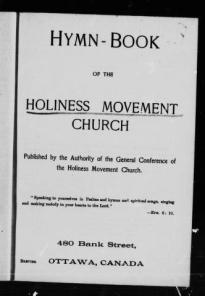
But it is not only the mainline Methodist tradition that has strong Eastern Ontario roots.  The late nineteenth century holiness movement also had a significant impact on this part of Canada, especially in the legacy of Ralph Horner, whose biography I read and blogged about earlier this year.  Horner was from the Ottawa Valley, and had a ministry as an evangelist which centred around Eastern Ontario.   Originally serving with the Methodist Church of Canada, Horner eventually went on to found two holiness denominations: the Holiness Movement Church and the Standard Church of America.  Many of the churches that emerged out of the Hornerite revival in Eastern Ontario are still around today, although these two denominations also merged with others (HMC joined the Free Methodist Church in 1958 and the SCA merged with the Wesleyan Church in 2003).

Holiness Movement Church Hymnal via internet archiveIn addition to the fact that the Holiness churches have historically had a significant concentration of their congregations in Eastern Ontario cities and towns, there is also a rich history of revivals through camp meetings in rural locations.  Almost every little village was impacted.   Even Sunbury, where I grew up, had a Salvation Army corps at one time, and the Hornerite movement impacted nearby Inverary.   In Hastings County today, Ivanhoe may be known today as a place with a cheese factory along Hwy 62, but a century ago it was known as one of the most important holiness revival sites in Canada.  It was at the Ivanhoe camp meeting that Ralph Horner died in 1921, not long after preaching his last sermon.

The surprising thing for me has been the way that my life has now come full circle.  As a professor Wesley Studies at Canada’s largest seminary, my teaching and research interests now coincide with my personal history in a way I never thought they would.   The connection between between my geographical roots and my ecclesial roots, of which I was unaware for most of my life, now seems to have been established by providential design.

Highlights from Len Sweet’s talks at the Wesley Ministry Conference

Len Sweet speaking at TyndaleThis year’s Wesley Ministry Conference at Tyndale was a great success.   Over 180 people from various Wesleyan denominations gathered to hear Leonard Sweet speak, and to take in a workshop on discipleship from Matt Eckert and Luc and Rosetta Del Monte.  It was a very engaging and thought-provoking day.

When Howard Snyder heard that Len Sweet was coming to the conference, he commented that Sweet could give you enough ideas in five minutes to keep you thinking for five days.  It’s been a week since the conference, and I think Howard was right.

While I wouldn’t attempt to give a total summary of all Len Sweet said last Monday, here are three of the big themes from his talks that have stuck with me:

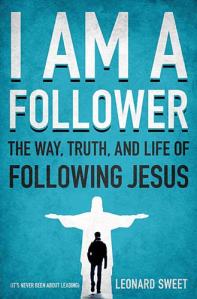
1. Leadership as a function vs leadership as an identity.  He began in the morning by addressing this topic, and lamented that in the past few years, the church has turned “leadership” into an identity, when it should really only be conceived as a function which people exercise at various times.  Our identity, rather, is as followers, not leaders; we are disciples first and foremost, but at times some of us have to provide a leadership function.  He asked the pointed question, “How many followership conferences have you been to in the past five years?”  Churches have spent a lot of time and energy trying to take on ideas and practices from the business world, often without reflecting theologically on how these ideas square with Christian discipleship.  This is something I’ve been concerned about for some time (I wrote about it three years ago), so I was glad to hear him address it on Monday (if you are interested in this issue check out his book I Am A Follower).

Sweet I am a Follower2. Mission stories vs mission statements.  Connected with the above point, Sweet addressed the issue of “mission statements,” one of the business practices that the church has taken up in recent decades.  He suggested that the church already has a mission statement – the great commission – but that we make up our own mission statements because we don’t like the one we’ve been given!   More importantly, Sweet was reflecting on how contemporary culture doesn’t connect well with truths communicated via “statements.”  This is familiar territory for students of post-modern culture – the idea that in contemporary Western culture, truth is most readily accepted as embodied in narrative and metaphor (or “narraphor” as Sweet stated it), rather than in propositional statements.  Sweet took this larger cultural trend and applied it to the church’s mission: it ought not to be articulated in a statement; rather, we need the story of the gospel to shape our mission in a compelling way.  He made a similar point in relation to preaching, saying that “points” don’t communicate to a “Google culture,” though they connected well in the “Gutenberg culture.”

3. Dirty hands and a clean heart.  Sweet then exemplified the ideas he’d been sharing by offering a “narraphor of holiness.”  Beginning with the incarnation as the revelation of God’s holiness, he focused in particular on foot-washing as an example of God “getting his hands dirty” in the world. Against our tendencies to view holiness as a kind of purity that remains separate from the world, Sweet stressed that true Christian holiness is normed by the story of God’s self-giving in the incarnation.  Thus, dirty hands are the evidence of a clean heart.

I’m really glad we had a chance to host Len Sweet here at Tyndale – he definitely gave us lots to think about.  You can read another report on the day on the Tyndale website.

Mainz altar painting via wikimedia commons

Great Resources from Asbury’s Seedbed

Just a quick post today to point you towards the great resources that are being produced by Seedbed, a site that Asbury Theological Seminary has set up.  Seedbed features blog posts and videos of Asbury faculty discussing a variety of topics relevant to ministry and theology – and doing so in a way that is accessible to a general church audience.  Former Tyndale professor Howard Snyder is one of the featured bloggers, and in posts like this one, he continues to challenge evangelicals to take creation stewardship seriously as an integral aspect of Christian mission.

One of the best features of Seedbed is their video series, “Seven Minute Seminary,” which features Asbury scholars giving concise but substantial talks.  This week Ben Witherington III discusses why he is a Wesleyan.

It’s great to see Asbury producing these excellent teaching materials.  I’d say seedbed is a wonderful example of a seminary trying to bridge the church/academia divide.  I hope other schools follow suit.

Mystical and Missional: Elaine Heath on Phoebe Palmer

Heath Naked Faith the Mystical Theology of Phoebe PalmerI’ve thoroughly enjoyed reading Elaine Heath’s Naked Faith: the Mystical Theology of Phoebe Palmer (Eugene OR: Pickwick, 2009).  Palmer had a massive influence in Wesleyan circles and beyond in the nineteenth century, but, as Heath notes, she has been largely forgotten or marginalized – even within her own tradition.   She certainly hasn’t been taken seriously as a theologian, though Thomas Oden sounded an enthusiastic call for the retrieval of her voice in his introduction to the collection of her writings he edited for publication (Phoebe Palmer: Selected Writings (New York: Paulist, 1988)).  John Farina, general editor of the series “Sources of American Spirituality,” of which the Oden volume was a part, briefly located Palmer in “that great mystical stream that runs like a golden river down through the ages” in his general introduction to the book, noting especially the interest in Catherine of Genoa in Palmer’s circles.  Heath has taken up this idea and written a book that attempts to both offer an interpretation of Palmer’s thought as an expression of mystical theology, and to hold out “Saint Phoebe” as a guide for the renewal of contemporary Methodism.

Palmer, for her part, would have resisted the “mystical” label, but Heath shows, through a discussion of the mystical tradition, that Palmer’s resistance was really to the antinomian perversions of the mystical tradition which she encountered (35ff).  Heath identifies mysticism as “the radically transformative experience of the Divine that is described by the great Christian mystics and saints throughout the ages” (41).  She also notes that genuine Christian mysticism will be Trinitarian, ecclesial, and transformational (42).

While a great deal could be said about the reception of mysticism in Protestant circles, and the degree to which John Wesley himself embraced some aspects of mystical theology at various points in his life (Heath deals with these issues), I was particularly taken by the way in which she connected mysticism with Christian mission.

Phoebe PalmerFor Palmer, the primary way this was expressed was in her own calling to a ministry of preaching and teaching, which followed immediately upon her “day of days” experience of sanctification.  Her profound mystical experience, then, became the source of an unprecedented (for a woman) ministry which had massive influence on the history of the Methodist, Holiness, and Pentecostal traditions.  Even those experiences of “union” with God that make some Protestants nervous, Heath contends, impel the mystic to service, rather than retreat from the world (as many suppose):

“The fruit of unitive experiences is a powerful desire in the mystic to help all people experience salvation and sanctification.  This desire partly originates in visions of the mysic being made one with the Trinity, whose goal in the church is to seek and to save the lost. Thus the life of the mystic increasingly becomes one of humble service in the world” (59).

Heath also carefully distinguishes problematic mystical “Quietism” from a healthy sense of “quiet,” an active passivity that bears fruit in missional activity:

“The result of true mystical passivity is an increase of strength and spiritual energy, an increase of love for God and neighbour so that the individual is increasingly alive to God in the community and world as the process of passivity progresses” (75).

Interestingly, in some other reading I recently found Henri Nouwen making a similar claim: “Mysticism is the opposite of withdrawal from the world. Intimate union with God leads to the most creative involvement in the contemporary world” (The Genesee Diary155).

Heath’s work seems to break new ground on several fronts: a sustained interpretation of Palmer as a mystical theologian, a retrieval of her theology by distinguishing it from the ways in which it was distorted by her later followers, and a contribution to research into the mystical aspect of Wesleyan spirituality – and I could go on.

Phoebe Palmer via cyberhymnalI think it is particularly important as a contribution to contemporary discussions of the “missional” character of the church.  I’ve sometimes worried in the past that some strands of missional thinking are anti-ecclesial, and create a false dichotomy between the church’s inner life (thinking here in terms of spirituality) and its mission.  In other words, the church is not only sent into the world, but also gathered together, and it is in the gathering that we are centred on the particular identity of the God of the gospel, who then sends us out.   Heath’s work on mysticism and mission helps to bridge this perceived gap between “inner” life its fruit in “outward” activity.  There is a strong connection between the arguments in this book and the account of the new monasticism in Longing for Spring, which Heath co-wrote with Scott Kisker (see my review here).  I still need to do some further reading of my own on mystical spirituality, as it is not an area with which I’m familiar, but my initial reaction to Heath’s work on Palmer is to give it a hearty endorsement.   Next on my list is her 2008 book, The Mystic Way of Evangelism.

Nouwen: happy are those who carry the Psalms in their hearts

Giovannino de Grassi Psalm 118 (119), Biblioteca Nazionale Florence via wikimedia commonsSince my time in seminary I have been praying the Psalms according to the two month plan offered in the  Book of Common Prayer.    The Psalms, of course, have served as perhaps the greatest source of wisdom and guidance in the history of Christian worship and spirituality.  They are indeed “the prayer book of the Bible”  (Bonhoeffer), and can give voice to our own prayers in an amazing variety of circumstances.

As time goes by, I find myself less inclined to attempt to compose my own prayers.  I would much rather submit myself to these rich forms of prayer that have nourished and inspired my brothers and sisters down through the centuries.      

I think those of us who find ourselves in “free” worship traditions tend to think of extemporaneous prayer as superior, because we assume it to be more authentic and sincere than the offering of prayers that have been written by another.  But this presupposes that prayer is, first and foremost, an expressive practice – a form of speech through which we pour out our self before God.  While it is certainly true that prayer has this expressive dimension, it is also a formative practice.  The prayers that we utter and hear on the lips of others are  shaping our understanding of God, his Church, ourselves, and the world around us.  The sincerity of a spontaneous prayer is important, but so is the depth and thoughtfulness of a written prayer – and no prayers have greater depth than the prayers of the Psalms.

This morning I was reading a bit of Henri Nouwen’s Genesee Diary, and came across these thoughts on how the recitation of Psalms during Compline brought him strength and comfort.  Commenting on Psalm 90, he writes:

Slowly these words enter into the center of my heart. They are more than ideas, images, comparisons: They become a real presence.  After a day with much work or with many tensions, you feel that you can let go in safety and realize how good it is to dwell in the shelter of the Most High.

Nouwen Genesee DiaryMany times I have thought: If I am ever sent to prison, if I am ever subjected to hunger, pain, torture, or humiliation, I hope and pray that they let me keep the Psalms.  The Psalms will keep my spirit alive, the Psalms will allow me to comfort others, the psalms will prove the most powerful, yes, the most revolutionary weapon against the oppressor and torturer.  How happy are those who no longer need books but carry the Psalms in their heart wherever they are and wherever they go.   Maybe I should start learning the Psalms by heart so that nobody can take them away from me.  Just to be able to say over and over again:

O men, how long will your hearts be closed,
will you love what is futile and false?
It is the Lord who grants favors to those whom he loves;
the Lord hears me whenever I call him (Ps. 4)
 

That is a prayer that really can heal many wounds.

Like Nouwen, I hope that as I absorb the prayers of the Psalms on a daily basis, they will sink in to my bones, and lodge themselves in my heart, so that they provide me strength and nourishment during the trials that surely lie ahead.

A Moving Service in the Chapel at Morrow Park

On Monday, February 11, the Sisters of St. Joseph invited the Tyndale community to join them in the chapel at Morrow Park for a symbolic “passing of the keys” service.  Tyndale is set to officially receive the keys to the Morrow Park campus on April 1, but the Sisters wanted to set aside some time for the two communities to worship together, share a bit of the respective histories, and bless one another in future endeavours.

Morrow Park is a really special property, and the chapel is truly stunning.

The service was a great idea, and I think it shows how much the sisters care about Morrow Park – and about its future use.  For them, this beautiful place is not just a building, but a home and a place of spiritual nurture and refreshment.   I really got the sense that, although they are definitely sad to be leaving, the Sisters feel a certain comfort in knowing that their former home is going to continue to be used as a centre for teaching and equipping servants for the church.

After an opening hymn and a  welcome from Sr Thérèse Meunier, Sr Margaret Myatt and Prof Donald Goertz shared a bit about the histories of each community.  The sisters have given themselves over to the service of God and their neighbours in an amazing variety of ways over the decades, and a quick glance at their website today will tell you that they continue to be active in the Toronto area in education, social services, and the arts, among other things.

After intercessory prayer by Sr Sue Mosteller and Regine Leugn, each community presented the other with a gift – a board from the Sisters that recounts some of their history, and an original piece of art from Tyndale.

Then came the most memorable part of the service.  All of the sisters present for the service stood in their places and sang a blessing to the Tyndale community, raising their hands towards us.  The words were:

May the blessing of the Lord be upon you
We bless you in the name of the Lord
May the blessing of the Lord be upon you
We bless you in the name of the Lord

After that, a small group from Tyndale sang this blessing, based on the priestly blessing in Numbers 6. All of us stood in our place and raised our hands towards the Sisters, scattered throughout the chapel.

The Lord bless you and keep you
The Lord make His face shine upon you
And give you peace forever
The Lord be gracious to you
The Lord turn His face towards you
And give you peace forever

I noticed several Sisters wiping tears from their eyes during this song, and in that moment I really felt for them.  It must be rather difficult for them to leave this place behind after 52 years.

Following the service we were all invited to the dining hall for refreshments, and it gave us a chance to talk with some of the Sisters.  They are moving to a new home at Broadview and O’Connor, not too far from where I live now.

At the end of the day, I was struck by the way in which the Sisters are approaching the transition: thoughtfully, reflectively, and prayerfully.  This is clearly more than a real estate transaction for them.  I am thankful for their generous spirit and their willingness to strengthen the connections between their community and ours.

You can see Tyndale’s official write-up about the service here.

Wesley Ministry Conference with Leonard Sweet: Rediscovering Transformational Discipleship, April 29

Ministry Conference posterLast week I posted about Tyndale’s upcoming Wesley Studies Symposium.   The Wesley Studies Committee has also been hard at work planning an event aimed at a broader audience of church leaders.  This will be the second time they have hosted a “Wesley Ministry Conference,” the first one featuring  Timothy Tennent in 2009.

This year’s ministry conference will take place on Monday April 29 here at Tyndale, and features prominent author Leonard Sweet.  Sweet is currently the E. Stanley Jones Professor of Evangelism at Drew University, in Madison, NJ, and is known as a creative thinker and exceptional communicator.  The theme for the day is “Rediscovering Transformational Discipleship,” and it will also feature workshop style presentations from some experienced practitioners: Matt Eckert, and Luc and Rosetta Del Monte.

The cost is $45, and registration is available here.

Please spread the word about this important event – we are blessed to have secured Leonard Sweet as our speaker, and I’m sure it will be a fruitful day of engagement with the challenges of discipleship in today’s context.

The night before the conference, a public worship service dubbed “An Evening in the Spirit of Wesley” will be taking place at Timothy Eaton Memorial Church in Toronto (7PM).   This service will also feature Leonard Sweet, along with The Salvation Army North York Temple Band and organist Rachel Mahon.

Hopefully many of you will be able to make one or both of these events!