Fifth Annual Wesley Studies Symposium at Tyndale Seminary

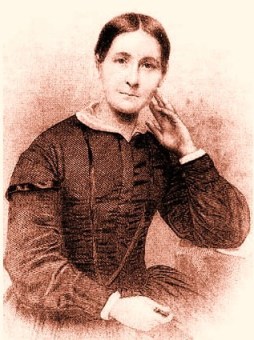
Richard Watson via wikimedia commonsOnce again this year Tyndale Seminary is hosting a Wesley Studies Symposium.   This symposium aims not only to promote Wesleyan scholarship in the Canadian context, but also to help build a network of people interested in Wesleyan theology and history.

Although this is an academic event, we purposely blur the lines a bit between scholarship and ministry, in part because it is thoroughly Wesleyan to integrate theology and practice.  So we typically have a nice mix of academics, graduate students, and practitioners in attendance.

The Symposium is scheduled for Tuesday March 12, and we have another interesting lineup of papers covering a range of topics and disciplines.   The papers to be presented this year are:

  • “Rediscovering Discipleship as a Pathway to Ekklesial Reformation – Wesley did!!” by Cliff Fletcher (Pastor, Whitby FMC / DMin graduate, Gordon-Conwell).
  • “The Importance of Richard Watson’s Theological Institutes for Methodist History,” by Barry Hamilton (Northeastern Seminary).
  • “Leading with the Ear: The Church as a Listening Community,” by Aaron Perry (Pastor, Centennial Road Standard Church / PhD Candidate, Regent University).
  • “The Character of God Revealed by The Incarnate Word in the Theology of John Wesley,” by Niven Harrichand (ThM graduate, Tyndale).
  • A Book Panel on Witnesses of Perfect Love: Narratives of Christian Perfection in Early Methodism, by Amy Caswell [Panelists TBA]

After dinner we will have a guest lecture by Donald E. Burke (President, Booth University College, Winnipeg) on “Salvation for Both Worlds: Contours of a Wesleyan/Biblical Social Theology.”

Registration is free, and you can sign up here. Please spread the word about this event among those who might be interested.

Sermon: A Testimony to Hope

Yesterday I was privileged to give this short sermon at the funeral of my Uncle, who died suddenly last week.   He had left some guidance about what he would like for the service, including the scripture readings: Psalm 31:1-5, Matthew 8:5-13, and Revelation 21:3-7.  

In a different setting I would have taken the time to explain that the Isenheim altarpiece I talk about at the beginning was a favourite painting of Karl Barth, and that it was through Barth that I first encountered the long pointing finger of the Baptist – but I didn’t think it was the time or place for a discussion of Barth.

Isenheim altarpiece via ibiblio

In a small museum in Northeastern France, there is a famous sixteenth-century altarpiece, painted by Matthias Grünewald for the Monastery of St. Anthony in Isenheim.  In the centre of this massive work of art is Jesus Christ, hanging on the cross.  On his right, his mother, Mary, collapses into the arms of the beloved disciple, John, overcome by her grief.  At his feet, Mary Magdalene prays fervently, the jar of perfume ready and waiting to anoint her saviour.  But on his left is John the Baptist, standing out of place and out of time.  Of course John the Baptist was not really at the crucifixion, because he had already died, but the artist decided to include John in this scene. So there he stands, barefoot, with his cloak of camel’s hair, and his long beard; in his left hand, he holds an open book; his mouth is closed; but with his right hand he is pointing to Jesus. And in the painting that outstretched right index finger is disproportionately long; so as you look at the scene your eye is drawn to the long finger of the Baptist, pointing to the Christ.

Some have suggested that this image of John the Baptist is a model of Christian witness.  This arresting figure draws our attention only to point away from himself, to Another.  Though John the Baptist was, by all accounts, a very holy man – the greatest of all the prophets – his message was, “He must increase, I must decrease.”  And that is what Christian witness ought to be.  We do not proclaim ourselves.  We do not claim that we are always right; we do not preach that we are always good; we don’t think we have all the answers.  No – we point to Another, we put our trust in Another.

We are gathered here to remember Robert; Bob – Uncle Bob to some of us.  We celebrate his life.  We remember the person he was; we remember his good character; we give thanks for the wonderful things he did, for the times we spent with him, and the way his life intersected with each of our lives. We rightly praise him for a life given in caring and advocating for neglected people.  He spent his days trying to help people that most of us would probably avoid if we ran into them on the street.  The mentally ill might be the most marginalized of all people in our society today.  Helping these often-overlooked people was his life’s work.  There are many things about Bob that we can admire, and that we would do well emulate.

But as we gather to remember and honour Robert today, we also have questions.  Why did this have to happen?  Why now?  He’s gone too soon.  It’s not fair – it’s not right.  The truth is we don’t have a simple answer for those questions.  But as we struggle to come to grips with this sudden loss, Robert has left us with a gift.  It is not an answer to our questions, but he has left us with a testimony to the hope that was in him – the hope that allowed him to say, “It is well with my soul.”  All of the scripture readings and the hymns for today’s service were chosen by Bob himself, because they were particularly important to him. And as we read these scripture passages, and sing these songs, I think we are hearing Uncle Bob’s witness.  He is pointing us beyond himself, to Another.

“In thee, O Lord, do I put my trust,” says Psalm 31, read to us by Nancy; “…deliver me in thy righteousness…thou art my rock…for thy name’s sake lead me, and guide me…into thine hand I commit my spirit.”

This Psalm is about faith and trust. Faith is not some kind of “power” that we have inside of ourselves.  Faith is completely outward-focused; it is fixed on its object; and the value of faith is determined by the object that we put our faith in. If I have faith in something worthless then my faith is worthless.  If I have faith that the Toronto Maple Leafs will win the cup this year, what good is that?  (I’ve used that illustration several times and for some reason it always gets a laugh.)  This faith that the Psalm is talking about is not that kind of wishful thinking, it is a sure trust and confidence in a loving a merciful God – a God to whom you can say, without reserve, “Into thine hand I commit my spirit.”

john the baptist detail isenheim altarpiece via wikipaintings

Rick read to us the second passage that Bob had chosen, about the healing of the Centurion’s servant.  And again, in this story, we see this outward-focused faith.  The centurion says to Jesus, “Lord I am not worthy that thou shouldst come under my roof: but speak the word only, and my servant shall be healed.”   Now, he could have come to Jesus and said, “Jesus, I think you should heal my servant because I’m a pretty good person; I’m kind to others, I give to charity, I’m honest – I think you owe me one.”  Now that it wouldn’t really be faith, because he’d be trusting in himself.  No, he says, “I am not worthy…but speak the word only.” In other words, “I’m not asking for this because I think I deserve it, I’m asking because I know who you are – you are the great physician; you are loving and merciful, and your word is faithful and true; just speak the word.”  And Jesus says, “Now that’s faith.”

And the final passage that Robert selected was about God’s promises for the future.  “Behold, the tabernacle of God is with men…God himself shall be with them…God shall wipe away all tears from their eyes, and there shall be no more death, neither sorrow, nor crying…Behold, I make all things new.”

These are wonderful promises for us today; and these are the words Uncle Bob wanted us to hear, as we gather today to give thanks for his life.  These scriptures that Robert loved are not an answer to all our questions, but they are like that long finger of John the Baptist, pointing us to a loving and merciful God; the crucified God; the man of sorrows; the one who is acquainted with grief; the God who went to the cross – the God who went to hell and back for us, and for Robert. Can anything separate us from the love of this God, from this Saviour, who not only died for us but rose victorious and is now at the right hand of God interceding on our behalf?  We grieve our loss; but we do not grieve as those who have no hope, because the God into whose hands we commit our spirits is the same One who has already paid the price for our sins, won the victory over death, and promised us a future in which he himself will wipe every tear from our eyes.
Conflict with the Conference: Parallels between William Booth and Ralph Horner

I’m currently reading the recently-released book, Lift Up a Standard: The Life and Legacy of Ralph C. Horner, by Laurence and Mark Croswell.    Although Horner is not exactly a household name, he is definitely one of the most significant figures in Canadian church history, and perhaps the most significant in the 19th century Canadian holiness movement.

That is not to say that he was universally admired – on the contrary, he was a controversial person, and the dramatic and emotional nature of his services raised concerns from some of his colleagues.   Nevertheless, he was a very effective evangelist, and his ministry generated a lot of excitement in late nineteenth century Eastern Ontario.

Horner began his career in the Methodist Church, and as I’ve been reading of his conflict with the Methodist Conference (the governing body) I have been struck by the similarities between Horner’s story and that of William Booth, about 30 years earlier.  Both men desired to be itinerant evangelists, but came up against a Conference that was unwilling to allow them the freedom they were looking for in ministry.

Booth had joined the Methodist New Connexion in 1854 and was initially appointed as an evangelist in London.  He would have been happy to stay in this type of ministry, but after two years, the Conference began giving him circuit appointments – first to Brighouse, and then upon his ordination in 1858, to Gateshead.   Booth continued to communicate his desire to be free from pastoral responsibilities so he could focus on evangelism, but Conference continued to deny his requests.

Finally, in 1861, Conference attempted to appease Booth by appointing him to an important circuit in Newcastle-upon-Tyne, and suggesting that he could engage in evangelistic work so long as he had properly arranged for the pastoral responsibilities of the circuit to be taken care of.   The Booths were not satisfied with this, however, so William resigned from the Connexion and went to work an independent evangelist.

Horner Revival Sermons via Internet Archive

Horner’s story is a bit different, but it centres around the same basic conflict between evangelistic and pastoral responsibilities.  Beginning in 1886, Conference appointed Horner to a series of circuits, however, every time, he refused to accept the appointment, arguing that he was called to a special ministry of itinerant evangelism.   Horner’s Conference, however, seems to have been much more forbearing, for in several instances they gave in to his requests and appointed him as Conference evangelist.

Conflict continued, however, and Conference used various methods in attempting to curtail Horner’s activities, including leaving him without an appointment at one time, and at another juncture instructing him to conduct services only under the direction of Conference.   Horner, for his part, was never willing to submit to restrictions on his “special” evangelistic activities.  As Croswell and Croswell summarize it:

It appears that the Methodist Church had no place for Ralph Horner’s ministry, and Horner had no place for the constraints of the Methodist Church (Lift Up A Standard, 62).

Unlike Booth, however, Horner was unwilling to resign, even when formally asked by the Conference.   Both sides seem to have genuinely desired to avoid a rupture of the relationship, but eventually it became clear that no resolution was possible.

It does seem Horner genuinely did not want to leave the Methodist Church, and to their credit the Methodists were doing all they could to keep Horner.   But Horner saw the church as drifting from the preaching and practice of early Methodism and consequently was trying to bring the church back to her roots…The Methodist Church was heading in a different direction and did not have a place for Horner’s interpretation of old-style Methodism.   Horner meant for his holiness revivals to be a renewal movement in the church, but the Conference saw Horner’s actions as insubordination and they could not treat him differently than any other minister (75).

So, after many years of conflict, the 1894 Conference again appointed Horner to a circuit, and decided that he would be removed from their Conference if he refused.   Of course Horner did refuse, and was suspended, before being formally deposed in 1895.  Horner would go on to found two denominations – the Holiness Movement Church and the Standard Church of America.

In part, of course, the stories of both Booth and Horner are part of the age-old conflict between established leadership structures and what are often called “charismatic” leaders.  Both men wanted to work outside the box of the established Methodist polity, and denominational leaders were unwilling to abide their apparent insubordination.

Croswell and Croswell also point to another issue, however (pp. 33-34), which I hadn’t thought of: the difference between the role of a “mass evangelist” (what Booth and Horner wanted), and the more traditional Methodist structures of ministry.   On the one hand, the early Methodist preachers were certainly evangelists rather than pastors.   Pastoral care and visitation in early Methodism was carried out mostly by class and band leaders, not preachers.   However, the early Methodist preachers were not free-ranging evangelists, like the “superstar” preachers of nineteenth century – Charles Finney, Phoebe Palmer, James Caughey, and later, Dwight L. Moody.   Methodist evangelists worked under the direction of Conference, and were appointed to specific circuits.   By the time of Booth and Horner, Methodism had clericalized to the point that the small-group structures were no longer in operation, and the circuit preachers had come to take on more traditional pastoral roles.

Influenced by revivalism, Booth and Horner wanted to exercise a truly itinerant and independent evangelistic ministry – something like the ministry of Finney.  Although these revivalistic evangelists had a significant influence in Methodist circles, their free-ranging evangelistic ministries were actually foreign to Methodist polity.   This helps to explain, in part, the conflict that both Horner and Booth faced with their respective Methodist Conferences.

A “greater effusion of the Holy Spirit”: Isaac Hecker’s hopes for renewal

Hecker via wikimedia commonsIn one of William Booth’s songs, he famously penned the line, “We want another Pentecost.”   Booth and his holiness movement counterparts placed a heavy emphasis on the Holy Spirit in their preaching, teaching, praying, and worshipping – an emphasis that David Rightmire has termed a “pneumatological priority” (see his article in the most recent Wesleyan Theological Journal and his book, Sacraments and The Salvation Army).

As I’ve noted here before, my dissertation compares the Booth and Isaac Hecker, the founder of the Paulist Fathers, a Roman Catholic movement from the same time period.   Although the two men are quite different in many ways, Hecker’s theology could also be said to evidence a certain “pneumatological priority.”

Hecker was possessed by a life-long quest for the renewal of human society.   He came to believe that societal renewal could only be achieved if individuals were renewed, and that such individual renewal could only come through religion.  As a devout Catholic, he believed that the Catholic faith was the one true religion, and therefore placed the Catholic Church at the heart of his vision for social renewal.

His particular emphasis on the direct work of the Holy Spirit in the lives of individuals, however, was somewhat unique among Catholic authors of his day.  While he drew on traditional Catholic sources, his particular way of emphasizing the Spirit’s direct work went against the grain of the majority of Catholics in his day, and raised some eyebrows.   He put the Spirit’s work in the individual Christian at the centre of his vision of renewal.  As John Farina has summarized, for Hecker, “The cure for the world’s problems was Spirit-filled individuals” (An American Experience of God: The Spirituality of Isaac Hecker, 150).

Hecker via bustedhaloHowever, unlike Booth, Hecker was keen to safeguard against potential fanaticism by grounding the immediate work of the Spirit upon individuals in the external authority of the church, which he also credited to the Spirit’s presence.

These twin emphases are abundantly clear in his book The Church and the Age.  Of individual renewal by the Spirit, Hecker writes:

The renewal of the age depends on the renewal of religion. The renewal of religion depends upon a greater effusion of the creative and renewing power of the Holy Spirit. The greater effusion of the Holy Spirit depends on the giving of increased attention to His movements and inspirations in the soul. The radical and adequate remedy for all the evils of our age, and the source of all true progress, consist in increased attention and fidelity to the action of the Holy Spirit in the soul (The Church and the Age, 26).

The other side of the Spirit’s two-fold action, however, is found in the church’s external authority.

The action of the Holy Spirit embodied visibly in the authority of the Church, and the action of the Holy Spirit dwelling invisibly in the soul, form one inseparable synthesis; and he who has not a clear conception of this twofold action of the Holy Spirit is in danger of running into one or the other, and sometimes into both, of these extremes, either of which is destructive of the end of the Church (Ibid., 33).

Hecker 2 via wikimedia commonsOf course, most Protestants will note that individual discernment of the Spirit’s voice often comes into conflict with the discernment of those in ecclesial authority.  Church life is often filled with these types of conflict, and this raises questions about Hecker’s claim of an “inseparable synthesis” between the Spirit’s action in individuals and in the church’s authority structures.   When push comes to shove, how do we know which side is really hearing the voice of the Spirit?  As we would expect, Hecker takes the traditional Catholic line:

From the above plain truths the following practical rule of conduct may be drawn. The Holy Spirit is the immediate guide of the soul in the way of salvation and sanctification; and the criterion, or test, that the soul is guided by the Holy Spirit, is its ready obedience to the authority of the Church. This rule removes all danger whatever, and with it the soul can walk, run, or fly, if it chooses, in the greatest safety and with perfect liberty, in the ways of sanctity (Ibid., 35).

In spite of his clear affirmations of the ultimate authority of the church over individual believers, Hecker was still accused of leaning too much towards Protestantism by some of his contemporaries.  While these concerns were probably overblown (as we might expect in the nineteenth century, given the state of Protestant-Catholic relations), he certainly shared a “pneumatological priority” with William Booth and his contemporaries, and some of his writings seem to point to a desire for “another Pentecost.”

Distinguishing Wesleyan and Fundamentalist approaches to Scripture

Al Truesdale, a Nazarene theologian, has posted an interesting article on “Why Wesleyans Aren’t Fundamentalists” over at Holiness Today (ht Kevin Jackson).

Some excerpts:

God himself, not information about him, is the primary content of revelation. God manifests himself, his person, his “Name,” and his will in all the earth. He reveals his “glory” as Creator and Savior, the proper end of which is our worship of and obedience to him. God declares his Name particularly by creating a people who, in covenant with him, will bear redeemed witness to his holiness, his love, his Kingship, and his faithfulness. The Bible uniquely and definitively tells the story of God’s self-disclosure and of humankind’s response. But not everything in the Bible is essential to God’s self-disclosure.

For Wesleyans, knowing the truth is primarily a matter of knowing God, of being transformed and gifted by him, and of being placed in his kingdom service. Thinking of knowing the truth as principally a matter of assent to a body of divine knowledge or propositions strikes Wesleyans as once-removed from knowing him who is the “Way, the Truth, and the Life.”

It’s worth a read.  Although Wesleyans have never taken a fundamentalist approach to scripture, I find that on the popular level it has infiltrated many of our churches.

Albert Orsborn on The Salvation Army and the World Council of Churches

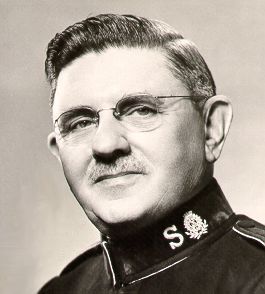
orsborn via salvationarmy.org.auI’ve been doing some reading today on The Salvation Army’s relationship to the World Council of Churches in the mid-20th century.  Salvationists didn’t really do a lot of reflection on the doctrine of the church prior to the late 20th century, but one of the ways in which Salvationists were pushed to reflect upon their ecclesial status was through their involvement in the WCC.   The Salvation Army was a founding member of the Council, and remained a full member until 1981 (the story on their withdrawal from full membership is interesting as well but needs a separate post).

In preparation for the first Assembly at Amsterdam in 1948, General Albert Orsborn engaged in consultation with Army leaders as to whether or not the SA should be involved in the life of the Council.  Though Orsborn declared that he did not want to impose his views on his advisors, he circulated a memorandum which concluded, “I do not wish my period of leadership to be associated with the gravitation of The Salvation Army nearer to church life in faith and order.” The advisory council to the General, however, responded in their report back to the General that “The advisory council has no hesitation in recommending that The Salvation Army continues its membership of the World Council of Churches.”  Orsborn went along with the consensus, though he continued to be resistant to the idea: “It occurs to me to wonder why we should participate in the Assembly…but the majority of our leaders think that we should be represented therefore I have told the chief to arrange it.” (Quotes taken from General Arnold Brown’s biography, The Gate and the Light: Recollections of Another Pilgrim, 232.)

Orsborn, like generations of Salvationists before him, insisted that the Army was not a church, and this conviction seems to have been part of the reason he was concerned about WCC involvement.  For starters, the WCC is a fellowship of churches, and therefore membership implied that the Army was a church, and signalled that other churches (at least some of them) were willing to acknolwedge the Army to be a sister church.

He had occasion to offer some further reflections on the relationship between the movement and the WCC in an article written for The Officer magazine in 1954, just prior to his retirement.  The article as a whole struck a defensive tone, beginning with am apologetic for William Booth’s decision to keep the Army autonomous. “How wise he was!  Nothing has occurred which would justify us in revising the Founder’s decision”(Albert Orsborn, “The Army and the World Council of Churches,” in The Salvation Army and the Churches, ed by. John D. Waldron, 88).

After noting that “…we are almost universally recognized as a religious denomination by governments,” he asserted,

That is as far as we wish to go in being known as a church.  We are, and wish to remain, a Movement for the revival or religion, a permanent mission to the unconverted, one of the world’s great missionary societies; but not an establishment, not a sect, not a church, except that we are a part of the body of Christ called “The Church Militant” and we shall be there, by His grace, with “The Church Triumphant” (Ibid., 88-89).

Orsborn was thus continuing in the line of argument established in the movement’s early years: The Salvation Army is an independent mission, and a part of the universal church, but is not, itself, a church in the sense of a denomination.

orsborn via fsaofAs for Salvationist involvement in the Council, he continued to posture the Army defensively against perceived threats of ecumenical involvement.  “We are there to listen, and perhaps to learn. But we are not prepared to change or to modify our own particular and characteristic principles and methods”(Ibid., 89).  They ought not to seek “closer identification with the churches” he urged, because it was the Army’s autonomy that had been its strength.  He closed his article with list of areas where the Army was not willing to compromise in its involvement with the Council.

We do not favour organic unity with the churches…

We can accept no discussion and no challenge to our position on the sacraments…

We cannot allow the effective ordination (commission) of our officers, including women, to be challenged…

We are not prepared to change our doctrine…

We must preserve absolutely our world-wide missionary freedom…

We cannot allow ourselves to become involved in those so-called “social” questions which in reality are political…

We cannot join anything which may tend to curb our spirit of aggression…

We must agree to nothing which might give our people the idea that it is all the same with us whether they are loyal to the Army or not…

We must not join any aims and purposes which might have the effect of gradually changing the nature and aims of our training colleges (Ibid., 92-94)

The extent to which Orsborn went in outlining the limits of Salvationist participation in the ecumenical movement suggest that he was not alone in his concerns regarding where it might lead The Salvation Army.  I think many of his concerns were unfounded, though some proved to be true over time.   It may be that full membership in the WCC did contribute in some way to the main shift he was concerned about – “the gravitation of The Salvation Army nearer to church life in faith and order.”  Although Orsborn wasn’t willing to budge from the early Salvationist line of thinking about the Army’s non-churchly status, within a couple of decades that would begin to change.

Recommended listening: Parry, Burgon

Lately I’ve been listening to a fair bit of C.H.H. Parry’s music (1848-1918).   I’d heard of Parry before, but my new-found interest in him was sparked after I heard the processional anthem “I was glad” at the Royal Wedding last year.   With the full orchestration and the Westminster Abbey choir, it is absolutely magnificent.

Of course, now I realize that Parry wrote two of my favourite English hymn tunes, the almost-national anthem “Jerusalem,” and “Repton,” used for “Dear Lord and Father of Mankind.”

Here’s another beautiful piece of his I’ve since discovered, a setting of Tennyson’s text, “Crossing the Bar,” sung by the St. Paul’s Cathedral Choir.

Finally, on more recommendation, in keeping with the theme of English choral music.  I stumbled on Geoffrey Burgon’s Nunc Dimittis this past summer.   Samantha and I went to see Tinker, Tailor, Soldier, Spyand loved it, so I decided to take out the older mini-series from the library.  I was surprised that Burgon (who also composed the score for the series) chose to use this sacred choral selection for the credits.   It seems a bit out of place for a spy story.  Still, whatever his reasons, I’m glad he made that choice, because I’ve been listening to it a lot lately.

Charisms and the Methodist approach to Christian Ministry

Recent ecumenical dialogue has turned to the theology of charisms as a way of building a common approach to Christian ministry.  As the landmark text Baptism, Eucharist and Ministry (1982) puts it:

the Holy Spirit bestows on the community diverse and complementary gifts. These are for the common good of the whole people and are manifested in acts of service within the community and to the world. They may be gifts of communicating the gospel in word and deed, gifts of healing, gifts of praying, gifts of teaching and learning, gifts of serving, gifts of guiding and following, gifts of inspiration and vision. All members are called to discover, with the help of the community, the gifts they have received and to use them for the building up of the Church and for the service of the world to which the Church is sent (§M5).

The benefit of this approach is that it both a) grounds Christian ministry in the activity of God (because the Spirit gives the gifts which enable the various ministries) and b) grounds the theology of ordained ministry in the broader context of the ministry of the whole people of God (since the gifts are given to all, and therefore all are given a vocation to ministry).

I would argue that this consensus that has emerged regarding the theology of ministry comports well with the approach to ministry that has been practised in the Methodist tradition throughout its history.  This approach involved candidates proceeding through various orders of ministry, beginning at the local level, depending on the evidence of their gifts as seen by the community of faith. The early Methodist tradition followed a “bottom-up” pattern of discerning gifts for ministry, in which “local preachers” were chosen to assist in preaching and teaching the gospel in one location, and local preachers who showed evidence of gifts chosen to serve as “helpers.” “Assistants” were chosen from among the helpers, to assist Wesley in the oversight of a given circuit of Methodist Societies (hence their title was changed to “Superintendent” after Wesley’s death).   That was the basic track to what would later become ordination.  Beyond that, there were other important roles, such as that of the class leader, who basically acted as a pastor and spiritual director to the members of their neighbourhood small group.

This bottom-up approach to ministry makes particular sense when considered from the perspective of oversight.  Charisms are not self-authenticating, and they need to be discerned in the context of Christian community.  Each charism is interdependent, and in a sense is limited by the other charisms, like the parts of the body are interdependent and limited by their relation with other parts of the body.  Among the gifts is the gift of oversight, and those who have this particular charism are called to help others in the community discern and faithfully exercise their own gifts.

All of this best takes place in the local Christian context, where people know each other and can see each one living out their gifts in the context of the body of Christ.  So, first and foremost, the discernment of a call to any kind of ministry, including the role of pastor or teacher, should begin at the grassroots level.

Now, the fact of the matter is that the Methodist approach to ministry did not develop on the basis of an extended theological reflection on the gifts of the Spirit.  It was not even the result of thoughtful planning.  Rather it emerged, as Henry Rack says, through “a series of accidents and improvisations” (Reasonable Enthusiast, 237).  Wesley improvised the order of his movement in response to the needs of the time, believing that matters of church order were subservient to the church’s mission:

“What is the end of all ecclesiastical order?  Is it not to bring souls from the power of Satan to God?  And to build them up in his fear and love?  Order, then, is so far valuable as it answers these ends; and if it answers them not it is nothing worth” (Letter to “John Smith,” June 25, 1746, in The Works of John Wesley, 26:206). 

In spite of Wesley’s “improvisational” approach, I would argue that the process that emerged is in fact quite consistent with a New Testament approach to gifts and ministries, and with the ecumenical consensus on these issues that has emerged in the past few decades.  Perhaps this was one of the ways in which divine providence was shaping the Methodist movement during its early years.

In praise of interlibrary loans

I am blessed to study at the University of Toronto, which has a world-class library system.   In fact, U of T’s libraries were recently ranked third among research libraries in North America, behind only Harvard and Yale.   The theological collections are strengthened by the fact that students have access to the libraries of the seven TST seminaries, as well as theological books held in Robarts Library, and special collections such as the Pontifical Institute of Medieval Studies library.   The U of T library system has just about everything you could need as a researcher.

However, when you get into a doctoral disssertation, you are often dealing with subjects that are so obscure that even U of T libraries can’t meet your needs.  That’s where interlibrary loans come in.

I think many students aren’t even aware of the amazing service that is available to them through interlibrary loans.    If my library does not have a particular book, but it can be found in another library (anywhere in the world), interlibrary loans will get it for me, free of charge.

I’ve received dozens of rare books through interlibrary loans in the past two years.  Most have come from North America, but the 1921 book Les Charismes De Saint-Esprit by Bernard Maréchaux was sent to me from Radboud University Nijmegen in the Netherlands!

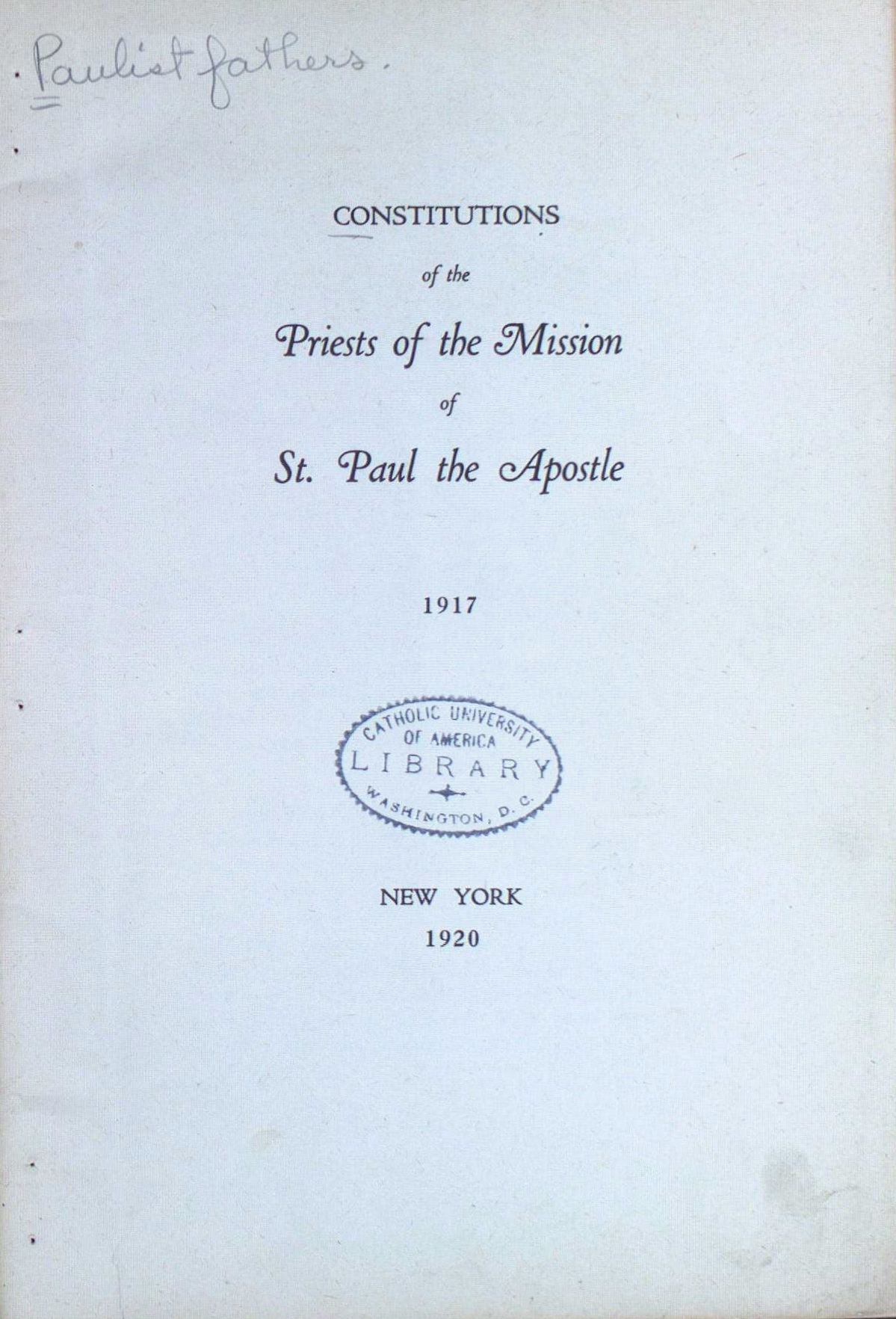
Earlier this fall I was able to get a copy of the 1917 Paulist Constitutions, sent from the Catholic University of America.   Twice I have accessed a two-volume unpublished official history of the Paulists by James McVann, which came from the U.S. Library of Congress (I had to read that one on-site in the Thomas Fisher Rare Book Library).   Without interlibrary loans, I would have only been able to access those materials in Washington, either at the Library of Congress or the Paulist Archives.

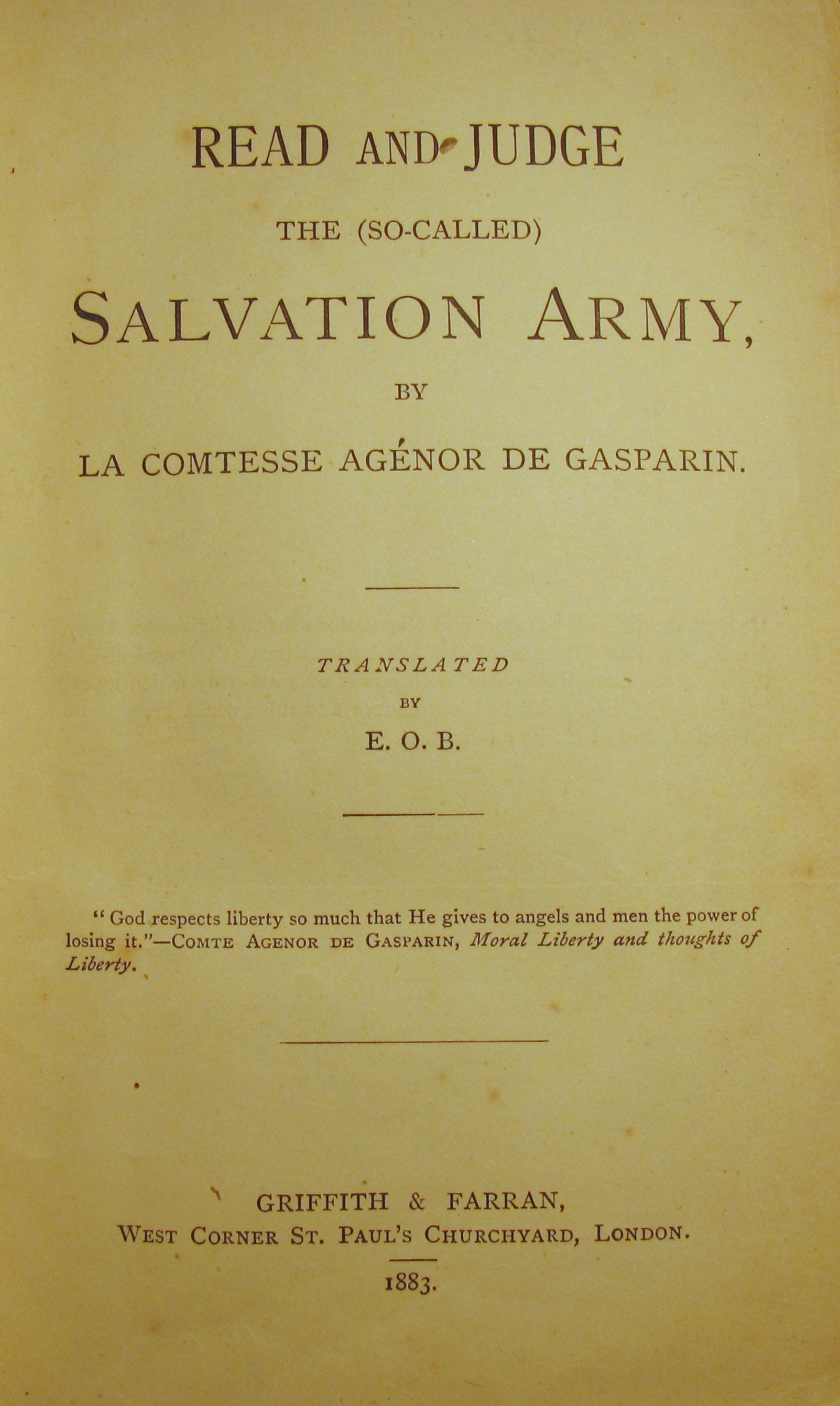
Today I picked up an 1883 book attacking The Salvation Army, Read and Judge the (So-Called) Salvation Army, written by a Swiss Countess and translated from the French.  This one came from Duke Divinity School.

Every time I receive something on interlibrary loan, I say to myself, “I can’t believe this service exists.”  And I wonder how long it has been since anyone else has picked up this obscure book that I’m holding in my hands.  I guess I am a total geek, since I find interlibary loans so exciting, but I definitely wouldn’t have been able to do the research I’ve done without the help of the interlibrary loans staff.

Some Wisdom from Wesley on Zeal

Christians today don’t normally use the word “zeal.”  It is maybe a bit old-fashioned, and I has associations with a kind of fanaticism that most people want to avoid.  I don’t think there are too many today who want be seen as “zealots”, although I suppose there might still be some who are ready to be labelled “zealous” for a certain cause.

We are more likely to talk about “passion.”  Many evangelicals want to be “passionate worshippers,” or will talk about their passion for a certain kind of mission or for evangelism.

Religious passion, or zeal, however, can be a dangerous thing, if it is misdirected.  Many people, following a disordered religious zeal of one kind or another, have done horrible things and inflicted great pain and suffering on others.  Maybe that is part of the reason many would shy away from an overly zealous religion.

John Wesley recognized the potential danger of religious zeal, noting that “nothing has done more disservice to religion, or more mischief  to mankind, than a sort of zeal which has for several ages prevailed, both in pagan, Mahometan (Muslim) and Christian nations.”  And yet he also maintained that “without zeal it is impossible either to make any considerable progress in religion ourselves, or to do any considerable service to our neighbour, whether in temporal or spiritual things” (Sermon 92, “On Zeal,” §1).

How then, can we distinguish the necessary and good type of zeal from the destructive type?   Wesley’s answer was to focus on true zeal as an expression of love.

In an interesting passage of his 1781 sermon “On Zeal” (§§ II.7-11) he outlines how this “zeal for love” ought to rule and direct all other types of religious zeal.

7. Every Christian ought, undoubtedly, to be zealous for the church, bearing a strong affection to it, and earnestly desiring its prosperity and increase. He ought to be thus zealous, as for the church universal, praying for it continually, so especially for that particular church or Christian society whereof he himself is a member. For this he ought to wrestle with God in prayer; meantime using every means in his power to enlarge its borders, and to strengthen his brethren, that they may adorn the doctrine of God our Saviour.

8. But he should be more zealous for the ordinances of Christ than for the church itself; for prayer in public and private; for the Lord’s supper, for reading, hearing, and meditating on his word; and for the much-neglected duty of fasting. These he should earnestly recommend; first, by his example; and then by advice, by argument, persuasion, and exhortation, as often as occasion offers.

9. Thus should he show his zeal for works of piety; but much more for works of mercy; seeing “God will have mercy and not sacrifice,” that is, rather than sacrifice. Whenever, therefore, one interferes with the other, works of mercy are to be preferred. Even reading, hearing, prayer are to be omitted, or to be postponed, “at charity’s almighty call;” when we are called to relieve the distress of our neighbour, whether in body or soul.

10. But as zealous as we are for all good works, we should still be more zealous for holy tempers; for planting and promoting, both in our own souls, and in all we have any intercourse with, lowliness of mind, meekness. gentleness, longsuffering, contentedness, resignation unto the will of God, deadness to the world and the things of the world, as the only means of being truly alive to God. For these proofs and fruits of living faith we cannot be too zealous. We should “talk of them as we sit in our house,” and “when we walk by the way,” and “when we lie down,” and “when we rise up.” We should make them continual matter of prayer; as being far more excellent than any outward works whatever: seeing those will fail when the body drops off; but these will accompany us into eternity.

11. But our choicest zeal should be reserved for love itself, – the end of the commandment, the fulfilling of the law. The church, the ordinances, outward works of every kind, yea, all other holy tempers, are inferior to this, and rise in value only as they approach nearer and nearer to it. Here then is the great object of Christian zeal. Let every true believer in Christ apply, with all fervency of spirit, to the God and Father of our Lord Jesus Christ, that his heart may be more and more enlarged in love to God and to all mankind. This one thing let him do: let him “press on to this prize of our high calling of God in Christ Jesus.”

It sounds simple, but how often have people failed to focus their zeal on love of God and neighbour, with the result being various forms of bigotry, oppression, and persecution?  The whole sermon is still worth a read today.