A brief follow-up on the early Salvation Army as “a church”

Just a quick follow-up to my last post, “When did The Salvation Army become a church?”   I was arguing that the SA started to “function” as a church from a very early date – once its members stopped finding their spiritual home and nurture elsewhere.

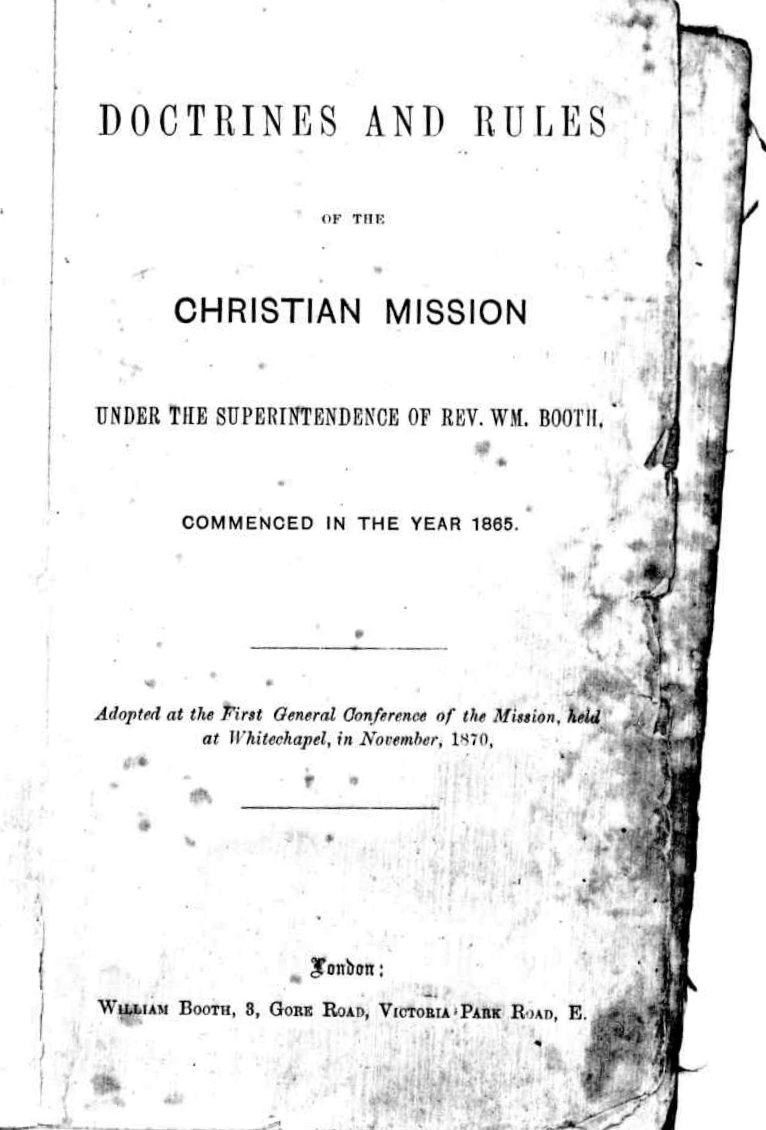
Thanks to the kind staff at the Salvation Army International Heritage Centre, I’ve been reading through a scanned-image copy of the 1870 Doctrines and Rules of The Christian Mission.  

This document was endorsed by the first “General Conference” of The Christian Misison, which met in November 1870, and marked the transition of the movement into a Methodist-style polity.  This lasted until 1878 when the switch was made to a military-style government, although by then the role of Conference had already been minimized by Booth.  

To get back to the 1870 Doctrines and Rules: I find it interesting that under “Membership,” rule V.17 states:

Persons belonging to other churches seeking membership with us shall be admitted on presentation of their note of transfer, if such can be obtained.

The reference to transfer from “other churches” implies that the members of The Christian Mission, at that time, saw themselves as a “church,” or at least the equivalent of a church on the issue of church membership.

Although this document was later replaced by the 1875 and 1878 Deed Polls, it is an interesting window on a mission that was already dealing with movement / church tensions.

When did The Salvation Army become “a church”?

Of course, the question of when The Salvation Army became a church is a loaded question.  First of all, there are many who would debate whether or not The Salvation Army ever became a church.  Is today’s Salvation Army a church?  The key sticking point is, of course, the sacraments, and whether or not they are key “marks” of the church.  That requires a separate post, I think, and I’ll attempt that in the next couple weeks.

To put my own view in a nutshell, however, I would say that The Salvation Army is a peculiar hybrid of church and specialized movement. This will be part of the argument I put forward in my thesis.  On the one hand, it has always acted like a church in terms of the functions it performs for its members.  It is the spiritual home for Salvationists, the place where they are converted, the place where they are nurtured, where they fellowship and serve, mark significant moments in their life, and raise their children.  On the other hand, it has often maintained that it has a special vocation, to be something more than, or other than “a church.”  And for a long time, Salvationist leaders explicitly and publicly insisted that The Salvation Army was “not a church.”

William Booth insisted that their original design was not to set up another church or denomination, but to evangelize people, and then send them to established churches.   In an oft-quoted passage, he explains why this didn’t happen:

My first idea was simply to get the people saved, and then send them to the churches.  This proved at the outset impracticable.
1st. They would not go when sent. 
2nd. They were not wanted. 
And 3rd. We wanted some of them at least, ourselves to help us in the business of saving others.
We were thus  driven to providing for the converts ourselves (“How We Began,” in Boundless Salvation: The Shorter Writings of William Booth, 39)

So, from an early date, even before it was known as “The Salvation Army,” Booth’s movement was functioning as a “spiritual home” for its converts and workers.   This is what I mean when I saw the Army “acted like” a church from the early days.  It was functioning as a church.

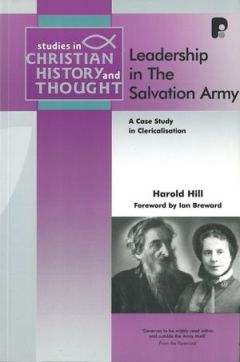
How early did this start to happen?   Harold Hill, in his fascinating book Leadership in the Salvation Army: A Case Study in Clericalisation, suggests that 1867 was a “turning point” for the young movement, when it became established as a “distinct body.”   Drawing on Sandall’s official account, Hill notes a number of important things that happened in 1867, including the formal naming of the movement as the East London Christian Mission, the acquisition of headquarters, the hiring of workers, and the establishment of a system of processing converts.

But if 1867 was a turning point, Hill goes on to argue, it was the beginning of a decade-long transition towards something very much like a “denomination.”  1878, the year when Booth assumed full, autocratic control of the movement, and the year when its name was changed to “The Salvation Army”  marked the end of this transition.

Between 1868 and 1878, then, the process took place whereby an independent mission staffed by volunteers from a variety of church backgrounds evolved into a highly centralised, sect-like organisation, a people with a distinct and common identity, and its own full-time, employed leaders, analogous to clergy (Hill, Leadership in the Salvation Army, 49).

With a distinct identity as a Christian body, members who were not part of other churches, and a clergy-like leadership structure, the newly-named Salvation Army was certainly acting like a church, and therefore from the perspective of “function,” was a church (leaving aside those difficult theological questions which I’ll take up another day).

Yet, in the first Orders and Regulations, issued in the same year of 1878, William Booth wrote: “We are not and will not be made a Church.  There are plenty for anyone who wishes to join them, to vote and rest.”  Subsequent Salvation Army Generals continued to maintain this view through the mid-20th century.  It wasn’t until the 1970s that Clarence Wiseman publicly affirmed his conviction that the Salvation Army was “a church” while still affirming that it was “a permanent mission to the unconverted” and that it shared some features of a religious order.

So, while acknowledging that the question of when The Salvation Army became “a church” is a very complicated one, I would argue that, functionally speaking, it began to act like a church from as early as 1867, even if it refused to self-identify as a church.  Whether or not we should say that the early Salvation Army was a church from a normative, theological sense, will depend upon how we define “a church,” and specifically, whether we believe the observance of sacraments is essential to ecclesiality.

The Wesleys and the “New Evangelization” – from First Things

An interesting article came out on First Things this week, entitled “New Evangelization and the Wesley Brothers,” by Colleen Reiss Vermeulen (HT Dan Sheffield).

If you aren’t familiar with the idea, “new evangelization” is a term used in Catholic circles to talk about re-proposing the gospel to those who have fallen away from the faith, or are apathetic about their faith.   In particular, the new evangelization is about re-evangelizing cultures that have a strong Christian heritage, but have embraced secularization and marginalized the faith.    European cultures are the most obvious target for new evangelization, but  North America is also considered ripe for re-evangelization.    New evangelization, or re-evangelization, is seen as a necessary antidote to the de-Christianization of previously Christian cultures.

Pope Benedict XVI has shown some initiative in this regard, establishing the Pontifical Council for Promoting the New Evangelization in 2010.  In October, a synod of Bishops will be held on the new evangelization, and, as Vermeulen notes, the US Council of Catholic Bishops has just produced a resource on the new evangelization.

In this context, Vermeulen suggests that Catholics pondering new evangelization have something to learn from the Wesleys, noting that the 18th century evangelical revival began at a time when Christian religion and observance in England was at a very low point, with many either hoping to get by with a bare minimum of religious commitment, and others showing seeming indifference.

So what did the Wesley brothers do in their setting of indifference and perceived divisions? Did they tone down their sacramental devotion to appeal to the “rational” sensibilities of the age? Or scrap the Book of Common Prayer’s disciplines of daily liturgical prayer as obsolete? Did they insist that a particular “right” way of worship would solve all problems? Did they ignore suffering and injustice in England and focus only on an otherworldly, eternal salvation? None of the above. Instead, Charles and John Wesley set out for the mines, meadows, prisons, and town squares of England with an urgent Gospel message, a messagemeant to be lived.

So she encourages Catholics, facing immense indifference among their own constituency in the United States today, to adopt a full-fledged and in-depth approach to evangelization, calling people to a real, robust, “lived Christianity,” but one that includes a rich sacramental and ecclesial life:

Charles and John Wesley demonstrated a confidence in the Gospel—that by bringing Jesus Christ into all aspects of the lives of those they ministered to, lukewarm members of the Church of England and the “unchurched” masses alike would be inspired by the Holy Spirit to draw close to Christ in the sacraments, especially Holy Communion. In Disciples Called to Witness, the bishops of the United States call on each person today to have a similar confidence that by “proposing anew” the unchanging message of encounter with the person of Jesus Christ, we too can trust and participate in the work of the Holy Spirit, drawing people out of indifference and into authentic Christian living.

It’s an interesting comparison, and an appropriate one,  I think, given Methodism’s original location as a movement of reform and renewal within the Church (noted previously here).

Jerry Walls on “What’s Wrong With Calvinism”

Jerry Walls, well known Wesleyan philosopher, formerly of Asbury Seminary, and now at Houston Baptist University, has put out a useful two-part video on “What’s Wrong with Calvinism.”

This isn’t a full-fledged positive account of the Wesleyan-Arminian position, but rather a philosophical critique of Calvinism.

The take-away point is Walls’s claim that the heart of the difference between Calvinists and Wesleyan-Arminians has to do with the character of God, not the issues of sovereignty and biblical authority as people sometimes assume.   I’ve made a similar point in a previous post here.

Thanks to Kevin Jackson for spreading the word about these videos.

These are well worth a listen.  Both parts together total about 35 minutes.

Updated – he’s added a third part (below) – 23 more minutes on why this debate matters

Here is part 1:

And part 2:

Part 3:

Remembering Margaret O’Gara

I was saddened to hear that Professor Margaret O’Gara passed away yesterday after a two year battle with cancer.  Margaret was a long-serving professor of theology at St. Michael’s College, with a distinguished record of research, publication, teaching, and service to the church. She will be remembered by many, including myself, as a great theological mentor.

When I began my doctoral studies in September of 2007, I found out that Margaret was on my supervisory committee.  My committee met without her, however, and I didn’t actually come into contact with her until I enrolled in her class “Breakthroughs and Barriers in Ecumenical Dialogue” in January of 2008.   I was somewhat unsure if I should take the class.  The course description looked good, and I was already convinced of the importance of doing theology ecumenically.  But I suppose I carried with me some of that typical evangelical reticence towards ecumenism.  One evangelical colleague even advised me that I should not take the course.  However, I was very glad that I did, because the course material, along with Margaret’s own teaching, played a significant role in shaping the direction of my dissertation.  In fact, I appreciated the course so much that I signed up for another in September of that year, “Ecumenical Dialogue on Authority.”

I was raised in a tradition that has a very strong sense of denominational identity.  Even more than that, The Salvation Army claims to have a distinctive mission within the broader Christian church.  I believe to this day that The Salvation Army does have a special vocation within the church, but I have pushed back against some of the ways that this has been explained and conceived in Salvationist thinking.  I think that Salvationist identity sometimes morphs itself into a prideful triumphalism, wherein The Salvation Army is seen as something “other than” or “more than” the church.  For this reason, I had, before studying ecumenical dialogue, begun to see all claims to a unique denominational identity and mission as problematic and divisive.

Margaret’s approach to ecumenical dialogue was to conceive of it as a “gift exchange.”  This idea was not unique to her – she drew it out of magisterial sources in her own Catholic tradition –  but she was able to express it in a way that brought helpful conceptual clarity to the process of ecumenical dialogue.  She literally wrote the book on the subject (see The Ecumenical Gift Exchange).  Her expertise on ecumenical dialogue was developed out of decades of participation in national and international bilateral dialogues, which included work with Lutherans, Anglicans, Mennonites, the Disciples of Christ, and evangelicals.

When we began the class, she introduced the idea of the gift exchange, and asked us to introduce ourselves by sharing a) one gift which our church tradition could share with others and b) one gift we would like to receive from another tradition.  I don’t remember what I said, but I do remember that both courses I took from Margaret were living examples of this exchange of gifts, as the students, drawn from a variety of church traditions, not only shared from the gifts of our own traditions, but studied the various gift exchanges that have taken place through the ecumenical dialogues of the past fifty years.

The idea of “gifts” found within different traditions is, ultimately, what led me to my dissertation topic of ecclesial charisms, though my argument proceeds along quite different grounds from Margaret’s conceptualization of the process of ecumenical dialogue.  I am looking at a more specific question about a particular kind of gifts (charisms) and how these might expressed corporately in ecclesial bodies of various kinds.  The specific idea of using the language of “charisms” in this regard comes not from the ecumenical dialogues we studied in those classes (though it is occasionally treated there), but rather from the Catholic theology of religious life (religious orders and societies in the church), which I am applying more generally and ecumenically to “movements” in the church.   Indeed, part of my argument is that the language of “charisms” should not be applied across the board to all of the various “gifts” found in our traditions (and shared in ecumenical relationships), but more specifically to personal gifts of grace which carry a vocational obligation.

Nevertheless, in spite of the differences, my dissertation on ecclesial charisms may not have existed if not for Margaret’s work on the gift exchange of ecumenical dialogue.  Not only that, but Margaret also provided a great deal of personal guidance and encouragement for the project.  She helped me work through the ideas as I was conceiving the topic, and also played a pivotal role in shaping my comprehensive exams, which formed the background for my work.  For example, it was Margaret who suggested that my second comprehensive exam should be on reform movements before the reformation – an idea I never would have thought of, but which gave me a wonderful historical perspective on various movements of reform and renewal, and how they  related to the established church.

I suppose, if it wasn’t for Margaret, I also might not have applied to work with the Commission on Faith and Witness at the Canadian Council of Churches.  I worked there throughout 2010 and 2011, and was able to experience the joys and frustrations of ecumenical dialogue for myself.  This only confirmed much of what I had already learned from Margaret in the classroom.  One of the highlights of my two years there was a three-person panel I helped organize for the November 2010 Governing Board meetings, entitled “Ecumenical Dialogue as a Gift Exchange.”  Margaret was one of the presenters.

There is much more that could be said, and I am sure that others, who knew Margaret much better than I did, will offer fitting tributes to her life and work.  I am just one of the many people she influenced.  I am truly thankful that, through God’s providence, I was able to benefit from Margaret’s wonderful gifts as a theologian.

Gems from Wesley’s Journal

Some great quotes I came across while reading Wesley’s Journal this week – a mix of the profound, the witty, and the humourous.

On an elegant meeting house:

“I was shown Dr. Taylor’s new meeting house, perhaps the most elegant one in Europe.  It is eight-square, built of the finest brick, with sixteen sash-windows below, as many above, and eight skylights in the dome, which, indeed, are purely ornamental.  The inside is finished in the highest taste and is as clean as any nobleman’s saloon.  The communion table is fine mahogany; the very latches of the pew doors are polished brass.  How can it be thought that the old, coarse gospel should find admission here?’ “Wednesday, November 23, 1757.

Advice for travellers:

“The captain with whom we were to sail was in great haste to have our things on board; but I would send them while the wind was against us.  On Wednesday he sent message after message, so in the evening we went down to the ship, near Passage; but there was nothing ready, or near ready for sailing.  Hence I learned two or three rules very needful for those who sail between England and Ireland: (1) never pay till you set sail; (2) go not on board till the captain goes on board; (3) send not your baggage on board till you go yourself.”  Tuesday, August 1, 1758.

His love for a soft cushion:

“On Monday and Tuesday evening I preached abroad, near the Keelmen’s Hospital, to twice the people we should have had at the house.  What marvel the devil does not love field preaching?  Neither do I.  I love a commodious room, a soft cushion, a handsome pulpit.  But where is my zeal, if I do not trample all these under foot, in order to save one more soul?”  Saturday, June 23, 1759.

Preaching to the rich:

“It is well a few of the rich and noble are called.  Oh, that God would increase their number!  But I should rejoice (were it the will of God), if it were done by the ministry of others.  If I might choose, I should still (as I have done hitherto) preach the gospel to the poor.” Saturday November 13, 1759.

Preaching over a hog sty:

“We had a pretty large congregation; but the stench from the swine under the room was scarcely supportable. Was ever a preaching place over a hog sty before?  Surely they love the gospel who come to hear it in such a place.”  Friday, November 23, 1759.

A false messenger:

“One came to me, as she said, with a message from the Lord, to tell me, I was laying up treasures on earth, taking my ease, and minding only my eating and drinking.  I told her, God knew me better, and if He had sent her, He would have sent her with a more proper message.”  Wednesday, January 16, 1760.

A fool of a saint:

“I read the celebrated Life of St. Katherine, of Genoa.  My Lesley calls one “a devil of a saint”; I am sure this was a fool of a saint; that is, if it was not the folly of her historian, who has aggrandized her into a mere idiot.  Indeed, we seldom find a saint of God’s making, sainted by the bishop of Rome.”  December 3, 1761.

In honour of London 2012: some great English music

In honour of the opening of the London 2012 Olympics, here’s some of my favourite English music, from one of my favourite composers, Ralph Vaughan Williams.

Now, these aren’t the kind of pieces that will inspire great feats of athletic prowess, but they do conjure up quintessentially English landscapes.  Better for meditation than exercise, but I guess that tells you something about the way I tend to spend my days.   I always listen to music as I work, and since I listen to Vaughan Williams more than I listen to any other composer,  I should probably recognize him for the significant contribution he has made to my dissertation.

Enjoy!

Norfolk Rhapsody No. 1 in E minor

*****

The Lark Ascending

*****

Fantasia on a Theme by Thomas Tallis

Sermon: The Tower of Babel

Here’s an excerpt from the sermon I preached a couple weeks ago on Genesis 11:1-9.  This is the passage where I was dealing with the insight from Reno I posted about two weeks ago.  You can read the whole thing here.

This is not a story with a lot of grace in it!  It is primarily a story of judgment.  The people, as a whole, seek to turn away from God and find their security and significance in their own achievements; God responds with a judgment which is complete and decisive. Each of their ambitions and hopes is overturned and their scheme unravels as God intervenes in the situation.  They had planned to build a city with a great tower; in the end they give up building the city, and the tower.   They want to avoid being scattered; but in the end they are scattered.  Lastly, they want to make a name for themselves; in the end, they do get a name, but it is not the great name they wanted; their name is Babel, which means confused.  They are indeed remembered by those who came after them, but they are remembered for their folly, rather than their greatness.

And yet, there is a note of grace in this judgment, and we will only be able to hear it if we clear up a misunderstanding about this story.  Many people make the mistake of thinking that God, in putting a stop to the building of the tower, was trying to protect himself against the ingenuity of the people of Babel. And the wording of the story can leave you with that impression if you don’t read it thoughtfully.  God says, “If as one people speaking the same language they have begun to do this, then nothing they plan to do will be impossible for them.”  It sounds as if God is worried, that his reign will be endangered, and that his heavenly home will be invaded if these humans are allowed to go on scheming and building towers up to heaven.  It almost sounds as if God is worried that humans will become like him, able to do anything!

But of course, we know that is not true. God is not threatened by human ingenuity.  Even the greatest of human achievements are no threat to the God who created all things, and continues to preserve and govern all things by the power of his Word.   It wasn’t as if they could have literally built a tower to heaven, snuck in the back door, and robbed God of all his riches!  No, that is silly. God doesn’t confuse the language of the people in order to protect himself, he does it in order to protect them.  It’s not that they are threatening him with this tower; they are threatening themselves; they are threatening their own humanity, by giving themselves over to wholesale corporate corruption and rebellion against God, and gathering all the resources of their society in order to try to degrade themselves and avoid their vocation of scattering across the face of the earth.  When God says “nothing they plan to do will be impossible,” he means “there will be no limit on their capacity for self-destruction.”  Those of you who have children know that sometimes you’ve just got to split them up.  There are times when they just can’t help but bring out the worst in one another.  God’s punishment is, in fact, a way of putting a check on their rebellion, and holding them back from further corrupting themselves.   It is definitely a judgment, but it is an act of mercy-in-judgment.

Read the rest: sermon 120708 GENESIS 11 1 TO 9

Reno on the real threat of Babel

I’ve been using R. R. Reno’s theological commentary on Genesis in my preparations for a sermon on the Tower of Babel this Sunday.  As a kid I remember thinking that God stops the building of the tower because he is somehow threatened by human ambition – as if human beings might have actually reached out from the top of the tower and grabbed God by the ankle, or something like that.   I’m sure that is how many people interpreted the story as children, and it is quite possibly how some still read it.  The confusion of languages, then, would be God’s way of protecting himself against humanity – limiting their ability to scheme together and take heaven by storm.

The story of the expulsion from the Garden is often taken in a similar sense: God sends Adam and Eve away because he’s worried they’ll eat from the tree of life, and therefore they’ll become divine.

Of course, this can’t be the meaning of either text.  Reno succinctly summarizes an orthodox theological interpretation:

“Faced with an accelerating project of prideful ambition on the plains of Shinar, God acts on the same rationale he gave for the expulsion of Adam and Even from the garden of Eden.  The LORD says, “ This is on the beginning of what they will do; and nothing that they propose will be impossible for them” (Gen. 11:6).  We need to be sure readers here. It cannot be the case that human beings can make themselves divine by dint of their efforts, any more than the fruit of the tree of life and sheer deathlessness would give Adam and Even divine life – “like one of us” (3:22).  Nor can God be threatened by human striving, as if he were a vulnerable despot anxious to protect his prerogatives.  No, the temptation of the covenant of the lie is precisely the false promise that worldly abundance is enough to bring rest to human beings.

…Therefore, the danger that God identifies in both the tree of life and the tower of Babel is simple.  It is the limitless human capacity to live according to the covenant of the lie.  However impossible the pure negation of radical evil, we really can say an enduring “no” to the covenant of life. As “slaves of corruption” (2 Pet. 2:19), we have a striking ability, day after day, to give ourselves over to sin.  God intervenes not to protect his power, but in order to protect us from the tenacious power of our own corruption” (R. R. Reno, Genesis, 132).

In other words, the confusion of languages is not God’s way of protecting himself from human beings, but it is his way of protecting human beings from themselves – it mitigates against the social corruption of sin.  It is an act of mercy-in-judgment.

Book Review – Boundless Salvation: The Shorter Writings of William Booth

An important new resource has been produced for students of Salvation Army history, theology, and ministry: Boundless Salvation: The Shorter Writings of William Booth.  Edited by Andrew Eason of Booth University College and Roger Green of Gordon College, this book is a very significant publication from an academic perspective.  The fact that a  publisher like Peter Lang would publish a book of William Booth’s writings indicates that academic study of The Salvation Army has become a significant and legitimate scholarly enterprise.

The book is also the first publication of the newly founded Centre for Salvation Army Studies at Booth University College.  Hopefully it is an indication of more good things to come.

Since it is a hardcover book published by an academic press, it is a bit pricey.   Hopefully the book will do well and they will issue  a softcover edition down the road.  If you’re a serious student of William Booth and The Salvation Army, however, this would be a worthwhile investment, even at full price.

Eason and Green have grouped the writings under several categories:

  1. Origins and Early Days
  2. Salvation
  3. Holiness
  4. Female Ministry
  5. Missions and Missionaries
  6. Relationship to the Church

The book begins with a 12 page introduction which offers a brief overview of Booth’s life and ministry.   Each section also includes its own introduction, which summarizes Booth’s views and offers some background on the particular writings included.

What the book provides is access to important writings of Booth that were previously found either only in periodicals from the time (such as The Revivalist, The Christian Mission Magazine, etc.), or were previously included in other anthologies or collections without proper documentation or background information provided.

For example, Chapter 1, “Origins and Early Days,” includes the following three pieces:

  • “East of London Revival Effort” (originally found in The Revival (August 17, 1865)
  • “Our New Name” (originally found in The Salvationist 1 (January 1879)
  • “How We Began” (originally found in George Scott Railton’s Twenty One Years Salvation Army (London: The Salvation Army Book Depot, 1886).

Other writings included which I find particularly fascinating are “Salvation for Both Worlds,” a pivotal 1889 document that demonstrates the shift in Booth’s theology of redemption, and “The Millennium; or The Ultimate Triumph of Salvation Army Principles” (1890).

As someone who is currently writing a dissertation which deals with Booth and the early Army, this resource has come at a very opportune time.   It is great to have these pieces collected together, and to be able to benefit from the expert scholarship of Eason and Green.

The only thing the book lacks (from my perspective) is a complete table of contents, listing all the writings included.   The TOC only lists the main headings, as I’ve identified above.   I found it a bit inconvenient to have to search through each section to see what was included.  After a few times flipping through the book, I actually typed out my own TOC and stuck it inside the front cover, so I could easily reference the specific writings included.  I’ve pasted the expanded list of contents below, in case any of you are like me and you want the complete list.

However, that is a very minor criticism.  This is a very important resource for those studying The Salvation Army, and I hope many people will make use of the excellent work done by Eason and Green.

*************************

Boundless Salvation: The Shorter Writings of William Booth

Expanded Table of Contents

Acknowledgments – vii

Foreword – ix

Introduction – 1

Chapter 1. Origins and Early Days – 13

East of London Revival Effort (August 17, 1865) – 21

Our New Name (January 1879) – 25

How We Began (1886) – 28

Chapter 2. Salvation – 41

The Conversion of the World (October 1869) – 48

The Model Salvation Soldier (1885) – 49

Salvation for Both Worlds (1899) – 51

The Millennium; or, the Ultimate Triumph of Salvation Army Principles (1890) – 60

Chapter 3. Holiness – 72

Holiness: An Address at the Conference (1877) – 80

Holiness (1881) – 87

A Ladder to Holiness (n.d.) – 101

Chapter 4. Female Ministry – 106

Mrs. Booth as a Woman and a Wife (1910) – 111

On Salvation Women (1901) – 114

More about Women’s Rights (1901) – 118

Woman (1907-8) – 121

Chapter 5. Missions and Missionaries – 128

To the Officers and Soldiers of the Indian Salvation Army (1886) – 134

The Future of Missions and the Mission of the Future (1889) – 139

Chapter 6. Relationship to the Church – 165

Wesleyan Methodist Conference (1880) – 173

What is the Salvation Army? (1882) – 178

The General’s New Year Address to Officers (1883) – 185

Conclusion – 197

Resources for Further Study – 201