Three Quotes from William Booth on the Sacraments

People who have done research on The Salvation Army and the sacraments will probably be familiar with these quotes, but I find that a lot of people are surprised by some of the things that William Booth said about the Army’s non-observance of the sacraments.  So I’m just putting these three quotes out there, as a follow up to my last post.

First, from Booth’s official announcement that the SA would stop observing the sacraments (“The General’s New Year Address to Officers,” The War Cry, Janary 17, 1883):

Now if the sacraments are not conditions of salvation, and if the introduction of them would create division of opinion and heart burning, and if we are not professing to be a church, not aiming at being one, but simply a force for aggressive salvation purposes, is it not wise for us to postpone any settlement of the question, to leave it over for some future day, when we shall have more light?”

Moreover we do not prohibit our own people… from taking the sacraments. We say, ‘If this is a matter of your conscience, by all means break bread. The churches and chapels around you will welcome you for this.

Second, from a book Booth wrote in 1885 called Doctrines and Disciplines of The Salvation Army, Section 26, question 6 (I’m taking the quote from Roger Green, The Life and Ministry of William Booth (Nashville: Abingdon, 2005), 148):

Q: What is the teaching of Army on the subject of the Lord’s Supper? A: When such an ordinance is helpful to the faith of our Soldiers, we recommend its adoption.

Finally, a quote from an interview Booth gave in 1895 (again from Green, 148):

…I should like to emphasize the fact that this with us is not a settled question.  We never disclaim against the Sacraments; we never even state our own position.  We are anxious not to destroy the confidence of Christian people in institutions which are helpful to them.

Obviously, I’m putting these up to flag the provisionality of Booth’s position (and the total lack of mention of a divine calling NOT to observe the sacraments), and also his desire to avoid any theological controversy relating to the sacraments.  He may have been naive to think that not having sacraments would steer him clear of controversy!, but also note that he viewed this position as conditional in part on the Army’s claim that it was not a church. Most Salvationists today claim that the Army IS a church.

A Comparison of Salvation Story and the 2010 Handbook of Doctrine

I’m working on a post for the Rubicon on the section of the new Salvation Army Handbook of Doctrine which deals with the sacraments.

In the preface to the new Handbook, General Shaw Clifton writes:

This 2010 Handbook of Doctrine retains the wording of the 1998 edition except for minor clarifications and stylistic changes. The principal aim has been to maximise user-friendliness, for example by reallocating the Bible references and inserting them into the main narrative at the relevant places; renumbering the chapters to match the numbers of the Doctrines; merging the main Handbook with the 1999 Study Guide into a single volume, removing outdated material from the latter and condensing some parts of it; revising certain Appendices and introducing three new study aids by way of Appendices 5, 6 and 9.

I guess the part on the sacraments falls under the category of “revising certain Appendices,” because there is clearly more going on here than “minor clarifications and stylistic changes.”

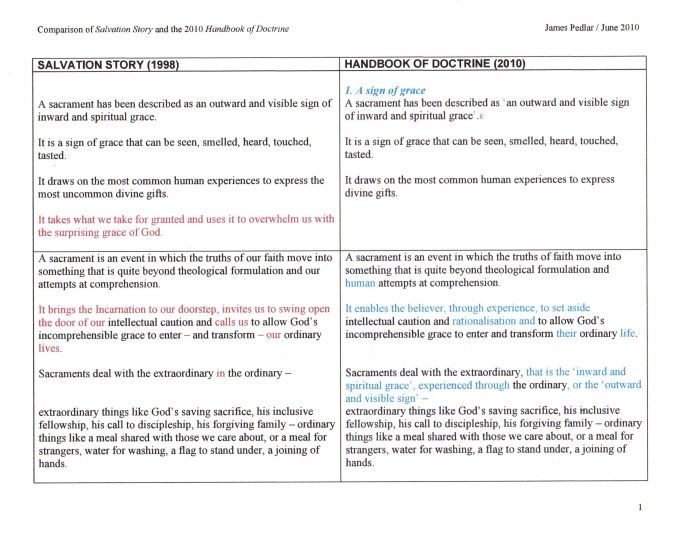
I’ve made a chart which puts the two texts side-by-side, so you can clearly see the changes that have been made to Salvation Story’s treatment of the sacraments (Salvation Story was the 1998 version of the Handbook).

I’ve got a pretty good idea how I’m going to structure the post – around two major points. But I’m interested in getting feedback from others.  Feel free to comment here, or email me (james [dot] pedlar [at] gmail [dot] com).

Here’s the chart in pdf: Comparison of Salvation Story and Handbook of Doctrine on Sacraments

If you want more context, you can find a pdf of Salvation Story here, and the Handbook of Doctrine can be downloaded here.

Typology of Views of Charismatic Movements, part 6: Institutional over Charismatic

As I said in my introduction to this series, it is hard to find anyone today who actually tries to make a theological argument for the priority of the institutional over the charismatic in the Church.

Historically, the obvious example of prioritizing the institutional over the chairsmatic is modern Catholicism, before Vatican II.   The Roman Catholic Church was conceived as a perfect society, meaning that the Church was a complete social system, and its various elements were instituted by God, so that it would lack nothing in its historical existence until the return of Christ.  The priesthood, all the sacraments, the hierarchy, even monasticism and the religious life, were said to be derived directly from Jesus Christ himself.  These institutions were therefore invested with divine authority, such that, any “charismatic” who arose outside the established order would be seen as problematic. As Johann Adam Möhler summarized this view, “God created the hiearchy and in this way provided amply for everything that was required until the end of time.”

Of course the problem with this perspective was that, for one, it was not historically accurate.  It embraces what Avery Dulles describes as a “regressive method” of theology, whereby the latest teachings of the Church are adopted “as if they have been present from the beginning” (Models of the Church, 32), since any change would be seen as an “innovation,” and would undermine the view that all had been provided for in the Church’s institutions (including the magisterium).  Clearly, the Church’s institutions have developed over time, and many innovations have been made along the way.  Among these innovations, we must include some which I would call “charismatic movements”: monasticism of various kinds, the mendicant orders, apostolic societies, and so on.  These are among Catholicism’s most treasured institutions, but in the modern “perfect society” scheme of ecclesiology, it would have been difficult to explain their origins, apart from rooting them somehow in the divine institution of Jesus Christ.

These ideas are pretty far removed from the life of the Church today, even for Roman Catholics. However, the “institutional over charismatic” mindset is by no means absent.  Institutionalism is a pervasive social phenomenon, and all of our churches (even those which are highly charismatic) have to wrestle with the challenges it brings.  Therefore, the natural tendency in any church tradition is to be sceptical of leaders and movements who arise from oustide the established order.  We could say that, though it is not argued for theologically, “institutional over charismatic” is the default operating perspective of most churches.

Clericalism is perhaps the best example.  Even in evangelical churches, which profess a strong doctrine of the “priesthood of all believers,” there is a tendency to view the pastors as “professional Christians,” and to exclude lay people from fulfilling many roles which they ought to be able to fulfill.  Those who have the gifts (charisms), should be freed to exercise them, but they are sometimes excluded simply by virtue of the fact that they are not clergy.

I grew up in a denomination (The Salvation Army) where the clergy are largely responsible for the business of the church.   It strikes me as rather odd that we should expect pastors to be business-savvy, when there are likely members of their congregation who are business men and women themselves.

I’ve noticed that a lot of other evangelical traditions tend to have a “pastoral prayer” at every service.   This is where the pastor stands up and leads the congregation in a long prayer prayer.   I suppose most people see this as harmless, but I think it promotes a clericalist mindset.  Why would we want the pastor to be the only who publicly prays during worship?  It sends the message, again, that pastors are the “professional Christians.” It is interesting that in the older traditions (Catholic, Anglican, Lutheran, etc.), which most evangelicals assume are more “clericalized,” the prayers are not led by the pastor, but by lay intercessors. In the SA, the officer often leads this prayer, but sometimes it is a layperson.

The problem is that we can’t go too far in the other direction.  We need institutions, including ordained ministry (in my opinion).  We need stable structures that endure over time, and provide a means for passing on the faith from one generation to the next in a way that retains the historic core of gospel teaching.  We cannot escape this need.   We must embrace the institutions of the Church, without absolutizing them, and thereby excluding any new wisdom that the Spirit might bring from unexpected places.  That means, in part, that the institutional authorities of the Church must be open to discerning and coordinating the charisms that arise among the people.

Typology of Views of Charismatic Movements, Part 5: Charismatic Enlivens Institutional

A number of interpretations of charismatic movements centre around the idea of the enlivening effect of charisms on the institutional elements of the Church.  Such perspectives view both the established structures of the Church and the continued emergence of new reforming movements as normal and part of the Spirit’s work in the Church.

Along these lines, Howard Snyder attempts to provide what he calls a “mediating perspective” of church renewal, incorporating both the institutional and charismatic aspects of the Church.  Noting that institutional and charismatic views of the Church individually have their limitations, Snyder argues for a “a theory of church life and renewal which combines insights from both the institutional and charismatic views,” not seeking a middle ground but attempting to “incorporate the truth of both.” In his view both stable institutional structures and dynamic renewal movements are legitimate and in some sense normal aspects of the Church’s life in history, although the merits and faithfulness of individual movements and institutions could be debated” (Signs of the Spirit, 274-275).

The reform movements spring up within the institutional church, bringing new life and growth, analogous to a new sprout growing out of a stump which appears dead.  Snyder then offers what he considers to be the “marks” of this mediating model, which is based upon the idea of authentic reform coming through ecclesiolae in ecclesia – radical and more intimate expressions of the church which exist in the Church, for the good of the whole Church, maintaining some form of institutional ties with the larger body (Signs of the Spirit, 276-280).

Francis Sullivan, a Roman Catholic reflecting on the charismatic renewal movement in Catholicism, offers a similar view of the Church and the place of renewal movements in the Church’s life.  Sullivan speaks of the official sacramental ministries and charismatic movements as two “equally important” ways in which the Spirit gives life to the Church.

There are two distinct, but equally important, ways that the Holy Spirit breathes life into the body of Christ: on the one hand, by his covenant relationship with the church, guaranteeing the effectiveness of its sacraments and official ministries, and on the other, by his unpredictable and often surprising charismatic interventions (Charisms and Charismatic Renewal, 47).

The official ministries of the Church exist to safeguard and pass on the tradition, but charismatic movements are given “for the purpose of shaking the church out of the complacency and mediocrity that inevitably creep into any institution” (47).  Sullivan is comfortable speaking of the official structures of the Church as institutional, and of ascribing an inevitable stultifying character to those institutions, which puts him closer to someone like Snyder than to Rahner or Ratzinger.

In addition to Catholic religious orders, Sullivan also suggests that many movements that ended up becoming sects or separate church bodies began as charismatic movements within the Church.  Their separation indicates a failure to renew the Church, but it need not indicate that the separated movements were not in fact the work of the Spirit, because blame for separation often lies on both sides, and at times has been due to a resistance to reform on the part of the Church.

I certainly do not think that the fact of separation by itself is proof that the movement in question could never have been an authentic work of the Holy Spirit, because there is also the possibility that it was rather the refusal of the Church at that time to admit its need of reform and accept renewal that led to the alienation and eventual separation (49).

Without going into detail, Sullivan suggests that “the history of Western Christianity in the last four hundred years has been profoundly marked by alienations of this kind, whether from the Catholic Church in the sixteenth century, or from various Protestant bodies in the following centuries” (49).

Sullivan also notes that, while for much of this period, Catholics simply denied that the Holy Spirit was at work protestant bodies, Vatican II affirmed that the Spirit works not only in individuals but also through churches and ecclesial bodies outside of Catholicism. On this see Unitatis Redintegratio §§3 and 4.

Moreover, some and even very many of the significant elements and endowments which together go to build up and give life to the Church itself, can exist outside the visible boundaries of the Catholic Church: the written word of God; the life of grace; faith, hope and charity, with the other interior gifts of the Holy Spirit, and visible elements too. All of these, which come from Christ and lead back to Christ, belong by right to the one Church of Christ (§3).

…Catholics must gladly acknowledge and esteem the truly Christian endowments from our common heritage which are to be found among our separated brethren. It is right and salutary to recognize the riches of Christ and virtuous works in the lives of others who are bearing witness to Christ, sometimes even to the shedding of their blood…Nor should we forget that anything wrought by the grace of the Holy Spirit in the hearts of our separated brethren can be a help to our own edification. Whatever is truly Christian is never contrary to what genuinely belongs to the faith; indeed, it can always bring a deeper realization of the mystery of Christ and the Church (§4).

I’ll continue the discussion of this perspective with another post on Catholic literature about charisms and the religious life (religious orders, etc.).

Typology of Views on Charismatic Movements, Part 3b: Balthasar’s Christological Constellation

Hans Urs Von Balthasar’s The Office of Peter and the Structure of the Church presents the most intriguing accounts of charismatic movements in the Church I’ve encountered thus far.     Balthasar provides an interesting example of an attempt to create legitimate space for radical movements of the Spirit within a robustly catholic ecclesiological framework.  The particulars of his argument are strange, and difficult for a protestant to digest, but his approach is sophisticated, and deserves engagement.  I include it under the “charismatic in legitimate tension with institutional” type, along with Rahner, but as a bit of an aside, given that the form of Balthasar’s argument is so idiosyncratic.

For Balthasar, the tension between stable orthodox Church structures and movements of renewal is inherent in the very nature of the Church.  This is seen most clearly in his use of the concept of the “christological constellation.” Balthasar’s argument is that just as Christ cannot be understood apart from his relation to the Father and the Spirit, so also he cannot be understood apart from the human relationships which were central to his historical life on earth.  John the Baptist, Mary, Peter, John, James, and Paul are all essentially related to Jesus and are therefore integral to christology (The Office of Peter, 136-137).  As the historical foundation of the Church, the members of the constellation are interpreted by Balthasar as “Realsymbols” or structural principles on which the church is founded, and through whom the presence of Christ is mediated to the Church (Office of Peter, 226-227).  Each member of the constellation is described according to their relationship with Jesus: the Baptist as a herald; Mary as the all-embracing perfect response to the grace of the Lord; Peter as one who participates in the authority of Christ in a singular way; John as the beloved who in love mediates between Peter and Mary; James as the one who takes Peter’s place in Jerusalem and represents continuity between the Old and New covenants; and finally Paul, the one untimely born who nevertheless takes the lion’s share of Christ’s mission, even though there seems to be no place for him among the college of the apostles.

Because the Church did not emerge en bloc, but is founded on the prophets and apostles, the particular relationship of each of the members of the constellation is prototypical for the Church.  Specifically, after Pentecost, Balthasar argues that there is a fourfold structure of the Church which emerges: the Pauline, Jacobite, Johannine, and Petrine aspects of the Church.   He sketches the constellation like this:
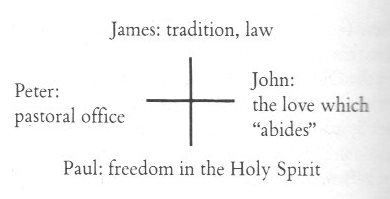
These are the four ways in which the Church is embodied in the world, and every community and every individual Christian life takes shape amid the tension and dynamism that exists between these poles. The Church “expresses itself concretely in the dynamic interplay of her major missions and in the laws inherent in her structure” (Office of Peter, 314-315).

In Balthasar’s scheme, the orthodox structures of the Church are interpreted as the Petrine and Jacobite aspects, while the movements of renewal are interpreted as Pauline.  Obviously the Petrine aspect of the Church is seen in office, and the Jacobite aspect is seen in Church law and tradition.  What is specific about the Pauline aspect is precisely Paul’s uniqueness, his supernumerary relationship to the apostles, and the unpredictable way in which he was chosen for his task directly by the Lord.  Because Paul is unique, his “successors” can only be identified by remote analogies as those who have charismatic vocations, whose recognition by those in office is compelled by divine evidence (Office, 159).  The founders of religious orders are examples of such direct divine vocations, according to Balthasar.  These movements of renewal are never founded by those in office, but by unexpected the founders of renewal movements, whose lives of sanctity “fall into the garden of the Church like a meteor” (The Laity and the Life of the Counsels, 67).  Their divine vocations must be tested by those in authority, but once tested, their unique missions and “charisms” cannot be suppressed.  These saints, “struck by God’s lightning,” ignite a blaze in those who gather around them, offering the Church hope of renewal and reform (The Laity, 42).  The religious orders that have arisen unexpectedly in response to these movements are able to radiate their light into the whole Church, moving outwards in concentric circles from the point at which lightning has struck (The Laity, 88).  The Petrine office is indispensable, but it is conceived by Balthasar as one aspect of the christological constellation, and must be seen in relation to the whole.  Because the Spirit works in unpredictable ways as well as through the official structures of the Church, Peter’s task is limited to making judgments and rendering verdicts amid the tensions that arise in the life of the Church.  He represents unity, but in so doing he must make space for others.
The unity of the Church is maintained when these major missions are understood in relation to the whole constellation.  The challenge is to achieve a reintegration of the elements which are isolated, in order that the tensions inherent between them may be lived out fruitfully within the mystery of the Church as Body and Bride of Christ.  In fact, the tensions between the principal figures of the constellation “all point to the mysterium; they are its necessary expression, not shortcomings on the part of the Church that need to be corrected by “changing its structure”” (Office of Peter, 24).  The history of the church can even be described by Balthasar as “an evident contest,” between the various poles of the christological constellation (Office, 314).  This process of contesting, for Balthasar, has a legitimate and community-creating value for the Church.  The church as ecclesia semper reformanda takes shape as various poles in the constellation are put back in their place, and a proper balance between the various aspects of the Church is established (Office of Peter, 314). The tension between the members of the constellation is the “force field” which generates apostolic missions.

What I like about Balthasar’s approach is that he avoids a simple opposition between “institutional” and “charismatic” without giving too much ground in one direction or the other.  His christological constellation is an innovative way of attempting to conceive of the complex human and divine reality which is the people of God.  It provides a way for discussing the history of the Church as it relates to charismatic movements, without smoothing out the conflicts that have often ensued between the movements and the established Churches.   The conflicts themselves are not so much a “problem” but an inherent part of what it means to be the Church.  This means we don’t need to “resolve” the conflicts between movements of renewal and established structures by siding with one side or the other (as has often happened in Church history).  The Church in her total reality needs both stable orthodox structures and unpredictable movements of renewal.

In the end, however, the particulars of Balthasar’s argument are a bit too idiosyncratic to be useful across ecumenical lines. The obvious problem (for protestants) with his approach is the high place which is afforded to the four apostolic figures in the ongoing life of the Church – even to the point of speaking of their “mediation” of Christ.  To be sure, Balthasar absolutely upholds the uniqueness of Christ, and is not assigning salvific value or merit to the apostles.  However, he argues (and I will grant that it is an interesting suggestion) that Jesus, fully divine but also fully human, cannot be understood apart from the human relationships he established during his life on earth, especially his relationships with those who were very close to him.  Historically speaking, we can also see how these primary persons in Jesus’ inner circle became the nucleus of the primitive Church.  Fair enough, but it is a stretch to move from these affirmations to four foundational principles for the Church in her continuing historical life.   While Balthasar’s theory is loosely grounded in the biblical narrative, the connection to the actual scriptural witness is quite tenuous, and leaves us wondering if he’s reading Church history back into the character of the four apostles.  Has he simply used these four biblical figures as a convenient means of conceptualizing what he believes are essential aspects of the Church?  I suppose if you begin from a Roman Catholic perspective, and you already accept the special role assigned to Peter as an essential aspect of the Church for all time, then it is not too much of a stretch to discuss similar principles of ecclesial life as grounded in other apostolic figures.  If that is the case, could his approach retain some merit, independently of the somewhat novel theory of these four apostles as Realsymbols of the Church?  Can we gain anything from his approach, without buying into the mediating role that Balthasar assigns to Peter, James, John, and Paul?   What would be left?  A set of “principles” which are inherent to the life of the Church?  On what foundation could such a set of principles be identified, if not on the basis of the apostles?  On strictly historical grounds, we can see how the history of the Church, interpreted from a broadly catholic point of view, supports these affirmations.  Should the lessons of Church history regarding renewal movements provide us with a normative basis for conceiving of the Church’s nature?  I want to say yes, but I’m still sorting out the details of how the argument can be made.

Typology of Views on Charismatic Movements, Part 3: Charismatic in Legitimate Tension with Institutional

Karl Rahner provides a perspective on the place of charismatic movements which recognizes the tension that exists between the charismatic and institutional aspects of the church, without prioritizing the charismatic as more fundamental. In The Dynamic Element in the Church Rahner attempts to overcome the opposition between “charism” and “office” by reframing the question in terms of “the charisma of office” and “non-institutional charismata” (42-58).  The charisma of office must be affirmed, Rahner argues, if the Church is to be conceived as the one abiding historical entity which was has its foundation in the apostles, and continues to be “always the locus and visible manifestation of grace” by virtue of God’s promise (43). The church must be conceived of as charismatic, otherwise the Catholic affirmation of the Church’s visible continuity would be based on the juridical power of the institutions themselves.

“…because the grace of God is not only offered to mankind as a possibility, but is promised to the Church as a victorious grace more powerful than sin, it is certain from the outset from God’s side and from him alone, that ecclesiastical office in what most properly belongs to it, in its essence, will not, though it could, be used as a weapon against God.  To that extent, therefore, ecclesiastical office and ministry is charismatic in character, if we understand by charismatic, what is in contradistinction to what is purely institutional, administered by men, subject to calculation, expressible in laws and rules” (43-44).

For example, Papal infallibility must imply that, “in order to be what it is,” the papacy “passes into the charismatic sphere” (45).

However, in order to distinguish itself from totalitarianism, the Catholic church must affirm that the hierarchy is not the only vehicle through which the Spirit works, but that “there are charismata, that is, the impulsion and guidance of God’s Spirit for the Church, in addition to and outside her official ministry” (49).  Rahner posits that “a legitimate opposition of forces” arises as an unavoidable result of the “multiplicity of impulsions in the Church” (73). That is, these forces are felt and experienced by human beings on earth as disparate and opposed to one another, “precisely because they are unified by God alone.” (74)  This means that there will be conflict and tension in the Church, with both sides needing to be “protected” from the other:

“Now it is no doubt a rule, a normative principle and a law for the spiritual gifts themselves, that they should operate in an “orderly” way, that they are not permitted to depart from the order prescribed by authority…Yet this formal rule alone would not of itself guarantee the actual existence of harmony.  For although official authority might be sufficiently protected by the rule from merely apparent spiritual gifts, the charismata also need to be protected from the authorities” (52)

What is required for visible unity in the present Church is “the love which allows another to be different, even when it does not understand him” (74).

Rahner connects his perspective to the question of reform movements by speaking of “the possibility of institutional regulation of a gift of the Spirit” (58). Movements such as the Franciscans are examples of the “institutionally organized transmission and canalization” of the gift of their founder.

“Not only Francis but the Franciscans too are charismatics if they really live in a spirit of joyous poverty.  What would Francis mean to the Church if he not found disciples throughout the centuries?  He would not be the man of charismatic gifts in the sense we have in mind here, but a religious individual, an unfortunate crank, and the world, the Church and history would have dropped him and proceeded with their business” (59).

In this way the charismatic element in the church is passed on through institutional means, which are courageously received and approved by the Church, as the charismatic movement in question submits to her authority and law. This aspect of “regulation” of the Spirit is, for Rahner, an essential part of the reform movement’s vocation, in which the charismatic element of the Church shows that it truly belongs to the Church and its ministry. Speaking of submission to the Church’s regulation, Rahner writes, “It is precisely here that it is clear that the charismatic element belongs to the Church and to her very ministry as such” (59).

Rahner’s subtle argument has much to commend it from the perspective of the Church’s history, providing a way of affirming the essential place of both established structures and unpredictable movements of the Spirit that arise from outside the usual official ministries.   In particular, it is interesting to see how a Catholic thinker reflects on the role of a founder, and how the charismatic gift given to a founder can be institutionally preserved by the Church.  It is precisely this idea that I think needs to be looked at ecumenically, with particular reference to protestant charismatic movements.   How should such institutional regulation take place?  Could some protestant divisions have been avoided, if the establised church(es) had found a way to incorporate the movements in question (i.e., Methodism, The Salvation Army, the Christian and Missionary Alliance, Classical Pentecostalism), affirming their place and giving them a measure of autonomy while also maintaining structural ties?

I’ll come back to this in discussing the fifth perspective in my typology, “Charismatic enlivens institutional” – a view which is very similar to Rahner’s perspective, but goes further in specifically discussing the role of charismatic movements in bringing life and renewal to the Church as a whole.