2025 Symposium Audio

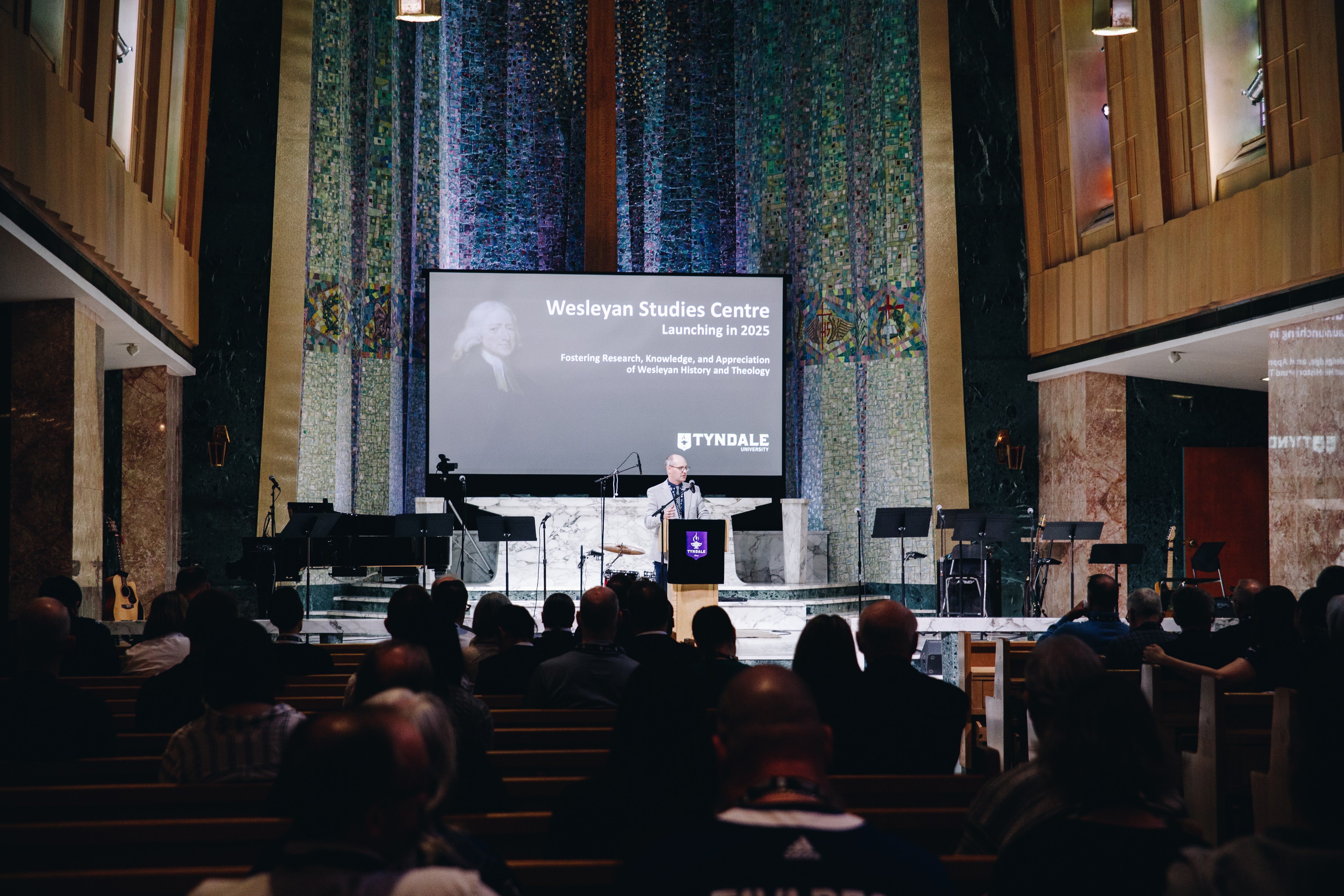
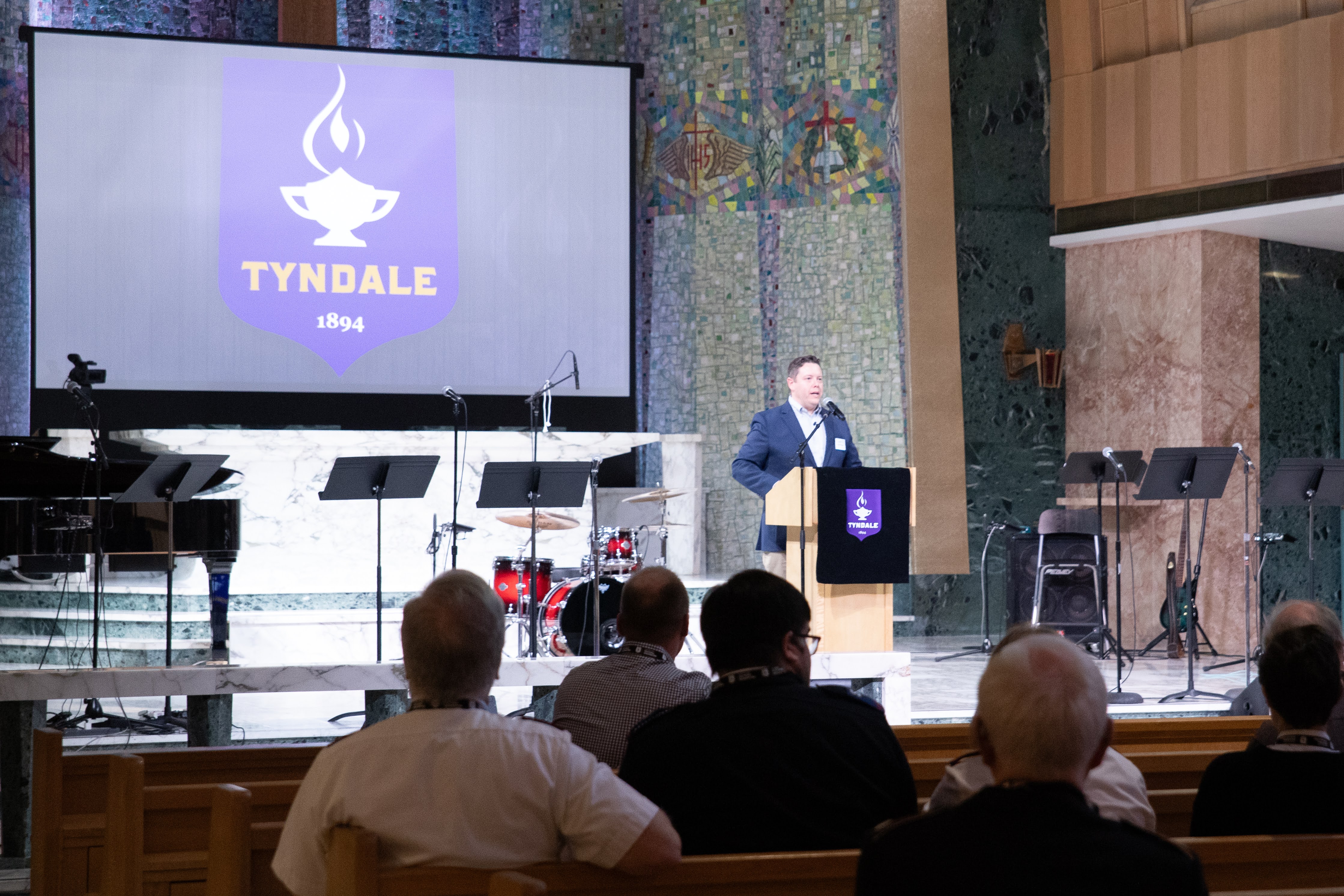
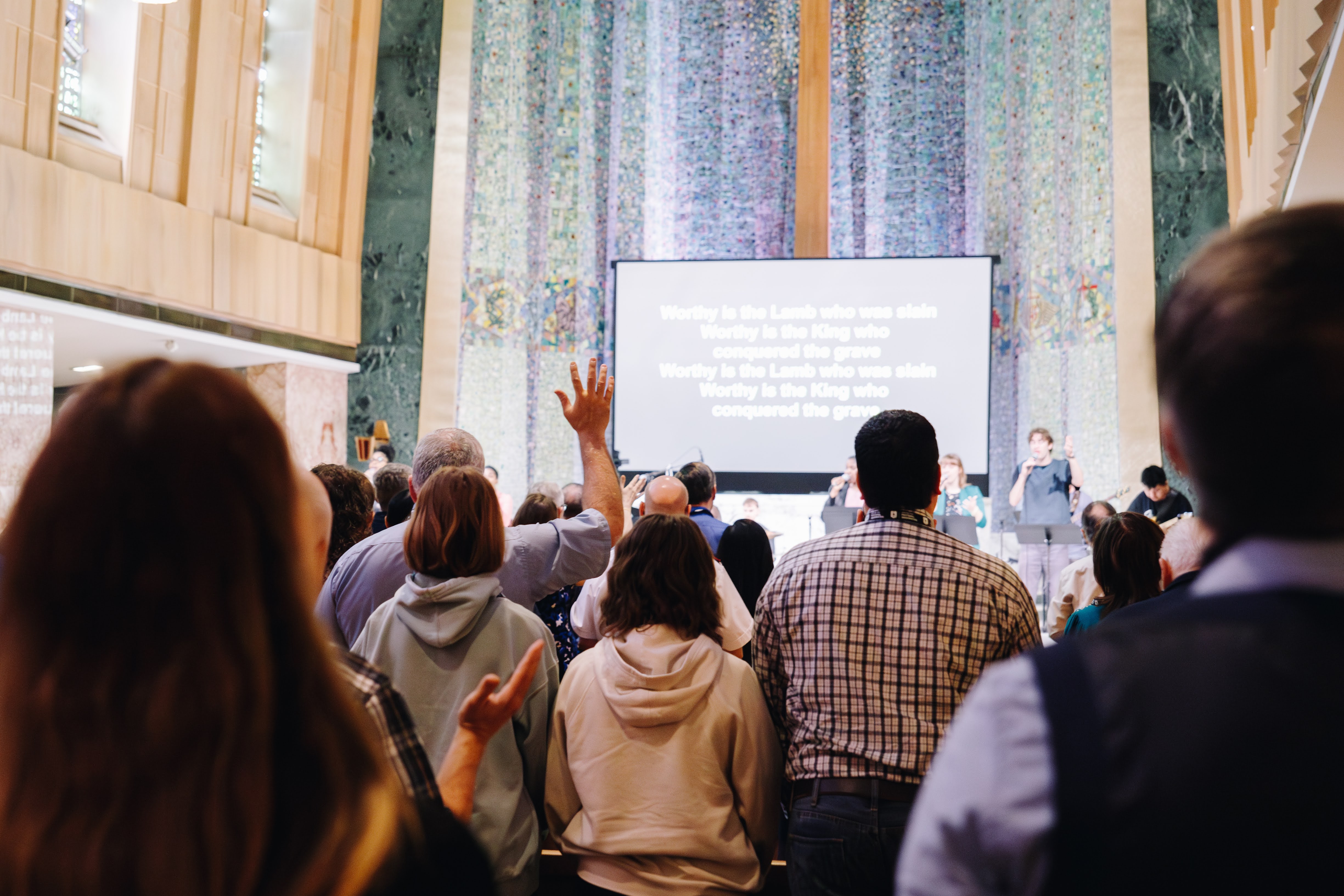
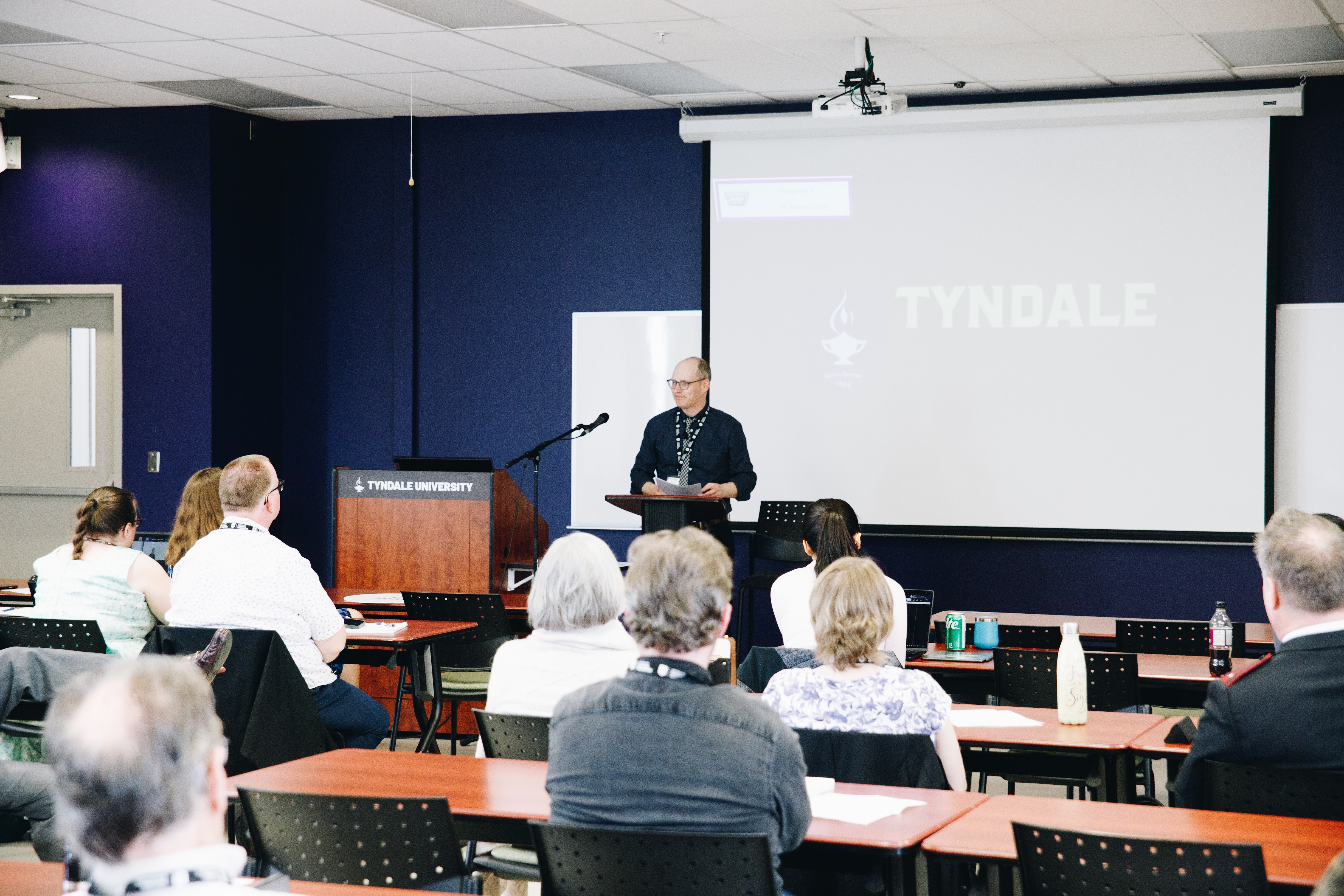
This a very belated update, sharing audio files from this year’s Wesley Symposium at Tyndale. Although Dr Thomas Noble was not able to join us, I was privileged to read his keynote address on his behalf. We had a strong lineup of presenters this year, and our highest attendance to date. The recordings of this year’s event are now available on the Symposium website.

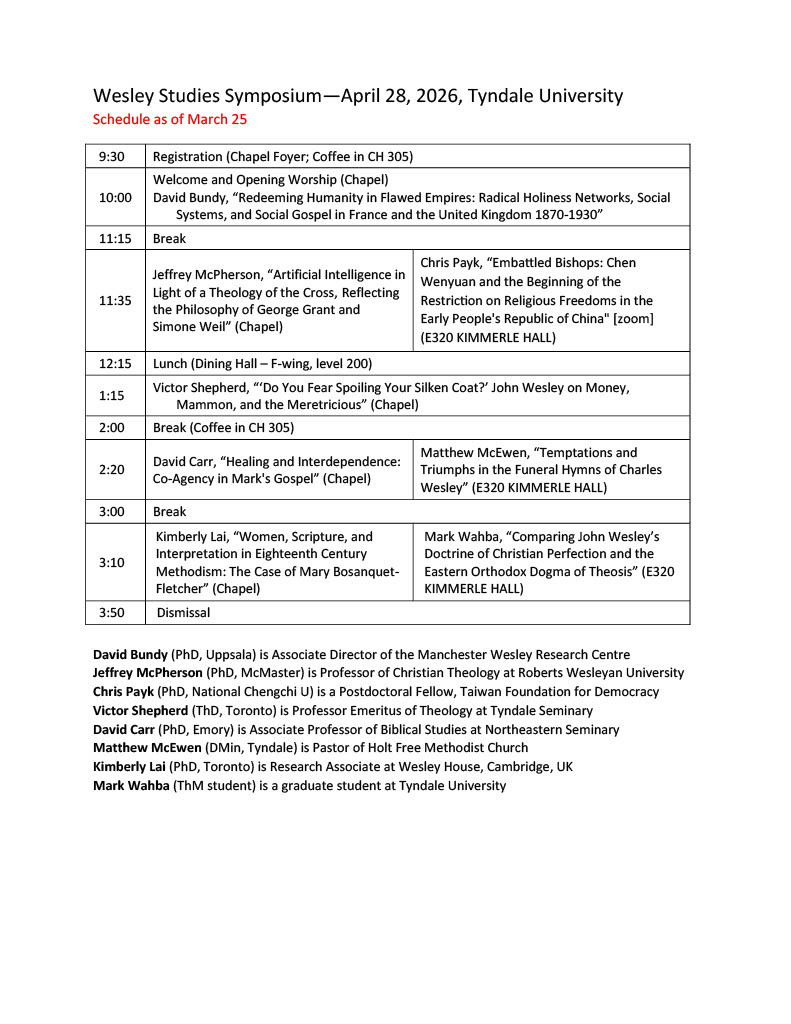
For this interested, next year’s Symposium will take place on Tuesday, April 28, with Dr. David Bundy as the keynote speaker. Dr. Bundy is a leading expert in Methodist, Holiness, and Pentecostal history, with an unparalleled knowledge of these movements in global contexts. You can read more about him on his profile page at the Manchester Wesley Research Centre.

2025 Wesley Studies Symposium with Thomas Noble

Since 2009, Tyndale Seminary has convened an annual Wesley Studies Symposium. The 2025 event will take place on Tuesday April 29. This year’s keynote speaker will be Dr. Thomas Noble, a leading theologian in the Church of the Nazarene. He is the author of the important book, Holy Trinity, Holy People, and is currently writing a major multi-volume work, Christian Theology.

Dr. Noble’s keynote address is titled, “Christian Holiness and the Triune God.”

Other confirmed presenters include:

  • Bruce Cromwell, “Biblically Faithful Ministry with the LBGTQ+ Community”
  • Chris Payk, “The Complex Legacy of Methodism in the Life of Wang Mingdao” [via zoom]
  • Aaron Perry, “Wide, Wild, and Deep: Theology for Ordained and Lay Ministry.”
  • Chun Hoi Heo, “The Philosophical Character of Wesley’s Theology”
  • Michael Reardon, “Recent Protestant Approaches to Deification in dialogue with Wesley’s View of Sanctification.”
  • Tom Elliott, “Christian Formation in John Wesley’s Preaching Ministry.”
  • Aaron Perry, “Wide, Wild, and Deep: Theology for Ordained and Lay Ministry.”
  • John Clifton, “The Homeless Man as a Christological Paradigm of Powerlessness” [via zoom]
  • Grant Gordon, “Newton’s Reflections on Wesley’s Sermons”

Visit the Symposium Webpage to find details about the schedule and registration.

The Catholicity of the Heart: Pathologies and Prospects

It was my honour and privilege to serve as President of the Wesleyan Theological Society for the past year. The President of the society chooses the theme for annual meeting and delivers the Presidential Address. I chose the theme “evangelical catholicity,” a term that has been used to describe John Wesley’s theological outlook, but has also been used to describe other thinkers and movements within the church.

The Annual Meeting was held March 1-2 at Trevecca Nazarene University, and I was delighted to see the way the theme was taken up by the many presenters who gave papers. My biggest frustration was that I was unable to be in multiple places at the same time, and I couldn’t hear all the papers that caught my interest.

Samuel Chadwick

The Presidential Address took up the theme, “The Catholicity of the Heart: Pathologies and Prospects.” It began by considering the two key figures from the closing chapter of my recently-published book, Samuel Chadwick and Arthur Samuel Peake. Chadwick was a theological conservative, and Peake a liberal, but they shared a kind evangelical catholicity that was more characteristic of eighteenth and nineteenth century evangelicalism. That is, their evangelicalism was, broadly speaking, about fostering the “religion of the heart” and struggling to eliminate nominal Christianity. I employed a threefold typology proposed by Donald Dayton to distinguish this type of evangelicalism from twentieth century evangelicalism. Then I noted some of the evident weaknesses of framing evangelical catholicity as the “catholicity of the heart,” and attempted to respond to some of those weaknesses with reference to John Wesley’s own evangelical catholicity. I concluded with my reasons for holding out hope for the catholicity of the heart.

I have an audio recording posted below; it is not very good quality, but I hope it is audible throughout. The written version of the address still needs some polish, but it will be published in next spring’s issue of the Wesleyan Theological Journal.

New Book on Revivalism and Ecclesiology in British Methodism

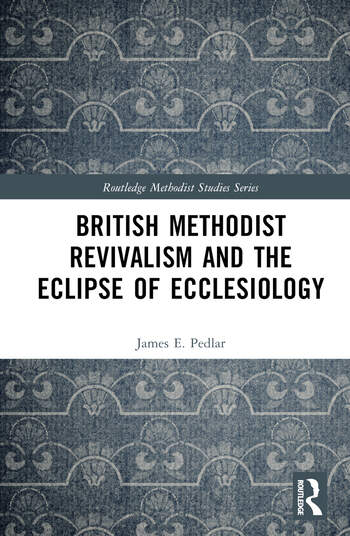
My book, British Methodist Revivalism and The Eclipse of Ecclesiology is now available. After many years of work and several delays (pandemic-related and personal) it is a pleasure to have the hard copy in my possession. I hope it will make a solid contribution to our understanding of the history and theology of Methodism, especially as it deals with some figures who have received little attention from a theological perspective.

The book is rather expensive for personal purchase, but, if you are interested, please encourage your librarian to pick up a copy for their collection. This flyer provides a discount code for 20% off the list price until March 1.

If you would like a preview, you can read the introduction and a good portion of chapter 2 on Google books.

In many ways, the book extends my previous work on the Salvation Army backwards to the time of Wesley, as well as considering the trajectory of British Methodist revivalism into the early twentieth century, In brief, the book demonstrates that the personal work of the Spirit was magnified by revivalists at the expense of the Spirit’s corporate work through the church, and argues that this pneumatological imbalance contributed to the division of British Methodism. The theology of revivalism was empowering to ordinary people, but was less successful at grounding the personal discernment of the Spirit in the broader community. The book points to the need for a full-orbed understanding of the Spirit’s work in the church through the means of grace–a pneumatology that recognizes that the Spirit’s work is personal and corporate, immediate and gradual, innovative and institutional. Crucially, the I argue that the means of communal discernment must include the ministry of oversight, or there will be no lasting unity in any ecclesial body.

Coming Soon: British Methodist Revivalism and the Eclipse of Ecclesiology

I am pleased to announce that my second book will soon be published by Routledge in their Methodist Studies Series.

The book analyzes the theology of the Spirit and the church in British Methodist revivalism and argues that seemingly subtle theological differences between the revivalists and other Methodists contributed significantly to the division and eventual reunion of British Methodism.

The book should be available late this year or early next. I’ve pasted the “blurb” and table of contents below, and I’ll post excerpts / highlights in the coming weeks.

Revivalism was one of the main causes of division in nineteenth century British Methodism, but the role of revivalist theology in these splits has received scant scholarly attention. In this book, James E. Pedlar demonstrates how the revivalist variant of Methodist spirituality and theology empowered its adherents and helped foster new movements, even as it undermined the Spirit’s work through the structures of the church. Beginning with an examination of unresolved issues in John Wesley’s ecclesiology, Pedlar identifies a trend of increasing marginalization of the church among revivalists, via an examination of three key figures: Hugh Bourne (1772-1852), James Caughey (1810-1891), and William Booth (1860-1932). He concludes by examining the more catholic and irenic theology of Samuel Chadwick (1860-1932), the leading Methodist revivalist of the early twentieth century who became a strong advocate of Methodist Union. Pedlar shows that these theological differences must be considered, alongside social and political factors, in any well-rounded assessment of the division and eventual reunification of British Methodism.

TABLE OF CONTENTS

1. Introduction

2. ‘A Division of Heart’: Separation and the Spirit in the Later Wesley

3. ‘We shall have no mastery’: Hugh Bourne and the Emergence of Primitive Methodism

4. Revival and the Reformers: James Caughey and the Schism of 1849

5. Separate but Non-Sectarian: The Salvation Army’s Ecclesiological Ambiguities

6. Catholicity of the Heart: Samuel Chadwick and Methodist Union

7. Conclusion: Revivalism’s Mixed Legacy

2023 Wesley Studies Symposium at Tyndale University

Heritage and Hope: Wesleyan Wisdom for the Future of Ministry

Celebrating 30 Years of the Bastian Chair of Wesley Studies

We are living in a time of tremendous challenge for the church: global instability, the continuing collapse of Christendom,  an ever-changing technological landscape, the challenges of intercultural ministry, evolving patterns of church attendance and affiliation…in many ways we are sailing in uncharted waters. How might John Wesley and the Wesleyan heritage  keep us on an even keel as we navigate toward a brighter future for the church and its ministry? How does the Wesleyan “optimism of grace” keep us oriented in a disorienting time?

We will consider these questions and more at our annual Wesley Studies Symposium on April 25, 2023 at Tyndale University.  This year we are celebrating the thirtieth anniversary of the Donald N. and Kathleen G. Bastian Chair of Wesley Studies by welcoming back the two previous occupants of the Chair as our keynote speakers: Dr Victor Shepherd and Dr Howard Snyder.  Both men are outstanding scholars who are well known to the Canadian Wesleyan community. Dr Shepherd held the chair from 1993-2003, and has continues to serve at Tyndale as Professor Emeritus of Theology.  Dr. Snyder was the Chair from 2007-2012, and is presently the International Representative of the Manchester Wesley Research Centre.

Online and In-Person tickets available. Order by March 31 to receive the early bird discount. Student discounts also apply.

Donald N. Bastian, Bishop Emeritus of the Free Methodist Church.

Video from Tyndale’s 2021 Wesley Studies Symposium

Although the pandemic prevented us from gathering in person for a second straight year, Tyndale’s annual Wesley Studies Symposium went ahead with an online event, and it was surprising to see that we had our highest registration to-date. We had an excellent group of presentations, all of which were recorded and are now posted on the Tyndale Seminary YouTube Channel. I’ve also linked them below.

We have also announced plans for next year’s symposium (April 26, 2022) on women in the Holiness and Pentecostal traditions, jointly hosted by Master’s Pentecostal Seminary. See the Symposium webpage for further information.

“A Division of Heart”: Wesley on Schism

I was thankful for the opportunity to share this paper with the Nazarene Theological College Research Seminar last week. It is now posted through the Manchester Wesley Research Centre’s YouTube page.

It is not the most polished presentation and very much a work in progress – a draft portion of one chapter from a larger book on revivalism and division in British Methodism – but that’s precisely why I am sharing it, as I’d value feedback and comments. Others in the seminar had access to the manuscript I was reading – so I’ll share it here as well, in case you want to follow along.

Installation Sermon: The Triumphs of His Grace

This past Tuesday I was officially installed as the Donald N. and Kathleen G. Bastian Chair of Wesley Studies at Tyndale Seminary.  I’ve been doing the work of the Wesley Chair since I arrived at Tyndale in January 2013. However, since I was a newly-minted Assistant Professor, I was hired with the understanding that I would be officially appointed to the Chair upon successful application for tenure and promotion. So this Tuesday’s ceremony was nearly six years in coming.

It was a good day to celebrate the partnership between Tyndale and the Wesleyan denominations that sponsor the Bastian Chair: the Be in Christ Church (formerly Brethren in Christ), the Church of the Nazarene, the Free Methodist Church, the Salvation Army, and the Wesleyan Church. The Bastian Chair was established in 1993, and Donald Bastian (then Bishop of the Free Methodist Church in Canada) was instrumental in drawing the partner denominations together.

Installation Sermon

The sermon audio is below, and it can be downloaded from the Tyndale website.  It was a bit of an unusual sermon – in fact, it was something of a blend of sermon and keynote address. Had the installation been held a separate occasion I would have done an inaugural lecture; since it took place during our regular community chapel service, it needed to take the form of a sermon and speak to the whole Tyndale community.

The scripture readings were Isaiah 25:1-9 and 1 Corinthians 1:18-31.

As I said on Tuesday, I am truly grateful for Tyndale and for this unique role, which allows me to serve both the Canadian Wesleyan family and the broader church.