One of the great things about John Wesley was his ability to distill theological wisdom and Christian experience into short, memorable phrases. Here are some gems that everyone ought to be familiar with:
“I went to America, to convert the Indians; but oh! who shall convert me? who, what is He that will deliver me from this evil heart of mischief? I have a fair summer religion.” –Journal, January 24, 1738.
Wesley’s time in as a missionary in Georgia was a total disaster. He came home, basically running away – running from a failed ministry, a failed mission to the native Americans, and a failed romance with Sophie Hopkey, who had now married another man who was pursuing legal action against Wesley. He was in crisis, and he could see that his faith had been tested and found wanting.
“I felt my heart strangely warmed. I felt I did trust in Christ, Christ alone, for salvation; and an assurance was given me that He had taken away my sins, even mine, and saved me from the law of sin and death.” –Journal, May 24, 1738.
 Four months later, Wesley had his “conversion” experience in a Moravian meeting at Aldersgate Street in London. People debate whether or not this should truly be called a “conversion,” but it was definitely a turning point in his life and ministry. As someone read from Luther’s preface to the Epistle to the Romans, the truth of the the transforming power of Christ’s death and resurrection became real for Wesley in a very personal way, and he found the assurance of faith for which he had been searching. Assurance came not from within himself, but from without – from the external word of the gospel, applied to his heart by the witness of the Spirit.
“At four in the afternoon, I submitted to be more vile, and proclaimed in the highways the glad tidings of salvation, speaking from a little eminence in a ground adjoining to the city, to about three thousand people.” – Journal, April 2, 1739.
This third quote is about Wesley’s first experience with “field preaching.” By nature, Wesley was a conservative high churchman, and therefore the idea of preaching outside was abhorrent to him. Yet his friend George Whitefield had invited him to Bristol to see the great throngs of people who were eager to hear the gospel, and he was convinced that he needed to set propriety aside, becoming “more vile” in order to reach people. Field preaching became a key part of Wesley’s ministry.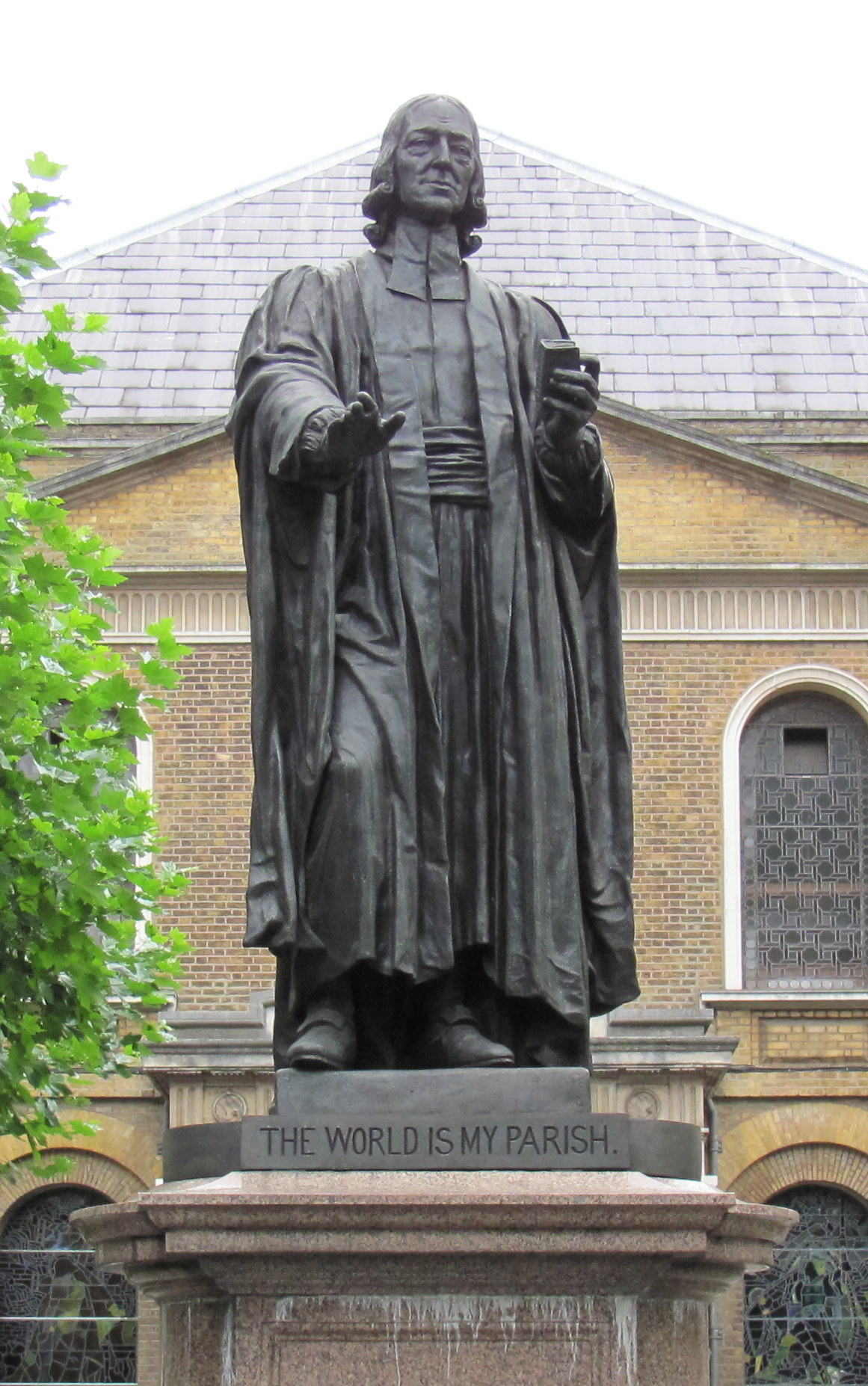
“I look upon all the world as my parish; thus far I mean, that in whatever part of it I am, I judge it meet, right, and my bounden duty to declare unto all that are willing to hear, the glad tidings of salvation.” –Journal, June 11, 1739.
Wesley’s itinerant ministry was challenged by some, because it meant that he crossed into the parishes of other priests of the Church of England, sometimes preaching in their territory without their permission. Wesley’s quote about the world being his parish is usually seen as his missional justification for preaching the gospel wherever he was. But he also knew that he was exempt from the parish boundary rules as a fellow of Lincoln College, Oxford. He had no parish of his own, and was free to preach where he liked. He used this to his advantage.
 James Pedlar