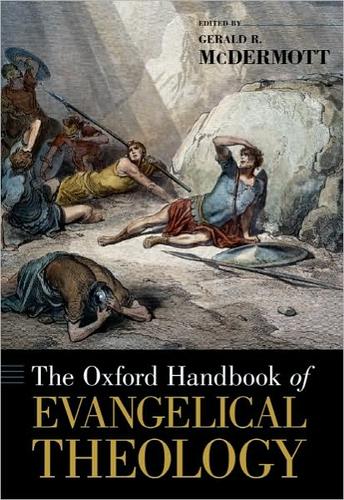
 Christianity Today has posted a fascinating article by Gordon T. Smith, excerpted from his essay on “Conversion and Redemption” in the Oxford Handbook of Evangelical Theology. The Handbook itself is a fantastic resource, though it is terribly expensive. Thankfully the libraries I have access to have bought the electronic version. Included in the Handbook are articles by my dissertation director, Ephraim Radner, on the church, and a chapter on spiritual gifts by Howard Snyder, who has been a mentor to me and many other Canadian Wesleyan theological students during his tenure as Chair of Wesley Studies at Tyndale Seminary.
Smith’s article argues that evangelical understandings of conversion are changing dramatically, and that a common feature that can be seen in the wide variety of changes in this regard is that, across the board, revivalism is being left behind:
It is not be an overstatement to say that evangelicals are experiencing a “sea change”—a paradigm shift—in their understanding of conversion and redemption, a shift that includes the way in which they think about the salvation of God, the nature and mission of the church, and the character of religious experience. Although there is no one word to capture where evangelicals are going in this regard, there is a word that captures what they are leaving behind: revivalism.
Smith offers a sketch of the ways that revivalism has impacted evangelicalism’s understanding of conversion: the focus on a dramatic one-time experience, often crystallized in the the saying of the “sinner’s prayer”; the emphasis on the afterlife; the practical distinction between “evangelism” and “disciple-making,” the emphasis on numeric growth, and so on.
 He then traces how developments in evangelical thinking in a number of different fields have challenged the revivalistic assumptions which characterized much of 20th century evangelicalism. New ideas in biblical studies, new approaches to religious experience, ecumenical influences, the changing face of global Christianity, and an increased interest in learning from Christian history have all combined to undermine the revivalist understanding of conversion.
Increasingly, there is appreciation that conversion is a complex experience by which a person is initiated into a common life with the people of God who together seek the in-breaking of the kingdom, both in this life and in the world to come. This experience is mediated by the church and thus necessarily includes baptism as a rite of initiation. The power or energy of this experience is one of immediate encounter with the risen Christ—rather than principles or laws—and this experience is choreographed by the Spirit rather than evangelistic techniques. Evangelicals are reappropriating the heritage of the Reformation with its emphasis on the means of grace, and thereby affirming the priority of the Spirit’s work in religious experience.
The excerpt ends with Smith pointing to the deeper issues that this sea-change will raise for evangelical thinking about the church.
The only question that remains, then, is whether evangelicals will trust these instincts and devote themselves to Christ-centered worship and kingdom-oriented mission. Will this be evident in deep trust that God will do God’s work in God’s time? To trust the work of God is to trust the Spirit and this necessarily means that the church trusts the Word—the Scriptures preached—as the essential means of grace and conversion.
This begs the question of what it means to be the church. The evangelical tradition is at a fork in the road and, given this sea change in the understanding of conversion and redemption, the most crucial issue at stake is what it means to be a congregation. Evangelicals will only be able to navigate these waters if they can formulate a dynamic theology of the church that reflects the Triune character of God, the means of grace—Spirit and Word—and a radical orientation in mission toward the kingdom of God.
The article is well worth a read. I think it helpfully draws together and summarizes some of the important developments that are taking place in contemporary evangelical thinking. While revivalism’s legacy includes many positive things, some aspects of revivalist thinking are deeply suspect, and a critical re-evaluation of its influence is most certainly needed. This was, in part, what I was trying to do in my article “Five Ways to Improve SA Worship” – I was highlighting the way in which Salvationist worship has been shaped by a kind of “routinized revivalism,” and arguing that there are aspects of this heritage that need to be jettisoned. The same kind of thing is happening on a much larger scale, and in relation to a broad range of topics. It is hard to say where any of this is going to end up, but I think this change in thinking about conversion certainly has potential to bear fruit in a genuine renewal of evangelical mission and theology.




 James Pedlar