Media from the Wesleyan-Pentecostal Symposium

We had a wonderful day at the Wesleyan-Pentecostal Symposium here at Tyndale on March 22. It was a pleasure to partner with Van Johnson and Master’s Pentecostal Seminary in hosting this event. Donald Dayton was his inimitable self and helped us to understand how significant it was to have a gathering of these two traditions, given our frosty relations in the past.  The other papers from scholars, pastors and graduate students provided a great deal of discussion material for the attendees.  More than one person commented to me about how engaged everyone was in the topic, discussing it over coffee breaks and lunch as well as in the sessions.

One of the benefits of moving to our new campus is that all our classrooms have very recently been outfitted with excellent audio-visual equipment. This made it very simple for us to record the presentations. The three plenary talks were recorded on video, and audio recordings of all the sessions were made as well. I’m grateful that all the presenters agreed to allow their recordings to be shared publicly after the event.

So, please take a moment to visit the symposium media page and make use of this excellent content.  I’ve embedded my own talk on Burns, Horner, and Burwash below.


Tyndale Wesley Studies News – September 2015


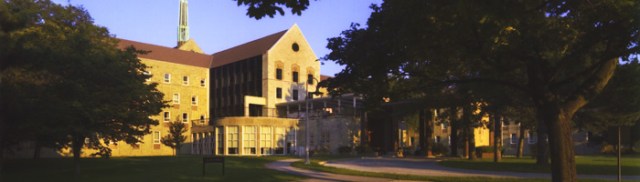
We are gearing up for another academic year at Tyndale, this time (finally) on our beautiful new campus.  It has been a bit of a chaotic summer, with all the disruption that comes along with a move, and I’m now looking forward to seeing this place filled with students in the next few days.

I’ve just sent out my most recent Wesley Studies newsletter, highlighting next year’s joint Wesleyan-Pentecostal Symposium on the role of experience in theology (March 22, 2016).  I’m really pleased to be bringing Donald Dayton to Toronto as our keynote, and I think we’ll have a great day of conversation about a topic that concerns both traditions.

There’s lots more in the newsletter about recent book releases (including the latest in the Tyndale Wesley series from Chris Payk and my own book, which I will blog about soon) and upcoming events and conferences in Toronto.  Take a look, and subscribe if you are interested.

bayview-chapel


Sermon Audio: A New Song and the New Creation (Psalm 96)

Last week I had the pleasure of spending five days with twelve fine seminary students, discussing “Creation and New Creation.”  You can find out about the course by reading the course syllabus here.  My goal for the week was lay some deep theological roots for engaging in the practice of creation stewardship. So our course included a range of topics: the Triune Creator, creation ex nihilo, the goodness of creation, general revelation, the image of God, sin, salvation, eschatology, and mission…an ambitious agenda to be sure!  But we were looking at each of these topics in relation to the question of humanity’s role as stewards of creation.  I hope it was successful in setting out creation stewardship as an issue that is deeply connected to core Christian doctrines – not at all a peripheral matter.

At Tyndale we often have summer school instructors preach during our weekly worship gathering, and so I had my first chance to preach in our new chapel on Bayview Avenue. It is an amazing worship space, as you can see from the image below.  My sermon was based on Psalm 96, keeping the themes of my course in mind, and also Tyndale’s transition to our new campus, which is still underway. Listen to the sermon below, or download the file here.

Tyndale Chapel by JDB Sound Photography via flickr

Wesley Studies News from Tyndale

Firefox_Screenshot_2014-12-17T20-17-25.932ZIn September I started a newsletter as a way to share information about events and resources of interest to the Canadian Wesleyan community.  Over the past seven years, the Tyndale Wesley Symposium has fostered a network of people interested in Wesleyan history and theology, and I hope this will be one more way of helping to connect that community. The second edition has now been sent out, and includes information on our 2015 Wesley Symposium, featuring Kevin Mannoia.  I’ll have more to say about the Symposium in a future post.

Go here to read the newsletter, and click the “subscribe” link in the top left corner if you want to sign up for future newsletters. The September edition can be accessed here.

Sermon: How Can I Keep from Singing? Psalm 126 [audio]

I was glad to have a chance to preach at Tyndale’s community chapel a couple of months ago, on Psalm 126.  The sermon is part of a series of “Journey” chapels – a series designed to help our community navigate through a year of transition to our new Bayview campus.  We’ve been looking at one of the Psalms of ascent for each of these chapel services.

I used this wonderful Robert Lowry hymn (written 1860) as a window into the message of the Psalm:

Robert Lowry via wikimediaMy life flows on in endless song;
Above earth’s lamentation
I hear the sweet though far off hymn
That hails a new creation:
Through all the tumult and the strife
I hear the music ringing;
It finds an echo in my soul—
How can I keep from singing?

What though my joys and comforts die?
The Lord my Savior liveth;
What though the darkness gather round!
Songs in the night He giveth:
No storm can shake my inmost calm
While to that refuge clinging;
Since Christ is Lord of Heav’n and earth,
How can I keep from singing?

I lift mine eyes; the cloud grows thin;
I see the blue above it;
And day by day this pathway smoothes
Since first I learned to love it:
The peace of Christ makes fresh my heart,
A fountain ever springing:
All things are mine since I am His—
How can I keep from singing?

Here is the audio, or you can download it from this site.

[audio https://ia600703.us.archive.org/30/items/20131119-sermon-my-life-flows-on/2013-11-19_Community_Chapel_James_Pedlar.mp3]

Sixth Annual Wesley Studies Symposium at Tyndale Seminary

Registration is now open for Tyndale’s annual Wesley Studies Symposium, taking place on March 25 at Tyndale’s new Bayview Campus.

haykin_lg_sqThis year, in honour of the 300th anniversary of George Whitefield’s birth, we’ll be welcoming Dr. Michael Haykin as our keynote speaker.  I am very pleased that this distinguished Baptist historian has agreed to come and make a presentation to our symposium. His talk is titled, ““The Revived Puritan”: The Life and Piety of George Whitefield.”

Here is a bit more from our event page:

2014 marks the 300th anniversary of the birth George Whitefield, friend, partner-in-ministry, and sometimes theological enemy of John Wesley. Because the lives of these two men are so intricately intertwined with one another, we are going to feature a paper on Whitefield as our keynote address at the Wesley Symposium.

Dr. Michael Haykin is a leading Baptist historian, who has published on a wide variety of topics, from the Church Fathers to Jonathan Edwards. He studied at the University of Toronto, where he earned a BA at Victoria College, and an MRel and ThD in church history from Wycliffe College. In addition to his position at Southern Seminary he is Director of the Andrew Fuller Centre for Baptist Studies, and an Adjunct Professor at the Toronto Baptist Seminary, where he previously served as President. His many books include Jonathan Edwards: The Holy Spirit in Revival (Evangelical Press, 2005); The God who draws near: An introduction to biblical spirituality (Evangelical Press, 2007); and Rediscovering the Church Fathers: Who They Were and How They Shaped the Church (Crossway, 2011).

bayview-campus-frontOther speakers for this year’s event include Dr. Claire MacMillan (National Director, Church of the Nazarene, Canada) Rev. Leonard Chester (Archivist of the Brethren in Christ Church, Canada), Rev. Dan Sheffield (Director of Global and Intercultural Ministries, Free Methodist Church in Canada), Rev. Michael Tapper (PhD Candidate, St. Paul University), Rebecca Nicol (PhD Candidate, McMaster Divinity College), and Rev. Dale Harris (Pastor, The Freeway Free Methodist Church, Oshawa).  You can find more information about the paper topics here.  We will also have a book panel on Lift Up a Standard: The Life and Legacy of Ralph Horner, including presentations from myself and Dr. James Robertson, and responses from authors Rev. Laurence Croswell and Mark Croswell.

Visit this page to find more information and to register.

Highlights from Len Sweet’s talks at the Wesley Ministry Conference

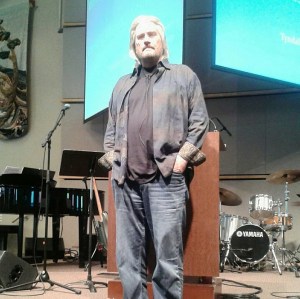
Len Sweet speaking at TyndaleThis year’s Wesley Ministry Conference at Tyndale was a great success.   Over 180 people from various Wesleyan denominations gathered to hear Leonard Sweet speak, and to take in a workshop on discipleship from Matt Eckert and Luc and Rosetta Del Monte.  It was a very engaging and thought-provoking day.

When Howard Snyder heard that Len Sweet was coming to the conference, he commented that Sweet could give you enough ideas in five minutes to keep you thinking for five days.  It’s been a week since the conference, and I think Howard was right.

While I wouldn’t attempt to give a total summary of all Len Sweet said last Monday, here are three of the big themes from his talks that have stuck with me:

1. Leadership as a function vs leadership as an identity.  He began in the morning by addressing this topic, and lamented that in the past few years, the church has turned “leadership” into an identity, when it should really only be conceived as a function which people exercise at various times.  Our identity, rather, is as followers, not leaders; we are disciples first and foremost, but at times some of us have to provide a leadership function.  He asked the pointed question, “How many followership conferences have you been to in the past five years?”  Churches have spent a lot of time and energy trying to take on ideas and practices from the business world, often without reflecting theologically on how these ideas square with Christian discipleship.  This is something I’ve been concerned about for some time (I wrote about it three years ago), so I was glad to hear him address it on Monday (if you are interested in this issue check out his book I Am A Follower).
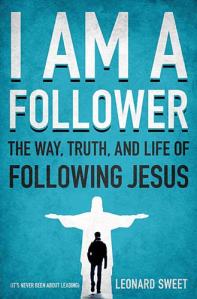
Sweet I am a Follower2. Mission stories vs mission statements.  Connected with the above point, Sweet addressed the issue of “mission statements,” one of the business practices that the church has taken up in recent decades.  He suggested that the church already has a mission statement – the great commission – but that we make up our own mission statements because we don’t like the one we’ve been given!   More importantly, Sweet was reflecting on how contemporary culture doesn’t connect well with truths communicated via “statements.”  This is familiar territory for students of post-modern culture – the idea that in contemporary Western culture, truth is most readily accepted as embodied in narrative and metaphor (or “narraphor” as Sweet stated it), rather than in propositional statements.  Sweet took this larger cultural trend and applied it to the church’s mission: it ought not to be articulated in a statement; rather, we need the story of the gospel to shape our mission in a compelling way.  He made a similar point in relation to preaching, saying that “points” don’t communicate to a “Google culture,” though they connected well in the “Gutenberg culture.”

3. Dirty hands and a clean heart.  Sweet then exemplified the ideas he’d been sharing by offering a “narraphor of holiness.”  Beginning with the incarnation as the revelation of God’s holiness, he focused in particular on foot-washing as an example of God “getting his hands dirty” in the world. Against our tendencies to view holiness as a kind of purity that remains separate from the world, Sweet stressed that true Christian holiness is normed by the story of God’s self-giving in the incarnation.  Thus, dirty hands are the evidence of a clean heart.

I’m really glad we had a chance to host Len Sweet here at Tyndale – he definitely gave us lots to think about.  You can read another report on the day on the Tyndale website.

Mainz altar painting via wikimedia commons

Wesley Ministry Conference with Leonard Sweet: Rediscovering Transformational Discipleship, April 29

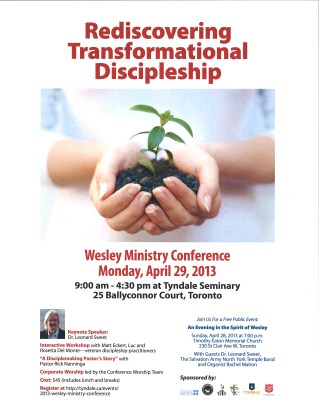
Ministry Conference posterLast week I posted about Tyndale’s upcoming Wesley Studies Symposium.   The Wesley Studies Committee has also been hard at work planning an event aimed at a broader audience of church leaders.  This will be the second time they have hosted a “Wesley Ministry Conference,” the first one featuring  Timothy Tennent in 2009.

This year’s ministry conference will take place on Monday April 29 here at Tyndale, and features prominent author Leonard Sweet.  Sweet is currently the E. Stanley Jones Professor of Evangelism at Drew University, in Madison, NJ, and is known as a creative thinker and exceptional communicator.  The theme for the day is “Rediscovering Transformational Discipleship,” and it will also feature workshop style presentations from some experienced practitioners: Matt Eckert, and Luc and Rosetta Del Monte.

The cost is $45, and registration is available here.

Please spread the word about this important event – we are blessed to have secured Leonard Sweet as our speaker, and I’m sure it will be a fruitful day of engagement with the challenges of discipleship in today’s context.

The night before the conference, a public worship service dubbed “An Evening in the Spirit of Wesley” will be taking place at Timothy Eaton Memorial Church in Toronto (7PM).   This service will also feature Leonard Sweet, along with The Salvation Army North York Temple Band and organist Rachel Mahon.

Hopefully many of you will be able to make one or both of these events!


Fifth Annual Wesley Studies Symposium at Tyndale Seminary

Richard Watson via wikimedia commonsOnce again this year Tyndale Seminary is hosting a Wesley Studies Symposium.   This symposium aims not only to promote Wesleyan scholarship in the Canadian context, but also to help build a network of people interested in Wesleyan theology and history.

Although this is an academic event, we purposely blur the lines a bit between scholarship and ministry, in part because it is thoroughly Wesleyan to integrate theology and practice.  So we typically have a nice mix of academics, graduate students, and practitioners in attendance.

The Symposium is scheduled for Tuesday March 12, and we have another interesting lineup of papers covering a range of topics and disciplines.   The papers to be presented this year are:

  • “Rediscovering Discipleship as a Pathway to Ekklesial Reformation – Wesley did!!” by Cliff Fletcher (Pastor, Whitby FMC / DMin graduate, Gordon-Conwell).
  • “The Importance of Richard Watson’s Theological Institutes for Methodist History,” by Barry Hamilton (Northeastern Seminary).
  • “Leading with the Ear: The Church as a Listening Community,” by Aaron Perry (Pastor, Centennial Road Standard Church / PhD Candidate, Regent University).
  • “The Character of God Revealed by The Incarnate Word in the Theology of John Wesley,” by Niven Harrichand (ThM graduate, Tyndale).
  • A Book Panel on Witnesses of Perfect Love: Narratives of Christian Perfection in Early Methodism, by Amy Caswell [Panelists TBA]

After dinner we will have a guest lecture by Donald E. Burke (President, Booth University College, Winnipeg) on “Salvation for Both Worlds: Contours of a Wesleyan/Biblical Social Theology.”

Registration is free, and you can sign up here. Please spread the word about this event among those who might be interested.

Mission and Unity

I’ve recently published an article in Missio Dei: Tyndale Seminary’s Journal of Missional Christianity,  entitled “That the World May Believe: Mission and Unity.”   It’s not a long read, and not overly specialized, since Missio Dei is a journal aimed at all Christian leaders, not just academics.  The journal aims to utilize the expertise of faculty and friends of the Tyndale community in such a way as to help equip Christian leaders in their day to day participation in God’s mission.

The article begins with John 17, in which Jesus prays for the church to be one, “so that the world may believe that you have sent me.”  This text suggests that there is a strong connection between Christian unity and Christian witness.  However, Christians have never really been able to agree as to what Jesus was really saying when he prayed “that they may be one.”

The article proceeds with a discussion of seven different approaches to Christian unity: spiritual, visible, structural, doctrinal, service, mutual recognition, koinonia.   Some of these approaches are usually identified with one particular Christian tradition, but they are not mutually exclusive, and can be combined in various ways.

The second half of the article suggests that evangelicals in particular could re-examine their aversion to one of these approaches: visible unity.

I would also sug­gest that, in a post-Christendom con­text, it is time to re-examine evangelicalism’s char­ac­ter­is­tic aver­sion to con­cep­tions of “vis­i­ble unity.” In a pre­vi­ous era, when estab­lished state churches could insti­tute a kind of false unity by coer­cion, it made sense for evan­gel­i­cals to resist such con­cep­tions of “vis­i­ble” unity and stand up for our free­dom to assem­ble and wor­ship accord­ing to con­science. How­ever, we no longer live in a time when state power is aligned with one par­tic­u­lar denom­i­na­tion, and so the idea of a “vis­i­ble unity” need not carry those con­no­ta­tions. We have also rightly resisted approaches to unity which pushed towards the build­ing of a “super­church” with a cen­tral­ized bureau­cracy. But “vis­i­ble unity” need not be taken in this direc­tion, either.

To say that our unity ought to be “vis­i­ble” is sim­ply to say that the church’s unity must take shape in the world, as the church lives out its life in space and time. We can’t just pay lip-service to the unity we have been promised in Christ. In order for our unity to serve the pur­pose of wit­ness­ing to the world about Jesus, it must be a unity that is on dis­play for the world to see.

Head on over to Missio Dei to read the whole article, and while you’re there, check out the archives.