John Wesley and the Mission of God, part 6: the new creation

In the later years of John Wesley’s life, the new creation became a dominant theme in his thinking and writing.  To a large extent, he embraced an integrated view of God’s creation, avoiding the typical spirit vs. matter dualism that so often lies beneath the surface of Western Christian thought.

This meant that Wesley did not treat issues relating to the physical world as unimportant, because all of creation was created good in its very physical reality, and because God’s plan of salvation includes the deliverance of creation (not its destruction, as some believe).

These convictions are reflected in a number of ways, including Wesley’s interesting reflections on the suffering of animals (see Sermon 60) and on the original state of creation before the fall (see Sermon 56, §I.1-14).

But it becomes especially clear as Wesley thinks through issues of eschatology, where it becomes clear what he thinks “the new creation” means – not disembodied souls floating in the clouds, but a new heavens and a new earth.

His sermon bearing the title “The New Creation” makes this clear, as he tries to think cautiously but imaginatively about what the new heavens and the new earth will be like.  For example, he suggests that there will be no more comets (§8), no more hurricanes or destructive storms (§9), no polluted water (§12), no volcanoes (§15), and no animal suffering (§17).

But the climax of his vision of the new creation comes in the closing paragraph, where Wesley discusses the deliverance of human beings to “an unmixed state of holiness and happiness far superior to that which Adam enjoyed in paradise.”  He concludes that,

…to crown all, there will be a deep, an intimate, an uninterrupted union with God; a constant communion with the Father and his Son Jesus Christ through the Spirit; a continual enjoyment of the Three-One God, and of all the creatures in him! (Sermon 64, “The New Creation,” §18)

This category of “new creation,” of course, was not just about the future restoration of all things, but was very important to Wesley’s understanding of salvation itself.  Of course, 1 Cor. 5:17 uses this same big-picture concept of new creation in relation to the salvation of the person – “So if anyone is in Christ, there is a new creation.”   The problem is that many Christians never see the big picture implied in this verse – that is, that their participation in the new creation is part of the bigger picture of God’s restoration of all creation.  The goal of God’s work of redemption is not to take disembodied souls out of creation, but to bring about a new heavens and a new earth, which includes resurrected and transformed human beings.  Therefore, for human beings, salvation means not only “continual enjoyment of the Three-One God” but also “of all creatures in him!”

This has two obvious implications for mission.

First of all, if our vision of salvation is a physically resurrected humanity, where all physical ailments and infirmities are healed, then meeting physical needs in the present is not irrelevant to the church’s mission.  God obviously values the physical well being of his creatures.  Therefore, our own work of physical healing, and meeting the basic needs of human beings can be an anticipation of God’s own final restoration.  Meeting physical needs can be a witness to the future new creation.  It is not surprising, then, that John Wesley was very interested in physical health and healing, as well as preaching the gospel.

The second implication is that our mission should include care for the created world.  God’s plan of salvation includes the restoration of the earth, as well as the resurrection of human beings.  Humanity was originally created in the context of creation as a whole.  It is not surprising then, that God’s new creation will also put humanity in the context of a transfigured creation, which will include not only a physical earth, but – we have every reason to expect – a new and transformed ecosystem, including and plant and animal life.  Because of this, proper stewardship of the present creation can be a witness to and participation in the new creation which has begun in the resurrection of Jesus.

[If you are interested in looking into this second implication at greater depth, I recommend the new book by Howard Snyder and Joel Scandrett, Salvation Means Creation Healed.]

John Wesley and the Mission of God, part 5: Social Holiness

In the preface to Hymns and Sacred Poems, published in 1739, John Wesley wrote,

“Holy Solitaries” is a phrase no more consistent with the gospel than holy adulterers.  The gospel of Christ knows of no religion, but social; no holiness but social holiness.

Wesley was particularly concerned about any spirituality influenced by the Mystics, who elevated individual contemplation to the highest ideal – a move that, Wesley suggested, undermined the importance of loving neighbour in both both word and deed.

But we must be careful to note that, for Wesley, “social holiness” did not simply mean “social justice.”  Social holiness begins in Christian community, and therefore has everything to do with the internal life of the church.  The fellowship of believers is the place where social holiness is cultivated and exercised, but it also spills over the boundaries of the church and reaches out to those who are outside of the fellowship.

In 1749, in answer to the objection that the Methodist Societies were divisive and disrupted Christian fellowship in the established parishes, Wesley wrote:

But the fellowship you speak of never existed. Therefore it cannot be destroyed.  Which of those true Christians ever had any such fellowship with these?  Who watched over them in love? Who marked their growth in grace? Who advised and exhorted them from time to time?  Who prayed with them and for them as they had need? This, and this alone is Christian fellowship.  But alas! Where is it to be found?…The real truth is just the reverse of this: we introduce Christian fellowship where it was utterly destroyed.  And the fruits of it have been peace, joy, love, and zeal for every good word and work. (A Plain Account of the People Called Methodists, §I.11)

Because salvation for Wesley was not simply about “souls” going to heaven, but about loving God and neighbour, he realized that the holiness was a reality which needed to be lived out in community.  And not only is Christian fellowship the necessary consequence of a holy life, but true Christian koinonia is also the means whereby the Spirit forms the mind of Christ in us.

Wesley was fully aware the the life of the church is messy, and sometimes painful.  But even through the difficulties of church conflict, the Christian community remains the place where Christians are formed after the mind of Christ, and learn to walk as he walked.  This, of course, includes Christian discipline, as a necessary part of Christian fellowship, and a necessary part of the church’s life as a covenant community.

Therefore the mission of God requires the church as the people of God, as a living, embodied reality.  The church is not an afterthought to mission, and Christian community is not an obstacle to mission, but the vehicle through which mission takes place.   Though Wesley felt he needed to create new structures and new forms of community to produce true Christian fellowship, he did not suggest (as many, who are understandably disillusioned with the church do today) that we can live out our faith in the world without being a part of the fellowship of believers.  This fellowship is the foundation of social holiness, and “zeal for every good word and work” is one of the fruits that grows from this root.

John Wesley and the Mission of God, part 4: Christian Perfection

John Wesley’s most distinctive theological theme was his emphasis on Christian perfection.  His ideas were controversial, and volumes upon volumes of books have been published to try to explain, defend, or dismiss Wesley’s position.

In a brief post like this I can’t really get into the details of the debates, but I can put forward my own interpretation of what I think Wesley was trying to say about holiness, and how it ought to shape a theology of the mission of God.

First, we need to make some clarifications about the word “perfection.”  In our culture we assume that perfection implies the complete absence of flaws of any kind.  Since we know that nobody is perfect (in this sense), it seems ridiculous to say speak of Christian perfection.

Wesley did not use the term “perfection” in a way that implied “flawlessness.”  In other words, he did not believe anyone could reach a state of sinless perfection in this life.  He did not teach that we should strive for absolute perfection, but for Christian perfection, a perfection which is fitting for a redeemed but flawed and frail human creature.  This kind of perfection is not static, but dynamic, personal, relational, and made possible by divine grace alone.  It is  a relative perfection, a perfecting perfection which always admits greater degrees.

Wesley was at his best when he defined Christian perfection as “perfect love”:

But what is perfection?  The word has various senses: here it means perfect love. It is love excluding sin; love filling the heart, taking up the whole capacity of the soul.  It is love ‘rejoicing evermore, praying without ceasing, in everything giving thanks’ (Sermon 43, “The Scripture Way of Salvation,” §I.9).

In other words, Wesley believed it was really possible for Christians to love God with heart, soul, strength, and mind, and love our neighbours as ourselves.   What this meant in a practical sense was that he believed we could be so filled with the love of God that we would not knowingly sin.  Even someone whose life was characterized by Christian perfection would continue to sin, and would continue to need the atoning blood of Christ at every moment.  But, Wesley believed, a Christian could be so overwhelmed by God’s love that their intentions would always be for the good.

These ideas are still controversial, and much more could be said.   I’ve said a bit more about this in a previous post, which you can find here.

An idea which was so central for Wesley and which continues to be a central aspect of Wesleyan theology today must have missional implications.  I would like to highlight three.

The first connects with my last post about the therapeutic nature of salvation.  Salvation is not simply about gaining a ticket to heaven, but about the healing of the sickness which has corrupted us.  Part of the church’s role in God’s mission is to be a community which cultivates the healing grace of God – that is, a community which moves its members towards Christian perfection.  Even if we disagree with Wesley on the degree to which this is possible in this life, we can still affirm that the Christian life ought to head in the direction of perfection.  Or perhaps it would be less of a stumbling block to say that the Christian life should head in the direction of maturity, or a kind of completeness that is fitting for sinners saved by grace.

Secondly, the church ought therefore, to demonstrate the salvation of God, not only in word, but in the manner of its life together.  The church is called to grow up into the fullness of Christ, personally and corporately.  Wesley was particularly fond of the Gospel of John and the epistles of John, and took quite seriously Jesus words in John 13:35 – “By this shall all men know that ye are my disciples, if ye have love one to another.”  The character of the church’s life together is part of our witness to the world.  Again, we think of Jesus’ great high priestly prayer in John 17 – “That they all may be one; as thou, Father, art in me, and I in thee, that they also may be one in us: that the world may believe that thou hast sent me.”  Our unity, our love for one another, is intricately connected to God’s mission.  He established the church to be a living demonstration – a sign, instrument, and foretaste of the kingdom of God – so that the world might know him.  Sadly, Christians often do a very poor job of this.

Again, this theme highlights the fact that the Church’s community life, including its various edifying and sanctifying practices, are themselves part of God’s mission.  Community life and mission should not be played off against one another.

John Wesley and the Mission of God, part 3: A Therapeutic Understanding of Salvation

John Wesley’s theology of salvation is sometimes said to combine the best of both the Western and Eastern traditions, meaning he combines a forensic understanding of salvation with a therapeutic understanding of salvation.    Western Christianity has tended to focus on sin as a guilt problem, and therefore preached salvation primarily in terms of forgiveness (forensic/legal language).    The Eastern tradition has tended to focus on sin as a sickness problem, and therefore preached salvation primarily in terms of healing (therapeutic language).

Wesley was able to draw on both of these traditions by integrating the Western concern with guilt into an Eastern-influenced therapeutic understanding of salvation.   This meant that, overall, Wesley saw salvation as a dynamic, relational process of healing from all the sickness of sin, but included the classic protestant understanding of justification as an important aspect of this process.

Consider the following two quotes, illustrating these two aspects of salvation.

Forensic: Sermon 43, “The Scripture Way of Salvation,” §I.3

Justification is another word for pardon. It is the forgiveness of all our sins; and , what is necessarily implied therein, our acceptance with God. The price whereby this hath been procured for us (commonly termed “the meritorious cause of our justification”), is the blood and righteousness of Christ; or, to express it a little more clearly, all that Christ hath done and suffered for us, till He “poured out His soul for the transgressors.” The immediate effects of justification are, the peace of God, a “peace that passeth all understanding,” and a “rejoicing in hope of the glory of God” “with joy unspeakable and full of glory.”

Therapeutic: Sermon 57, “On the Fall of Man,” §II.8

Hath he not then, seeing he alone is able, provided a remedy for all these evils? Yea, verily he hath! And a sufficient remedy; every way adequate to the disease… Here is a remedy provided for all our guilt: He “bore all our sins in his body on the tree.” And “if any one have sinned, we have an Advocate with the Father, Jesus Christ the righteous.” And here is a remedy for all our disease, all the corruption of our nature. For God hath also, through the intercession of his Son, given us his Holy Spirit, to renew us both “in knowledge,” in his natural image; — opening the eyes of our understanding, and enlightening us with all such knowledge as is requisite to our pleasing God; — and also in his moral image, namely, “righteousness and true holiness.”

The point of what I’m trying to say is that salvation, for Wesley, is  not found simply in being “declared” righteous (justification), but in being healed of all the corruption of sin, and conformed to the likeness of Christ.   Therefore, the salvation that God has prepared for us is something which begins now, but extends to the resurrection.  People sometimes speak of receiving forgiveness of sin as “being saved,” but this is not the whole story. Justification is one aspect of salvation, but properly speaking, salvation includes regeneration, justification, sanctification, and glorification.  These terms are ways of describing the initial, ongoing, and final deliverance from sin.

This has important implications for our understanding of the mission of God.  Mission is not simply about gaining “converts,” but also about cooperating with the Spirit’s healing work in people’s lives.   This also means that God’s mission is not only for those outside the church but for believers as well, who are currently experiencing the ongoing healing work of God in their lives.

In other words, mission is not only “outreach” but also includes the corporate life of the church.  Cultivating holiness, spurring one another on in our response to God’s ongoing work in our lives, teaching, catechizing, discipling – all these things which help to form people as disciples are part of the church’s mission

Wesley’s therapeutic understanding of salvation could be extended to other areas of “healing” (social, psychological, environmental), but I will leave that for another post.

John Wesley and the Mission of God, part 2: Prevenient Grace

I began this series last week by talking about the importance of the image of God for John Wesley’s theology.    As an heir of the theological legacy of the protestant Reformation, Wesley also believed in total depravity.  This means, not that human beings are totally evil, but that sin has corrupted every aspect of the human person, such that there is no aspect of our existence which is not affected by the Fall.  Those who accuse Wesleyans of being “soft” on sin have misread Wesley’s theology at this point.

While it is true that Wesley was somewhat more “optimistic” about humanity, his optimism sprang not from a weak understanding of sin, but from a high view of grace – hence Wesleyans sometimes speak of the “optimism of grace” (more on that later).

In other words, while Wesley believed human beings to be completely depraved and helpless in and of themselves, he believed that God had not left anyone to merely fend for themselves.  God’s grace, for John Wesley, permeates all of creation, not only the Christian church.  As an unconditional benefit of the atonement, extended to all humanity, God’s Spirit is actively at work in all creation, drawing people to himself through his grace.   This is what Wesleyans call “prevenient,” “preventing,” or “preceding” grace – it is our experience of God’s grace “going before” us, enabling us to respond to God’s call on our lives.

The following quote from Wesley’s Sermon 85, “On Working Out Our Own Salvation,”  §III.4, is illustrative of how Wesley used this concept:

… allowing that all the souls of men are dead in sin by nature, this excuses none, seeing there is no man that is in a state of mere nature; there is no man, unless he has quenched the Spirit, that is wholly void of the grace of God. No man living is entirely destitute of what is vulgarly called natural conscience. But this is not natural: It is more properly termed preventing grace. Every man has a greater or less measure of this, which waiteth not for the call of man. Every one has, sooner or later, good desires; although the generality of men stifle them before they can strike deep root, or produce any considerable fruit. Everyone has some measure of that light, some faint glimmering ray, which, sooner or later, more or less, enlightens every man that cometh into the world. And every one, unless he be one of the small number whose conscience is seared as with a hot iron, feels more or less uneasy when he acts contrary to the light of his own conscience. So that no man sins because he has not grace, but because he does not use the grace which he hath.

Wesley used the idea of prevenient grace in “broad” sense to refer to the restraint of evil throughout the world (similar to the Calvinist idea of “common grace”), and in a more narrow sense to refer to grace drawing people to faith in Christ.

Because Wesley affirmed total depravity, he had to claim that any good action, no matter who performed it, must attributed to prevenient grace. In other words, “First. God worketh in you; therefore you can work: Otherwise it would be impossible” (Sermon 85, “On Working Out Our Own Salvation,” §III.3).

Again, we see the universal dimensions of God’s mission to the world shining through in Wesley’s thinking.  Just as all people were created in image of God and now suffer the debasement of that image by sin, so also God is actively pursuing all people by his prevenient grace.

This means that the church’s missional activity is always preceded by God’s prior gracious action.  God is already at work in the lives of every person we come into contact with.  The witness of the church remains essential, however, as God’s chosen means of spreading the message of salvation.

Prevenient grace also provides us with a way of affirming the good in people outside of the Church.   God’s grace is at work in all peoples, in all cultures.  Therefore we can affirm the good in people of other religions, without denying the uniqueness of Jesus Christ as the only saviour; because whatever good is there is due to the grace of the triune God, and is ultimately a benefit of the universal atonement.

Prevenient grace therefore provides an essential piece of a Wesleyan theology of the mission of  God, which extends the hope of salvation to all people, not merely an elect few.

John Wesley and the Mission of God, part 1: The Image of God

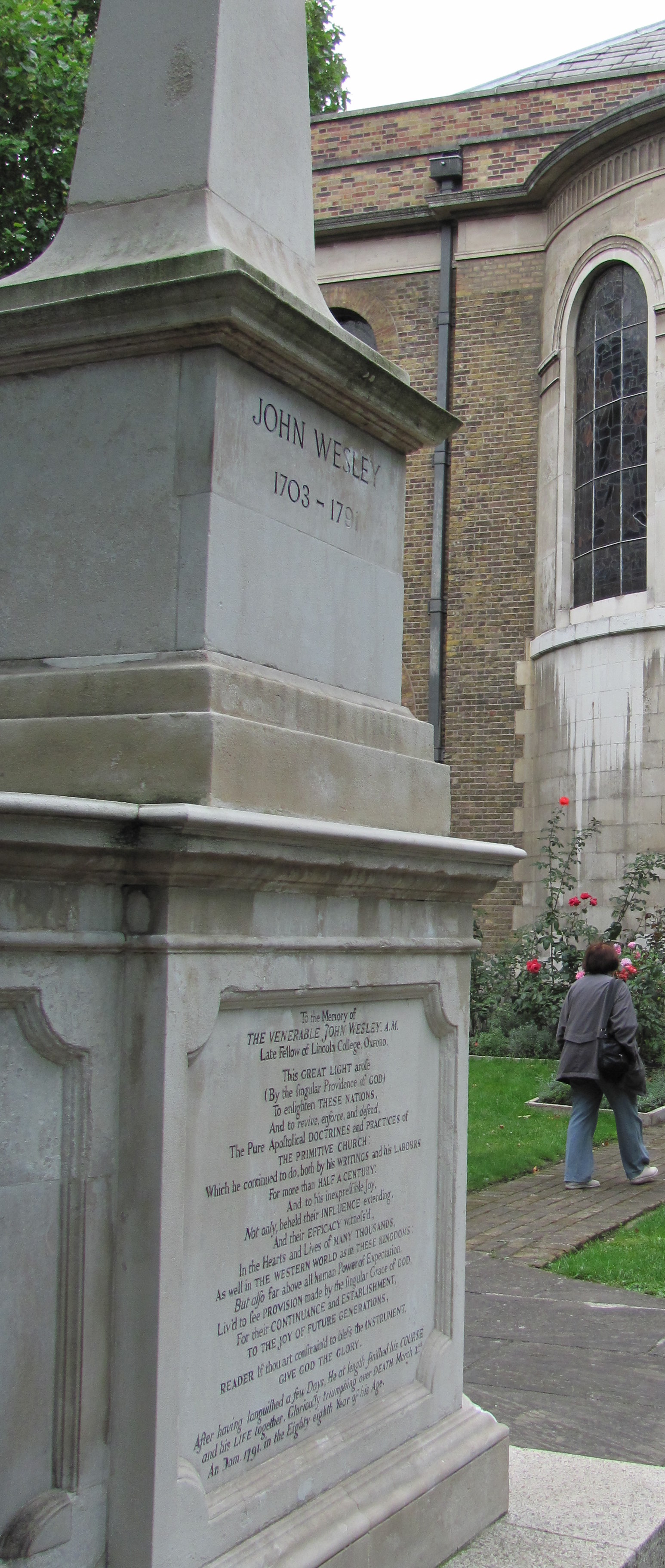
Wesley's tomb at Wesley Chapel, City Road, LondonToday I am beginning a series of posts on aspects of Wesley’s theology as they relate to the theology of the mission of God.  In recent years, evangelical theology has thoroughly embraced the missio dei concept as a way of re-framing the question of Christian mission.   By beginning the discussion of mission with the mission of God, we make it clear that Christian mission is not primarily the Church’s mission, but God’s mission, which includes the church.

John Wesley’s theology is rich with themes that could be developed into a theology of the mission of God.   Howard Snyder has written an excellent essay on this topic in his recent book Yes In Christ: Welseyan Reflections on Gospel, Mission, and Culture (Clements Academic, 2011).   My series takes its inspiration from Howard’s essay in that volume, entitled “Toward a Wesleyan Theology of Mission” (pp. 69-98), though I’ll be discussing some themes he doesn’t address.

As I mentioned in a previous post, Wesley does theology primarily from a salvation history perspective, rather than a “systematic” perspective.  So it is fitting to begin this series by discussing the topic that Wesley often begins his sermons with – the image of God.

The following quote, from Wesley’s 1760 sermon, “The New Birth,” represents the heart of Wesley’s perspective on the image of God:

“And God,” the three-one God, “said, Let us make man in our image, after our likeness. So God created man in his own image, in the image of God created he him:” (Gen. 1:26, 27:) — Not barely in his natural image, a picture of his own immortality; a spiritual being, endued with understanding, freedom of will, and various affections; — nor merely in his political image, the governor of this lower world, having “dominion over the fishes of the sea, and over all the earth;” — but chiefly in his moral image; which, according to the Apostle, is “righteousness and true holiness.” (Eph. 4:24.) in this image of God was man made. “God is love:” Accordingly, man at his creation was full of love; which was the sole principle of all his tempers, thoughts, words, and actions. God is full of justice, mercy, and truth; so was man as he came from the hands of his Creator. God is spotless purity; and so man was in the beginning pure from every sinful blot; otherwise God could not have pronounced him, as well as all the other work of his hands, “very good” (Gen. 1:31.) (Sermon 45, “The New Birth,” §I.1)

Notice that Wesley speaks of the image of God as threefold

1. The NATURAL IMAGE consists of those endowments given to the creature which make us capable of entering into conscious relation with God (notably, understanding, will, and freedom).  The natural image has been lost in part after the fall, such that all of these faculties have been impaired.  Our understanding does not function properly, so we make mistakes.  Our will does not function properly, because we have lost our freedom and are now in bondage to sin.  But God intervenes by his prevenient grace to restore a measure of freedom to fallen humanity (more on this in the next post).

2. The POLITICAL IMAGE consists of God’s endowment of the creature with faculties of leadership and management, making us stewards of creation.  Though this is expressed as “dominion” over creation, note that because this is an aspect of the image of God, human dominion over creation is to reflect God’s love.  In other words, we image God politically insofar as God’s benevolence is reflected in our stewardship of creation.

3. The MORAL IMAGE is not a capacity or a function but a relationship, marked by love.  In other words, the moral image is not, in the first instance, about a kind of legal status.  It is about being filled with love, as God is filled with love, and having our capacities and functions directed by love.  Because God is love, we are to reflect God’s love, continually receiving it and reflecting it back to him in love, obedience, prayer, praise, works of mercy, and so on.

Wesley's House, City Road, London-1What does all of this have to do with mission?

It means, first of all, that the story of God’s mission begins with good news. All people are created in God’s image, and were therefore created “capable of God.”  Though the image has been compromised by sin, the fact remains that all people were created to bear God’s image, and therefore all are called to experience God’s restoring grace.

If you read Wesley’s sermons, you will notice that he often begins his sermons with a description of the image of God before the fall.  That is, he does not begin with the problem of sin, but with God’s intention for all of humanity, and the dignity that all human beings bear by virtue of their original creation in the image of God.

Secondly, we see that, from the very beginning, then, the mission of God is universal in scope, not for an elect few.  All people were created in God’s image, therefore God’s love extends to all, and his redemption is open to all.  God’s intention, after the fall, continues to be that all human beings should be filled with love, and that this love should direct all their thoughts, words, and deeds.

John Wesley’s Theological Interpretation of Scripture

Last week I was assisting Howard Snyder as he taught the class “John Wesley and the Mission of God” at Tyndale Seminary.  Towards the end of the class I asked the students about their general impressions of Wesley’s sermons.  One of the first comments was that Wesley doesn’t really do “exegesis” of a text.   Rather, he usually takes a single verse as his starting point and then expounds upon a theme.  His sermons are, in a sense, more “topical” than “exegetical.”

Personally, I’m quite wary of topical preaching.  Typically it means that the preacher begins with a topic, knowing what they want to say, and then goes to the Bible to find a verse or passage that supports their preconceived idea.   Scripture then becomes (in the worst case scenario) a prop to support the preacher’s ideas.  The better way, then, is to begin with a passage of scripture and a blank sheet of paper – no preconceived agenda, other than allowing the text to speak to the particular context in which you are preaching.

Having said that, it would be wrong to dismiss Wesley’s sermons as examples of “topical” preaching.   Although his preaching is not exegetical in the contemporary sense of the term, I would argue that his sermons are thoroughly biblical, in that they arise out of Wesley’s consistent theological interpretation of scripture.

This point is underscored by an excellent essay, “Wesley as Biblical Interpreter,”  by Robert Wall, which is included in the recent Cambridge Companion to John Wesley.   Though, as Wall indicates, Wesley is sometimes misread by some as an uncritical biblicist, a closer reading reveals that he can be seen as “an exemplar of theological interpretation of the Bible.”

Wesley had a keen sense of the overall shape of the Biblical narrative, centred on the saving message of salvation by faith, and read through the Epistle of 1 John as the simplest and most sublime statement of the gospel.  While it might seem arbitrary for Wesley to give 1 John primacy of place, his logic was that the Apostle John lived the longest, and his writings were the last, and therefore, the most advanced witnesses to Christ.

Consider this quote from Wesley’s Journal, July 18, 1765:

In the evening I began expounding the deepest part of the holy Scripture, namely, the first Epistle of St. John, by which, above all other, even inspired writings, I advise every young Preacher to form his style.   Here are sublimity and simplicity together, the strongest sense and the plainest language!  How can any one that would “speak as the oracles of God,” use harder words than are found here?

The reality is that every interpreter makes these kinds of choices, but most protestants read the Biblical canon through Pauline eyes, rather than Johannine (which is generally seen as the Eastern preference).  Not that Wesley spent all his time in 1 John.  His sermons are peppered with scriptural quotations and allusions which range throughout the biblical canon.   But 1 John served as a kind of hermeneutical key for Wesley.  As Wall summarizes:

Whereas Wesley’s extensive use of biblical citations and allusions in his sermons instantiate an interest in letting each part of Scripture engage the whole – obscure texts illuminated by more lucid ones – his final court of appeal is 1 John.  (“Wesley as Bibilcal Interpreter,” p. 117-118).

Wall also goes on to list ten “interpretive practices” in which Wesley engaged as a biblical interpreter (his headings, my summaries in brackets):

  1. The intuited text (role of the HS)
  2. The naked text (use of critical tools to understand the literal sense)
  3. The canonical text (sense of the way the whole of scripture fits together)
  4. The community’s text (reading scripture in the church, alongside other interpreters)
  5. The salvific text (reading scripture “for salvation”)
  6. The ruled text (use of the “analogy of faith” – the non-negotiable core of Christian faith – as a rule for interpreting each part)
  7. The preached text (translating the text to the immediate context)
  8. The responsive text (interpreting scripture so as to be changed by it)
  9. The performed text (relating scripture to Christian experience)
  10. The sacramental text (using scripture as means of grace for the community)

These practices, so helpfully illuminated by Wall, give us a rich picture of Wesley as a nuanced interpreter, who was well attuned to important theological and pastoral issues as he read scripture – a far cry from an uncritical biblicist!

The essay is well worth reading if you are a student of Wesley.

A Hymn for Ascension Day

One of my favourite Charles Wesley hymns is “Arise my Soul, Arise.”  Originally published in Hymns and Sacred Poems in 1742, it was included as no. 194 in A Collection of Hymns for the Use of the People Called Methodists (1780).

The hymn emphasizes the assurance that comes from knowing that the sufficient once-for-all sacrifice of Christ is forever made effective through the ongoing high priestly work of the same ascended Lord, who intercedes on our behalf continually.   Assurance, therefore, comes not from an inner feeling or from self-examination but from the objective reality of Christ’s fully sufficient work on our behalf.  This assurance is communicated to us through the testimony of the Spirit, who assures us of our forgiveness and adoption specifically by witnessing to the very same saving work of Christ for us.

Scripturally, the hymn recalls several passages from Hebrews, notably 4:14-5:10, and chapter 10:1-25.

I grew up singing this to the tune “Darwall” (better known for “Rejoice the Lord is King), but online I’ve heard a number of other arrangements, including some new tunes.   You can find a nice one by Kevin Twit on the Indelible Grace hymn site, here.

1 Arise, my soul, arise,
Shake off thy guilty fears,
The bleeding sacrifice
In my behalf appears;
Before the throne my surety stands;
My name is written on his hands.
*
2 He ever lives above
For me to intercede,
His all-redeeming love,
His precious blood to plead;
His blood atoned for all our race,
And sprinkles now the throne of grace.
*
3 Five bleeding wounds he bears,
Received on Calvary;
They pour effectual prayers,
They strongly speak for me;
Forgive him, O forgive, they cry,
Nor let that ransomed sinner die!
*
4 The Father hears him pray,
His dear anointed one,
He cannot turn away

The presence of his Son:
His Spirit answers to the blood,
And tells me, I am born of God.
*
5 My God is reconciled,
His pard’ning voice I hear,
He owns me for his child,
I can no longer fear;
With confidence I now draw nigh,
And Father, Abba Father, cry!

Doctrine in The Salvation Army Tradition

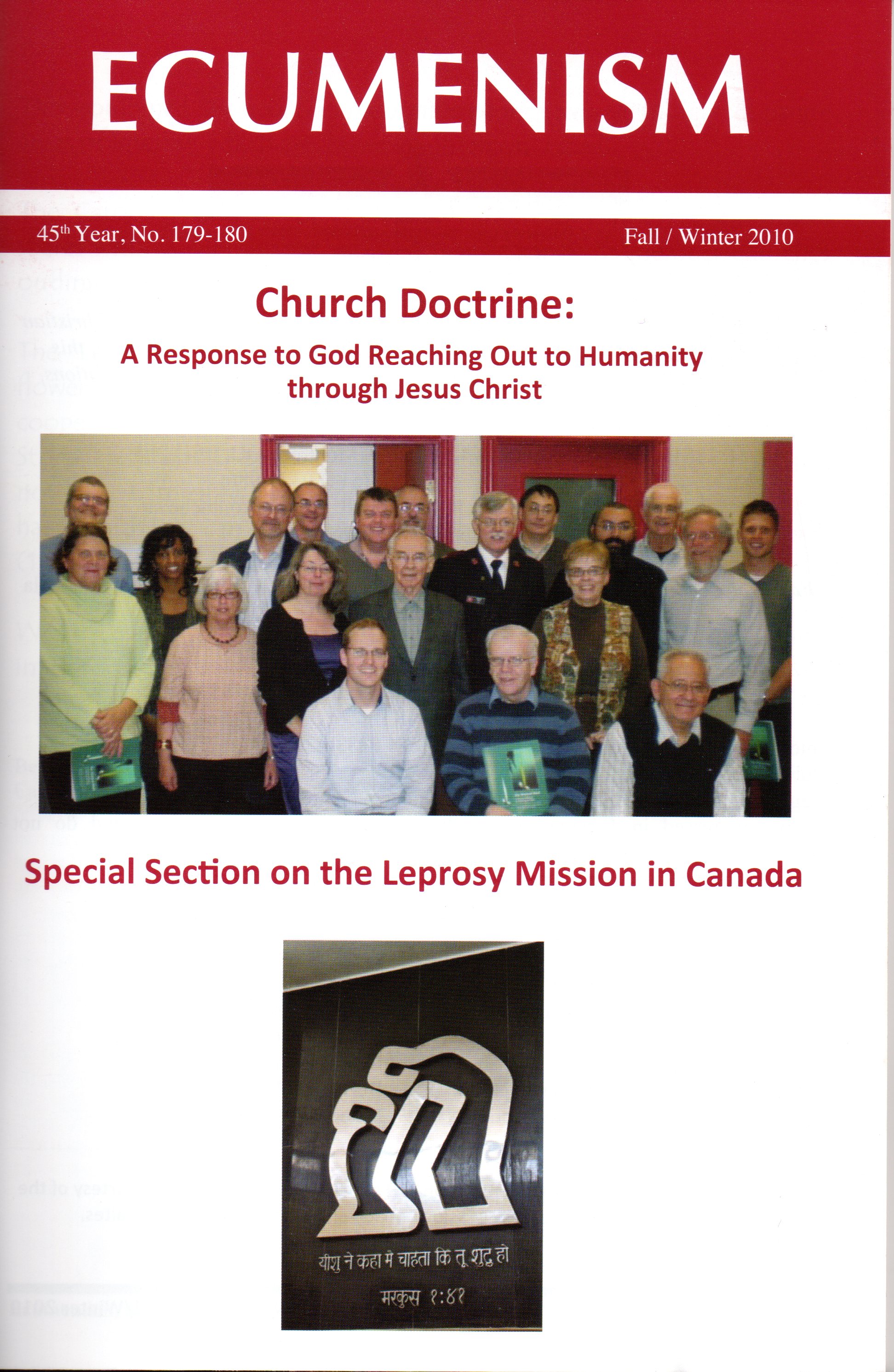
From 2007 to 2010, the Commission on Faith and Witness (Canadian Council of Churches) engaged its members in a dialogue regarding the role of doctrine in the life of the church.   The fruits of this dialogue are reported in the current issue of Ecumenism, published by the Canadian Centre for Ecumenism in Montreal.  Each commission member was asked to articulate their tradition’s answer to the following questions:

  1. What is dogma or doctrine in your tradition?
  2. What are considered to be doctrinal statements?
  3. Who can make doctrinal statements?
  4. What is the relation between doctrine and revelation?
  5. How does your tradition view the first seven ecumenical councils?
  6. How does your tradition understand the reliability of Scripture?
  7. What are those shared convictions without which the Church’s mission would be seriously impaired, or even become.

While ecumenical dialogues often aim at producing some sort of consensus statement, members reported that during this particular dialogue, it became clear at the outset that no consensus would be achieved.  The membership of the commission is very broad, including Catholics, Orthodox, historic Protestants, radical reformation, and evangelical traditions.  Some of these traditions are committed to holding fast to formal statements of  belief (creeds and confessions), while others have historically been opposed to creeds of any kind.

In an introductory article, Gilles Mongeau, Paul Ladouceur, and Arnold Neufeldt-Fast note the general commonalities that they identified in the process:

Every member Church holds to the necessity of some doctrine, explicit or implicit, as a reference point.   In all cases, one or more documents exist which lay out this doctrine, though the authority and form of these documents varies greatly. In all cases, Scripture, tradition, reason, and religious experience interact in some way in the emergence of doctrine.  Similarly, the role of some form of reception by the community of the faithful is a strong component of all of the traditions represented.  Finally, the presenters of the papers agree that the fullness of truth resides in God alone, and that the truth of doctrines is eschatological, that is, oriented to a future complete fulfillment or plenitude.
“Introduction to the Working Papers on Doctrine,” Ecumenism 179-180 (Fall/Winter 2010): 5-6.

While I wasn’t part of the actual discussion, I was able to participate by revising and expanding the Salvation Army contribution to this publication, originally written by Kester Trim, and entitled “Doctrine in the Salvation Army Tradition.”   It is interesting to consider doctrine in the SA’s life via a comparison with the role it plays in the life of other traditions.   Some of our observations that are relevant to the above:

The Salvation Army is not known for placing a particular emphasis on doctrine.  This is not because doctrine is unimportant for Salvationists, but because The Salvation Army has customarily emphasized evangelism and service, rather than theological scholarship.  Nevertheless, The Salvation Army’s official doctrines are viewed as essential to its corporate life and witness.
“Doctrine in the Salvation Army Tradition,” Ecumenism 179-180 (Fall/Winter 2010): 36.

The Army is an interesting ecumenical partner in this dialogue, as it is on many issues, because it treats doctrine as essential, but tries to avoid doctrinal controversy.  It wants its doctrine to be clear, but Salvationists haven’t wanted to spend much time developing their doctrinal tradition.  It envisioned its brief 11 articles as a minimalist list of essentials, which would allow the SA to be “an evangelisitic force free from the entanglements of doctrinal controversy” (Ibid., 37).

Of course, it is not easy to remain aloof from doctrinal controversy!  First of all, the Army’s doctrines are clearly Wesleyan, and therefore anti-Calvinist:

In these brief 11 articles of faith, one can see the seminal Wesleyan themes of total depravity (Article 5), universal atonement (Article 6), justification by faith (Article 8), assurance through the witness of the Spirit (Article 8), and a strong emphasis on sanctification (Articles 9 and 10) (Ibid., 37).

Secondly, from the perspective of “implicit doctrine,” the obvious point of controversy would be the sacraments.  Even here, a large part of Booth’s motivation was to avoid controversy.

The Army’s non-observant stance on the sacraments had its historical precedent in the tradition of the Society of Friends, but was also justified in part by the above-mentioned desire to avoid theological controversy (since the sacraments have often been a matter of theological dispute in Christian history).  It was not Booth’s intent to disrespect the practice of other traditions, nor to make it a matter of dispute. Moreover, Salvationists have never been prohibited from from partaking of the Lord’s Supper in other traditions where they are welcome, and are free to be baptized if they feel it to be of importance (Ibid., 37-38).

Avoiding controversy is a noble aim, but very difficult to achieve in practice.  I would suggest that recent sacramental statements of the Army have lost this early irenic tone and approach, and have become much more controversial than Booth would have liked.  Also, I think one needs to be careful that a desire to be non-controversial does not become a justification for avoiding deep theological discussion, and meaningful engagement with ecumenical partners.

Methodism as religious society-become-church

Continuing on the theme I posted last week: In the quote below, Albert Outler reflects on the origins of Methodism as a religious society, with a view to the way this has evolved in Methodist history.  As with many such renewal movements, Methodism became a sort of hybrid of “movement” and “church,” and its peculiar structures, practices, and culture reflect this inherited tension.  While the tension can be fruitful, it sometimes produces a certain amount of confusion regarding the nature of the movement-church, both for the membership of the movement-church and for their fellow Christians.

It is interesting that this text comes from the same time as the Rupp essay on Wesley as prophet.  In the wake of Vatican II, there was great optimism regarding the possibilities of visible Christian union.  Both Rupp and Outler are keen to stress Wesley’s insistence on Methodism’s ecclesial location as a movement within the Church of England, raised up in “extraordinary” circumstances to meet a particular need.   From the perspective of “ecclesial charisms,” the vocation to “spread scriptural holiness throughout the land” through the “irregular” ministry of lay preachers could be seen as the particular Methodist charism.

What happens when the specialized movement takes on the character of a “church”?  The original charism and vocation cannot help but be hampered, because the Methodists are now focused on doing all the things that the church does, rather than the specific vocation around which they were formed.  The church at large also suffers the impoverishment of being cut off from the ministry of those with the particular Methodist charism.   Again, with Rupp, he wants to stress that Wesley only broke with the Church of England because it was necessary for the provision of the mission of the Church in America.

Here is the quote, from That the World May Believe: a study of Christian unity and what it means for Methodists (New York: Board of Missions of the Methodist Church, 1966), pp. 59-63.

Methodism is a religious society that became a church without the complete loss of its character as a religious society.  Methodists are not always mindful – and many non-Methodists are not even aware –  of this dual inheritance from both the Catholic and Protestant traditions in the Christian community, an experiment in the fusion of “justification by faith alone” with a disciplined ethic of “faith working by love.”  The history of this society-become-church is often confusing both to ourselves and to our neighbours.  We are usually reckoned among the pietists – but no typically pietist group ever had anything like our General Rules and Discipline.  We classify ourselves as Protestants, but none of the classical traditions of continental Protestantism had anything like the Wesleyan ideal of “Christian perfection” and the Wesleyan concept of evangelical morality.   And yet, if the quintessential formula for ecumenism is something like “consensus in faith, community in worship, unity in mission,” then it would be true to say that Methodism has been ecumenical from the beginning.  John Wesley was a rebel and a church reformer, a critic of the standing order, and a rude disturber of the false peace of Zion.  Because he was convinced that the regular ministries of the Church of England were failing in their mission to the nation, he felt authorized by the Holy Spirit to raise up an irregular ministry of gospel proclamation and to organize a network of religious societies in England, Wales, Ireland – and later, America.  To these he gave a distinctive set of “General Rules,” a peculiar pattern of organization (classes, bands, etc.), a novel principle of lay-leadership, and a communal ethos that marked off the Methodists from the Non-conformists as well as from the “High Churchmen.”

Despite all this, Wesley was no separatist. He never lifted a finger to overthrow the power structure of the Established Church nor even to invade it.  The Methodists were ill-treated, but Wesley held them in the church and kept them loyal to the sacraments.  The Anglican bishops reacted in varying degrees of distaste and bafflement, but they wisely refrained from any resort to formal excommunication in dealing with these Wesleyan irregulars.

This self-image of an evangelical order within an inclusive church was not effaced even when the Methodist societies developed into separate churches with sacramental ministries of their own.   Thus we learned – or might have learned – that wide diversity within an inclusive fellowship is not only tolerable but can actually be a vital service to the cause of authentic unity.  The early Methodists deliberately retained their distinct ties with the ancient and universal community but, quite as deliberately, they insisted on their freedom in Christian mission and nurture.  Wesley had no qualms in his use of laymen as preachers in the Revival and as leaders of the societies.  At the same time, he refused, on principle, to allow these laymen to administer the sacraments which were available in the Church of England.  He even forbade Methodist preaching services to be scheduled in competition with “church hours.”  Given the violent and divisive spirit of the age, this uneasy maintenance of the Methodist societies within the unity of “Mother Church” is one of the most remarkable incidents in Protestant church history.  When, however, the American Revolution had deprived the Methodists in the new republic of any ordained ministry for the sacraments, Wesley proceeded – by his ordinations of Richard Whatcoat, Thomas Vasey, and Thomas Coke – to remedy this defect himself rather than to approve the pattern of sectarian self-ordination by laymen begun by Philip Gatch and others at the Fluvanna Conference of 1779.

Where was Outler going with this?  His phrase at the start of the last paragraph is telling, where he speaks of Methodist “self-image” as that of “an evangelical order within an inclusive church.”   I believe Outler longed for this to be recaptured in some way, although he was clear that this would be costly: “We are, or ought to be, willing to risk our life as a separate church and to face death as a denomination in the sure and lively hope of our resurrection in the true community of the whole people of God” (p. 75).