Reflections on my time at the Manchester Wesley Research Centre

It was a privilege to spend six weeks at the Manchester Wesley Research Centre as a Visiting Research Fellow for the summer of 2016. My work focused on early Primitive Methodism.

I am interested in the development of Wesleyan ecclesiology, especially as related to issues of renewal, unity and division. The Primitive Methodists are of interest as the first major revivalistic breakaway from Wesleyan Methodism. I focused my time primarily on the unpublished and published writings of Hugh Bourne, co-founder of the Primitive Methodist Connexion.  While his colleague William Clowes was the more charismatic personality and a more compelling preacher, it was Bourne who did most of the writing for the movement, particularly through his long tenure as editor of the Primitive Methodist Magazine.

Nazarene Theological College

Bourne and the other Primitive Methodists were very keen to clear themselves of the charge of schism. In doing this they stressed both their continuity with early Methodism and the novelty of their movement as a body of newly-evangelized people. In my ongoing work on this subject I am looking at the arguments Bourne used to defend against the charge of schism, and the theology of the church that underlies those arguments.

I am also considering the interesting mix of influences that can be seen in Bourne’s theology. As was the case with many later nineteenth-century Wesleyan revivalists, Bourne was strongly influenced by John Fletcher. But he was also shaped by his contacts with the Quaker Methodists of Warrington, the “Magic Methodists” of Delamere Forest and other Independent Methodists and revivalists such as Lorenzo Dow. His spirituality had a strong pneumatocentric focus, leading to a very participatory and egalitarian view of church and ministry. Bourne is a fascinating and complicated person, who certainly had his faults. Yet he was also ahead of his time on questions of lay representation and women in ministry.

John Rylands LibrarySome of Hugh Bourne’s writings are only available at the John Rylands Library, and those that are available elsewhere are still quite rare and difficult to find. I was very grateful for the opportunity to spend several weeks at the Rylands through the MWRC Visiting Fellow program, as it gave me access to numerous sources that I would not have been able to find at home in Toronto. I also appreciated the many connections I was able to make with other scholars from the UK, as well as those visiting from North America. At the MWRC and Nazarene Theological College I found a welcoming community and ideal base for doing research on the Wesleyan tradition. All in all it was a wonderful experience – I hope I’ll be able to go back and do further research in Manchester in the future.

Media from the Wesleyan-Pentecostal Symposium

We had a wonderful day at the Wesleyan-Pentecostal Symposium here at Tyndale on March 22. It was a pleasure to partner with Van Johnson and Master’s Pentecostal Seminary in hosting this event. Donald Dayton was his inimitable self and helped us to understand how significant it was to have a gathering of these two traditions, given our frosty relations in the past.  The other papers from scholars, pastors and graduate students provided a great deal of discussion material for the attendees.  More than one person commented to me about how engaged everyone was in the topic, discussing it over coffee breaks and lunch as well as in the sessions.

One of the benefits of moving to our new campus is that all our classrooms have very recently been outfitted with excellent audio-visual equipment. This made it very simple for us to record the presentations. The three plenary talks were recorded on video, and audio recordings of all the sessions were made as well. I’m grateful that all the presenters agreed to allow their recordings to be shared publicly after the event.

So, please take a moment to visit the symposium media page and make use of this excellent content.  I’ve embedded my own talk on Burns, Horner, and Burwash below.


Donald Dayton on Experience and Theology

As I announced in the fall, I’m glad to be joining forces with my Pentecostal colleague Van Johnson to host a Wesleyan-Pentecostal symposium on experience and theology this coming Tuesday. When we sat down more than a year ago and began to discuss this possibility, Donald Dayton was at the top of our list of potential presenters, and we were delighted that he said yes.  Dayton’s work in teasing out the theological connections between the Wesleyan-Holiness and Pentecostal traditions has been groundbreaking, and has blazed a trail for a whole body of Pentecostal scholarship.  He is also one of the most respected voices in Wesleyan scholarship, having received the Lifetime Achievement Award from the Wesleyan Theological Society in 2010.

There is still time to sign up for the symposium, but if you can’t make it, we will be livestreaming Datyon’s lecture at 10:15 am EDT this Tuesday.

The full schedule is posted on the event page, and I’ve also listed the papers below.  As usual, we’ve got a nice mix of scholars, graduate students, and scholar-practitioners.

My own paper will focus on the role of experience in the theology of three figures in Canadian Wesleyan history: Nelson Burns, founder of the Canada Holiness Association, Ralph Horner, founder of the Holiness Movement Church and the Standard Church of America, and Nathanael Burwash, Chancellor of Victoria College at the University of Toronto and a leading mainline Methodist theologian.

I’m looking forward to a great day of discussion.  I hope you can consider participating, either in person or via livestream. The video of the lecture will also be posted as a recording after the event, along with audio of other presentations.

Papers to be presented at the Wesleyan-Pentecostal Symposium, March 22:

  • Bradley Truman Noel, “Experiential Verification: The Pentecostal Advantage in Hermeneutics?”
  • John Vlainic, “How a Theology of Experience Shows Up in Pastoral Care.”
  • James E. Read, “‘Whatever it is which reason or experience shows’: Experience in a Wesleyan approach to ethics”
  • Stephen J. Bedard, “Experience as Christian Apologetics.”
  • Justin Schwartz, “Objectivity is the Fruit of Subjectivity: Experience as a Fundamental Category for Theology in the work of Bernard Lonergan”
  • Janelle Zeeb, “Comparing Arminianism and Open Theism on Theodicy: An Example of How Experience Affects our Preferences for Theological Systems”
  • Peter D. Neumann, “Pentecostal Mediated Immediacy: Overcoming Experience of God as Ecumenical Barrier”
  • James E. Pedlar, “Experience and Theology: Lessons from some Canadian Examples.”


Why Wesleyans shouldn’t frame salvation as a “choice”

From The Works of John Fletcher, vol II. 2nd American Edition. New York: John Wilson and Daniel Witt, 1809

In the endless discussions and debates between Calvinism and Wesleyanism, it is quite common for people on both sides to frame the Wesleyan position in terms of human choice. That is, people often say that Calvinists believe God determines who is saved, whereas Wesleyans believe God allows us to “choose” our salvation.  However, I don’t think this is a good way of stating the Wesleyan-Arminian position.

When we frame salvation as a “choice” we are leaving too much up to the human person; it is an anthropocentric way of discussing salvation. And it is not the way that Wesleyan theologians primarily frame the issue. You will not find John Wesley, for example, talking about salvation in terms of a human choice. What you will find is John Wesley talking about salvation being granted to all who repent and have faith in Christ; but repentance and faith are always framed as a response to God’s gracious calling and drawing of the sinner to himself. It is not that there is no choice involved at all, but that the word “choice” doesn’t begin to do justice to what takes place in new birth and justification.  Faith is primarily a response to God’s prior, gracious action, and the response is to submit and surrender to the Lordship of Christ, which is to confess our own utter sinfulness and helplessness, and accept that our salvation is found in Christ alone. It’s not that we have the power in and of ourselves to “choose God.” Rather, since Wesleyans believe grace is resistible, we have a “negative” power to resist God’s work in our lives, but a positive response is better discussed as a “yielding” to grace, rather than a “choice” of faith.

In that case, there is more common ground between Calvinists and Wesleyans here than is often presupposed. Both sides teach that people come to faith by God’s gracious work; Calvinists teach that it is God’s grace that brings us to faith and that it always does so effectively for those whom God has chosen; Wesleyans say God’s grace brings us to faith, only that such grace is actively working in all, and that it is resistible. As Wesley states it in his sermon “Salvation by Faith,” §III.3, “That ye believe, is one instance of his grace; that, believing, ye are saved, another.”  Again, I don’t think the language of “choice” does justice to this view of salvation.

Wesley's Notes on Romans 8:29

The same could be said of framing the Wesleyan position around “free will.” When we say “free will” most people assume we are talking about an innate, “natural” human freedom to “choose salvation.” Wesley did not believe that fallen humans were free to respond to God in faith without the working of divine grace. The reason to point this out is because it is a point on which Wesleyans and Calvinists agree. The difference, again, is that Calvinists believe salvation by grace is only available to the elect, who are irresistibly drawn to faith, whereas Wesleyans believe prevenient grace is working in all to draw them to Christ, providing a measure of freedom (not total freedom of the will) sufficient to enable a response to God’s offer of salvation. Grace is “free in all” and “free for all” from a Wesleyan viewpoint, but it is always resistible. So, if Wesleyans want to talk about human freedom, I think it’s best to emphasize that we are “freed by grace” to respond, rather than to assert that we have free will.

It may seem like I’m splitting hairs there, but these distinctions are important, because the way the debate is often framed on the popular level exaggerates the differences and obscures the common ground.  I should also note that my own perspective is one that has been deeply shaped by engagement with other Christian traditions; so even though I am a Wesleyan, I am trying to state the Wesleyan position in a way which is responsive to the critiques of Reformed theologians (even though I also happen to believe what I am saying accords very well with what John Wesley himself taught).

Tyndale Wesley Studies News – September 2015


We are gearing up for another academic year at Tyndale, this time (finally) on our beautiful new campus.  It has been a bit of a chaotic summer, with all the disruption that comes along with a move, and I’m now looking forward to seeing this place filled with students in the next few days.

I’ve just sent out my most recent Wesley Studies newsletter, highlighting next year’s joint Wesleyan-Pentecostal Symposium on the role of experience in theology (March 22, 2016).  I’m really pleased to be bringing Donald Dayton to Toronto as our keynote, and I think we’ll have a great day of conversation about a topic that concerns both traditions.

There’s lots more in the newsletter about recent book releases (including the latest in the Tyndale Wesley series from Chris Payk and my own book, which I will blog about soon) and upcoming events and conferences in Toronto.  Take a look, and subscribe if you are interested.

bayview-chapel


A response to a Calvinist brother on predestination

NOTE: this post is in response to a lengthy comment from Jeff Kreisel on my previous post, “John Wesley on Predestination.”  See Jeff’s comment here.

*****

Jeff,

Thanks for stopping by and commenting on my post. I apologize for my slow reply.  I have been swamped the past few weeks with work, and didn’t want to reply too hastily to your comment.

I would also encourage others to read Whitefield’s response, and if they are serious about the debate, to study it in context.  Wesley’s Sermon, “Free Grace” is not one of his better theological writings.  It is very polemical and not as organized as it might have been.  A calmer and clearer statement of his views is found in the Sermon 58, “On Predestination.” A longer treatment of the subject is found in Predestination Calmly Considered. I don’t expect these writings will change your mind, but it is always good to engage with an opposing argument on its best terms.

I can’t respond to all that you’ve said, but let me offer a few thoughts and clarifications.

First, Wesley’s position was certainly not based on mere emotion; perhaps some Wesleyans base their theology on emotion, but I suspect that the same is true of people in every theological camp. Wesley’s view was based on scripture first and foremost, interpreting scripture by scripture in light of the whole “analogy of faith” (the overall biblical message).  It’s not that Wesley simply “felt” Calvinism presented God as unfair; rather, he believed the central message of Scripture is that God is love, as revealed in the gospel of Christ. You may disagree with his interpretations of scripture, but you can’t accuse him of not taking scripture seriously.
5952670-MRe: Calvinism and total depravity – there are some differences, to be sure. Some Wesleyans don’t use the term “total depravity,” though I think it can be applied to Wesley’s view.  My main point is that Wesley agrees with the Reformed tradition that unregenerate humanity is completely helpless and unable to save themselves. Without the grace of God we can only “add sin to sin.”  In our own power, we are not capable of not sinning. Wesley is quite clear on these matters.

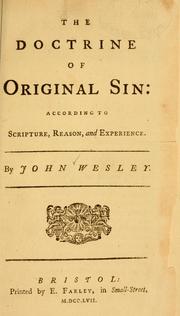
One area of difference, however, relates to Wesley’s view of original sin and imputed guilt.  Wesley wholeheartedly affirms that all people are born totally corrupted at birth, and inclined to sin, such that they are not able to turn to God in their own power, as just noted above. He does not support, however, the idea that infants are counted guilty for Adam’s sin.  We are counted guilty for our own sins, which we will inevitably commit because of our inherited corruption. Therefore all are guilty, with the exception of infants and small children who have not reached an age at which they can be held accountable for their actions (though they are still totally corrupted).

Now, in relation to your charge that Wesley is inconsistent, and the question of those who do not have access to the gospel (these two issues are related): Wesley acknowledges that some people (such as himself) have significant advantages in that they have been raised in a Christian environment and have many opportunities to respond to the gospel. That is why he leaves such cases (those who have never heard the gospel) up to the judgment and mercy of God, and believes God will judge them according to the light they have received. And he would make such a case precisely on the basis of God’s justice and love for all. Those who have never heard the gospel would not be damned for rejecting the gospel, since they have never had opportunity to do so; therefore we are not sure how they might be judged, but we leave it in God’s hands. This is not grossly unbiblical, as you charge.  First, he is not saying that they will be saved apart from Christ or Christ’s work on the cross; Wesley was well aware of John 14:6. Rather he is saying that they will be saved by Christ, though they have not known Christ by name in this life (but have responded to the grace that was available to them). Second, in the sermon I noted, he explicitly appeals to Acts 10:34-35 as a scriptural example. We might also note the “holy pagans” or “pagan saints” of the OT as examples of God being mysteriously at work outside the visible bounds of the church (Rahab, Jethro, etc.).

Calvinists such as yourself say that it would be a “failure” of God’s grace if he was to draw someone to himself and yet leave them with the ability to resist God’s grace. We simply have a different understanding of divine and human action; it does not “take away” from God’s agency if human persons are able to resist grace. We cannot compete with God’s agency; this isn’t a tug-of-war.  We can only respond to God because he is at work within us; that means our response is not “work” on our part; and yet because God is at work within us we can respond.  Grace is enabling and transformative by its very nature. In much of this we agree; however, Wesleyans believe that God’s grace enables a genuine human response, which would not be possible if such grace were irresistible. This is the heart of the matter I referred to in my previous point: a sovereignty understood in a monarchist sense, or a sovereignty understood in terms of a loving Parent. It’s not a “failure” because this is God’s purpose – to save those who yield to his gracious work in their lives. God has freely chosen to work in this way with his human creatures, because it accords with his loving and just nature.

Finally, you say that Wesley asserts that every human is a child of God. Perhaps I was sloppy in my own language explaining Wesley’s position. Normally, he only uses the term “child of God” for believers. Indeed, it is a hallmark of his teaching that all Christians should have the assurance of salvation through the Spirit’s witness to their adoption as sons.  He is quite clear that this is the privilege of believers – to know that they are in fact God’s children.  I do not recall, off-hand, if he refers to all people as children of God; there is a sense in which this is the case, since God is the Father of all that lives. And if Wesley ever says something along those lines, I’m sure that is what he meant (simply that God is creator of all and therefore “Father” to all in that sense).  Do you have a reference to Wesley calling all humans children of God?

Perhaps your point is simply that if only believers are properly called children of God, then God’s loving character as Father does not apply to non-believers?  My point in stressing the “Parental” character of God is not to say that therefore all are in God’s Parental favour; it is, rather, simply a point about God’s own character and the way he exercises his sovereignty. The distinction between the “sovereignty of a king” and “sovereignty of a parent” should not be stressed too far, however. I’m not talking about absolute distinctions but differing emphases; Calvinists certainly draw upon parental analogies for God, and Wesleyans certainly draw on monarchist analogies.  But each tends to favour one or the other.

I’m sure I haven’t changed your mind, Jeff; you certainly haven’t changed mine. But I hope these comments clarify some of Wesley’s ideas.

Yours in Christ,

James
Wesley Studies News from Tyndale

Firefox_Screenshot_2014-12-17T20-17-25.932ZIn September I started a newsletter as a way to share information about events and resources of interest to the Canadian Wesleyan community.  Over the past seven years, the Tyndale Wesley Symposium has fostered a network of people interested in Wesleyan history and theology, and I hope this will be one more way of helping to connect that community. The second edition has now been sent out, and includes information on our 2015 Wesley Symposium, featuring Kevin Mannoia.  I’ll have more to say about the Symposium in a future post.

Go here to read the newsletter, and click the “subscribe” link in the top left corner if you want to sign up for future newsletters. The September edition can be accessed here.

Two Recommendations: Witnesses of Perfect Love and Transatlantic Methodists

These two new books will be of interest to those who study Methodist theology and history.

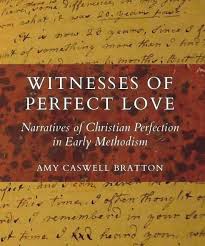
witnessesofperfectloveFirst, Amy Caswell Bratton’s Witnesses of Perfect Love: Narratives of Christian Perfection in Early Methodism (Clements Academic, 2014), tackles the doctrine of Christian perfection from a different angle: the personal narratives of Methodists who claimed the experience of perfection.  While Methodist conversion narratives are well-known, this book looks at how early Methodist narrated their continuing struggle towards Christian perfection.  By examining four particular cases in detail, Bratton is able to delve deeply into the way that early Methodists interpreted and understood their own Christian life in light of distinctive Wesleyan teaching on sanctification.

What must also be remembered is that such narratives were often published and circulated in Methodist circles.  Therefore, these narratives represent not only personal interpretations of the doctrine, but also one of the ways that Christian perfection was interpreted to the Methodist community.  In other words, theological studies of Christian perfection, which traditionally focus mostly on more traditional theological literature, should also consider these narratives as part of the corpus of Wesleyan holiness teaching.

You can find out more about the author and the book on her site.  Bratton’s book is the most recent volume in Tyndale’s Studies in Wesleyan History and Theology series.  Previous volumes were contributed by Howard Snyder and Victor Shepherd.

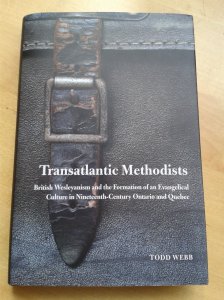
20140624_134307My second recommendation is Todd Webb’s Transatlantic Methodists: British Wesleyanism and the Formation of an Evangelical Culture in Nineteenth-Century Ontario and Quebec (McGill-Queen’s UP, 2013).  Webb, who teaches at Laurentian University, offers an account of 19th century Canadian Methodism that stresses its connections to British Methodism.

Against prevailing accounts, which downplayed the contributions of British missionaries to Methodism’s growth in favour of arguing for a distinctive Canadian Methodist identity, Webb argues that Canadian Methodism between 1814 and 1874 must be understood in terms of its relationship with British Methodism.  Canadian Methodists came to see themselves as transplanted Britons, and formed a British identity in a time when there we competing understandings of what it meant to be truly British.  It is not simply that the British Methodists exerted influence on Canadians, but developments in Canadian Methodism also affected the history of the home church during this time.

Webb’s excellent account not only narrates the history of the developments, which can be quite confusing, given the multiple mergers and schisms which took place on both sides of the Atlantic, but he but also notes how particular issues, such as finances (chapter4) and revivalism (chapter 5) can help to illuminate the complex relationship that existed between the various Methodist bodies.

As I’ve already said, both books are highly recommended.


Comparing William Booth and Isaac Hecker: my paper at WTS

I’m looking forward to the annual Wesleyan Theological Society meeting late next week at Northwest Nazarene University in Nampa, Idaho.  I’ve never been to Idaho, so I’ll be glad to see it first-hand, although I must confess I’d rather visit that state during a warmer time of the year!

This year’s theme is “Atonement in the Wesleyan Tradition,” and features keynote addresses by Ben Witherington III, Randy Maddox, and Jason Vickers.  A recent press release discussing the speakers and award recipients is available here.   You can find the full schedule of papers here.

I’ll be presenting a paper that builds on my dissertation research.  It will be presented in the Ecumenical Studies section, and the title is “Universal Atonement or Ongoing Incarnation? Comparing the Missional Theologies of William Booth and Isaac Hecker.”  Here is the abstract:

This paper will compare the missional theologies of William Booth and Isaac Hecker, two founders of 19th century missionary agencies. Booth, who started The Salvation Army in East London in 1865, was a Wesleyan revivalist who had previously been ordained in the Methodist New Connexion. Hecker was also raised in the Methodist church, but after a roundabout spiritual journey, became a Roman Catholic, first serving as a Redemptorist Priest, and then founding the Paulist Fathers in New York City, in 1858.

William Booth via wikimedia commonsBooth and Hecker were both possessed by visions of universal revival and reform in their later years, and both believed that God’s vision for universal reform extended beyond spiritual life, to social and political structures. However, the theological assumptions behind their universal visions for mission were markedly different, and are illustrative of divergences in 19th century Wesleyan and Catholic theology. The scope of Booth’s vision was founded upon the universality of the atonement, which provided a missionary mandate to evangelize the whole world, with a particular focus on those people not being reached by “the churches.” Hecker’s vision, on the other hand, was built on the universality of the Catholic Church as the historical extension of Christ’s presence in the world. These differing Christological starting-points funded two very different understandings of work of the Spirit, the place of the Church in God’s universal mission, and the relationship of their respective missionary bodies to established church structures. Whereas the Church has a rather ambiguous place in Booth’s understanding of world-wide redemption, Hecker’s view is thoroughly ecclesiocentric.

I will close by reflecting on the potential pitfalls of each view, and suggest some ways in which contemporary Wesleyans and Catholics might think together about universal mission in a way that avoids the theological extremes of our 19th century foreparents.

Hecker via wikimedia commonsFor Booth, the scope of Christian mission is very much related to his convictions about the universality of Christ’s atoning work, and the full implications of the atonement for human life.  As he got older, he came to believe that Christ had come not only to offer “spiritual” redemption, but to “destroy the works of the devil in the present time” by relieving humanity of temporal as well as spiritual evil (see his article “Salvation for Both Worlds” for example).  On other hand, for Hecker, the Catholic Church’s unviersality meant that the church was called to take up and incorporate the best of all the cultures of the world.  Hecker had a keen sense that the Spirit was guiding universal history, and had given “characteristic gifts” to the different cultures and races of the world, all of which needed to be directed to their proper ends and brought together in the one universal Church so that they might enrich the church’s life and bring glory to God.

As I’ve previously note here, I think Booth and Hecker are a very interesting comparison.  They are both compelling figures in their own right, but also provide an fascinating window into broader trends in the nineteenth-century church.   Hopefully the paper will help to bring out the contrast between the ecclesiological ambiguities of Wesleyan-holiness revivalism and the ecclesiocentrism of Catholic thinking from the same period.

Sixth Annual Wesley Studies Symposium at Tyndale Seminary

Registration is now open for Tyndale’s annual Wesley Studies Symposium, taking place on March 25 at Tyndale’s new Bayview Campus.

haykin_lg_sqThis year, in honour of the 300th anniversary of George Whitefield’s birth, we’ll be welcoming Dr. Michael Haykin as our keynote speaker.  I am very pleased that this distinguished Baptist historian has agreed to come and make a presentation to our symposium. His talk is titled, ““The Revived Puritan”: The Life and Piety of George Whitefield.”

Here is a bit more from our event page:

2014 marks the 300th anniversary of the birth George Whitefield, friend, partner-in-ministry, and sometimes theological enemy of John Wesley. Because the lives of these two men are so intricately intertwined with one another, we are going to feature a paper on Whitefield as our keynote address at the Wesley Symposium.

Dr. Michael Haykin is a leading Baptist historian, who has published on a wide variety of topics, from the Church Fathers to Jonathan Edwards. He studied at the University of Toronto, where he earned a BA at Victoria College, and an MRel and ThD in church history from Wycliffe College. In addition to his position at Southern Seminary he is Director of the Andrew Fuller Centre for Baptist Studies, and an Adjunct Professor at the Toronto Baptist Seminary, where he previously served as President. His many books include Jonathan Edwards: The Holy Spirit in Revival (Evangelical Press, 2005); The God who draws near: An introduction to biblical spirituality (Evangelical Press, 2007); and Rediscovering the Church Fathers: Who They Were and How They Shaped the Church (Crossway, 2011).

bayview-campus-frontOther speakers for this year’s event include Dr. Claire MacMillan (National Director, Church of the Nazarene, Canada) Rev. Leonard Chester (Archivist of the Brethren in Christ Church, Canada), Rev. Dan Sheffield (Director of Global and Intercultural Ministries, Free Methodist Church in Canada), Rev. Michael Tapper (PhD Candidate, St. Paul University), Rebecca Nicol (PhD Candidate, McMaster Divinity College), and Rev. Dale Harris (Pastor, The Freeway Free Methodist Church, Oshawa).  You can find more information about the paper topics here.  We will also have a book panel on Lift Up a Standard: The Life and Legacy of Ralph Horner, including presentations from myself and Dr. James Robertson, and responses from authors Rev. Laurence Croswell and Mark Croswell.

Visit this page to find more information and to register.