encountering God in the darkness

A couple of time a year when I was in seminary we would have “Quiet Days,” which were basically half-day retreats that third year students had to attend.  It was in the music of one of these Quiet Days that I experienced God speaking.

Two different pieces of music were played that day, and we were to meditate or pray while we listened.  I was not particularly connecting with the first piece – a Christian pop song – but the mournful sounds of a choral adaptation of Barber’s Adagio for Strings resonated with me immediately.  There is a certain reverence about the piece, but it also gives you the eerie sense that you are confronting something very dark. I noticed that this feeling struck a particular chord within me, and that I felt a deep connection to God in that confrontation with darkness.  I am talking about a kind of existential moment, a standing at the edge of “the abyss,” contemplating the futility of human efforts, the radical corruption of human desires, the “nothingness” of human existence and achievement.

I have faced depression on a couple of occasions in my life, and I believe that those experiences changed me profoundly.   I am not a particularly mournful or pessimistic person, but, I still pause in those “existential moments,” and feel an incredible resonance within me.  It is very difficult to describe.  The words of Ecclesiastes 1:8 spoke so clearly to my experience at the height of my depression:

All things are wearisome;
more than one can express;
the eye is not satisfied with seeing,
or the ear filled with hearing.  

While I don’t struggle with that feeling regularly, I have never really left it behind, and the brief moments when that weariness has resurfaced in my life have been some of the most profound encounters I have had with myself, and with God.

Aside from the music, I remember connecting with the Psalms we read that day, and with the practice of praying the Psalms, which I have done since experiencing the daily offices in my first year at Wycliffe.  During my depression, I was comforted to find an expression of my experience in Ecclesiastes, and in a similar way I have found it liberating to be able to pray with the emotion found in the Psalms.  Strange as it may seem to some, I find that I feel closest to God in those moments when I contemplate the loneliness and futility of human life with honesty. Somehow I know that God is there, because, as the Psalmist prayed, Christ also prayed, “My God, my God, why have you forsaken me?” In God the Son’s decent into that “abyss” of human darkness, he established his true presence in the God-forsaken places of this world. I am, therefore, surprisingly comforted when I find myself in such a place, knowing that, in spite of the profound sense of darkness I feel, he is indeed there, and I, in Christ, can make the same cry with authenticity.

I do connect with God in feelings of joy and thankfulness, of course.  Often, however, the shallow “happiness” that is sometimes characteristic of evangelical worship fails to resonate with my experience.  There is an unfailing optimism (“Christians should be happy people!”) among many which is only possible when the problem of sin and suffering is gravely underestimated.  Coming to terms with human depravity was a watershed moment for me, not only in terms of understanding myself and God, but also in terms of understanding the broken world in which we live.  I am not in any way discouraged by the profound brokenness of the world, or by my own depravity, given the sufficiency of Christ’s work.  Rather, I feel a great sense of freedom in resting my hope in him alone.

I was particularly thankful during that Quiet Day, that I could experience that dark encounter once again, and still feel that powerful resonance within me.  I am thankful that I have not left that experience behind, though I am no longer confined by it.

Theology and the Laughter of the Angels

Two weeks ago I began teaching Systematic Theology II at Tyndale Seminary.   I suspect that not all of the students in the course are excited to be there, both because the class meets at 8:30 AM on Mondays, and because systematic theology is not everyone’s favourite subject.  Some of the students are probably only taking the class because they have to.  I told them, “That’s fine.  You don’t have to love systematic theology.  You don’t have to be excited about it.  But you do have to know the basics.”

I think anyone who wants to be a leader in the church needs to be familiar with the basics of Christian doctrine – how it has developed and why it is important.  Systematic theology is not idle speculation; it’s not about professors sitting in their offices thinking up topics for papers.  It’s about the gospel and the God of the gospel.  It’s about proclaiming that gospel faithfully and biblically.  It’s about seeing the big picture of how each doctrine relates to the others; and it’s also about learning the lessons of history, so that we are not doomed to repeat the theological mistakes of those who have gone before us.

Stanley Hauerwas makes an interesting observation about the nature of seminary training today.  He’s concerned that many people don’t take seminary training seriously enough, and he makes his point by comparing seminary and medical school.  He asks us to imagine if a future doctor got to medical school and said, “You know, I’m just really not into anatomy.  I’m not going to worry about that subject. I’m going to focus more on my bedside manner.”  What do you think the school administrators would say to that student?  They’d say, “It doesn’t matter if you’re not interested in anatomy.  It’s important.  If you want to be a doctor you’ve got to understand how the human body works!”

Likewise, leaders in the church need to be able to think theologically.  It’s important.   This means they need to know the basic doctrines, historical figures, schools of thought, and so on, but more than that, they need to be able to bring these resources to bear upon the questions they face in their own life and ministry, so that these questions can be thought through theologically, and not simply on the basis of other concerns, be they pragmatic, psychological, financial, etc..

It is often said that everyone is a theologian.  I think this is true.  Theology is, simply put, God-talk. We all talk about God, and in that sense, we are all theologians.  The question is, are we going to be good theologians or are we going to be hacks?  We don’t need everyone to be experts.  But just like we expect that doctors will know the difference between our heart and our stomach, church leaders need to know the difference between Christology and ecclesiology; they need to see how they relate to one another, and both our Christological and ecclesiological assumptions inform our practices.  Just like a doctor needs to be able to tell the difference between a healthy person and a diseased person, church leaders need to be able to tell the difference between orthodoxy and heresy.

Having said all that, it’s important to recognize that theology is not like anatomy.  God is not laid out on a slab for us to poke and prod and test and dissect.  Although God does make himself known to us through Christ and the Spirit, this is always a profound condescension on his part; he comes down to our level so that we can understand him with our limited human minds – but we have to always remind ourselves that God is bigger than any theological system.  He is greater than the greatest thing we can possibly imagine. and so we have to remain humble about our theology.  We can speak truthfully and faithfully about God but we can never speak exhaustively.

I ended my introductory remarks during our first class with this wonderful quote from Karl Barth.  I reminded them that Barth was the greatest theologian of the 20th century – many would say the greatest theologian since the Reformation.  He wrote prolifically.  His Church Dogmatics was up to six million words when he died – and he hadn’t finished it.  In spite of all this, Barth retained a wonderful humility, both regarding himself as a person and about his theological work.  I always try to keep this quote in mind as I think theologically:

“The angels laugh at old Karl. They laugh at him because he tries to grasp the truth about God in a book of Dogmatics. They laugh at the fact that volume follows volume and each is thicker than the previous one. As they laugh, they say to one another, “Look! Here he comes now with his little pushcart full of volumes of the Dogmatics!” And they laugh about the men who write so much about Karl Barth instead of writing about the things he is trying to write about. Truly, the angels laugh.”
Quoted in Robert McAfee Brown’s “Introduction” to Portrait of Karl Barth, by George Casalis, trns. Robert McAfee Brown. Garden City, NY: Anchor, 1964, p xiii.

Book Review – Longing for Spring: A New Vision for Wesleyan Community

Elaine Heath and Scott Kisker, both professors of evangelism as United Methodist seminaries, wrote Longing for Spring: A New Vision for Wesleyan Community (Eugene, OR: Cascade Books, 2010) as a contribution to the “New Monastic Library” series, from Wipf and Stock.   The book is an engagement with the “new monasticism” movement from a specifically United Methodist perspective.  The authors are both advocates for new monasticism as a renewal movement, and both are involved in new monastic communities.   Heath and Kisker see the new monasticism as a way forward in the quest to renew the Methodist tradition in America.

New monasticism is a relatively recent movement of Christians who are banding together and forming intentional communities of radical discipleship, often (but not always) including communal living in what New Monastics call “the abondoned places of empire.”  Shane Claiborne and The Simple Way community in Philadelphia are probably the most well-known examples of new monasticism, but there are many others.  If you’re trying to get a sense of what the movement is about, look up the 12 Marks of New Monasticism.  For a book-length introduction, see Johnathan Wilson-Hartgrove’s book New Monasticism: What It Has to Say to Today’s Church (Grand Rapids: Brazos, 2008).

Heath and Kisker have written a book which is aimed at a United Methodist audience.   That means they document new monastic communities within the UMC, locating them within the broader new monastic movement, and they also lay out a proposal for further development of new monastic communities in the UMC.   In doing this, they argue that the new monasticism resonates with the heart of the Wesleyan vision for Christian community.  That is, they argue that Methodists can embrace the new monasticism as an authentic re-envisioned embodiment of the original Methodist communities.

After an opening chapter in which the authors recount their personal stories, the book spends two chapters looking at the history of intentional communities in the church: an initial chapter focused mainly on the history of monasticism in the early church and the middle ages, followed by a chapter discussing “Protestant Models of Intentional Community.”  The book does not present detailed scholarship (that is not its purpose), but provides an interesting narrative of church history from the perspective of intentional communities and their role in renewing the church.  So, the Anabaptist, Pietist, Moravian, and Methodist movements are laid out as part of a history of intentional communities of radical discipleship – a history that extends back to the ancient monks of the Egyptian desert.  The point is not to say that Methodism (which is the main focus of the book) was “monastic,” but that it shared many of the aims and features of monastic communities, in its own way, even as its forms of life were more directly borrowed from the Anglican religious societies and the Moravians.

Next, in chapter four, Heath and Kisker briefly describe the new monasticism, focusing particularly on how United Methodists have become involved.  The fifth chapter was the one I found most interesting, because it makes some concrete suggestions about how the UMC could embrace new monasticism.  For example, a rule of life is offered, based on United Methodist membership vows.  Phoebe Palmer is presented as a potential “patron saint” of new monasticism, someone who “embodied just about everything that the new monasticism holds dear” (53).  And the chapter deals with such concrete issues as appointments and the possibilities of bi-vocational ministry.   The book closes with reports from three United Methodist new monastic communities.

This is a very short book, and as I said above, it is not an attempt at rigorous scholarship, though it is well written.  It’s very accessible, and it offers an interesting window on the new monastic movement from a Methodist perspective.  Because it is aimed specifically at a United Methodist audience, I did feel at times like I was listening in to someone else’s conversation.   But I think this was a necessary consequence of the authors’ choice to write specifically for United Methodists.

As a Wesleyan who is interested in the history and theology of renewal movements I find the prospect of a “Methodist new monasticism” to be very intriguing.  As I’ve noted in previous posts, the origin of Methodism as a religious society in the Church of England means that Methodists have inherited a somewhat ambiguous ecclesial status.  It is not surprising, therefore, that Methodists longing for renewal would attempt to return to radical forms of intentional community as a way of re-connecting with the Methodist ethos in a new context.

“ekklesiophobia,” and Balthasar on the church’s particularity

Over at Reclaiming the Mission, David Fitch is blogging about “ekklesiophobia,” (he calls is “ekklesaphobia” but I prefer ekklesiophobia”) an issue he sees among people who are involved in the North American missional movement (a movement in which Fitch is involved).  The ekklesiophobia he’s describing is an unhealthy fear of any practices that are traditionally associated with being “church.”

He began his first post in the series in this way:

It happens on facebook when I give the slightest indication the church is God’s instrument in the world. It happens frequently when I am speaking and assert that God has empowered the church to extend Christ’s presence in the world. It happens when I coach church planters that are missionally oriented and ask them when they gather for worship. It happens when I engage my missional friends on one of the variants of the formula “missiology precedes ecclesiology.” It happens each time I meet someone who has been abused by the traditional church. Each time there is a out-sized reaction against organizing people into practices traditionally associated with being the church (this is especially true of the public worship gathering, or the ordination of clergy).

Read the rest here, and part two here.  More to come.

I’m glad to see someone flagging this as an issue.  The missional movement is making great contributions to the contemporary church in North America, and has started some important conversations which are spilling over its borders and engaging those who minister in more traditional denominational churches and structures.   But I’ve detected something like an ekklesiophobia in my own interactions with some of the misisonal literature (though I admit I’m not totally up to speed on it).   I sometimes worry that the church’s community life, manifested in things like weekly corporate worship, sacraments, and church fellowship, are treated as if they are barriers to mission (at worst), or (at best) simply a pragmatic means to the end of being the church “in the world” – something to be tolerated as a rejeuvenating exercise when such rejeuvenation is needed, but not a discipline to be attended to as part of the church’s essential vocation.

Of course, these critiques are based on the fact that corporate worship and fellowship can become barriers to mission, if the church becomes a kind of social club which is completely turned in upon itself and closed off from the world.   However, if this problem is met by an approach that avoids such “churchly” activity, it will create other problems – namely a vaccuum of Christian formation.   It is the church’s internal life that provides the basis for such formation, and therefore the church’s internal life is essential to the church’s being and well being.

All of this makes me think of the following quote from Hans Urs von Balthasar:

 The Church must be open to the world, yes: but it must be the Church that is open to the world.  The body of Christ must be this absolutely unique and pure organism if it is to become all things to all men.  That is why the Church has an interior realm, a hortus conclusus, fons signatus (a walled garden, a sealed spring), so that there is something that can open and pour itself out (from Truth is Symphonic, 100).

The church’s mission in the world cannot be played off against its internal life of regular worship, sacraments, catechesis, fellowship, and so on.  Being the church requires those practices.  The church needs to be in the world,  but as Balthasar says, it is the church that must be in the world.   Therefore, the church’s particularity, its apostolic strangeness, embodied in ecclesial practices, is an essential aspect of its mission.

Signs that make me laugh: Big Daddy’s Computer Lounge

I love this picture.

First, because the name is amazing.  Not only is it Big Daddy’s, but it’s a lounge.  So much better than an internet cafe.

Second, because of the cartoon face, which I presume is based upon a real person who calls himself Big Daddy.

Third, because they are selling PCs for $99.

Fourth, because they unnecessarily used an apostrophe on PCs.

Fifth, because the unnecessary apostrophe is upside down and backwards, meaning they are re-using a comma as an apostrophe (thanks to Anney for pointing that out to me!).

On Coxwell just north of Queen.

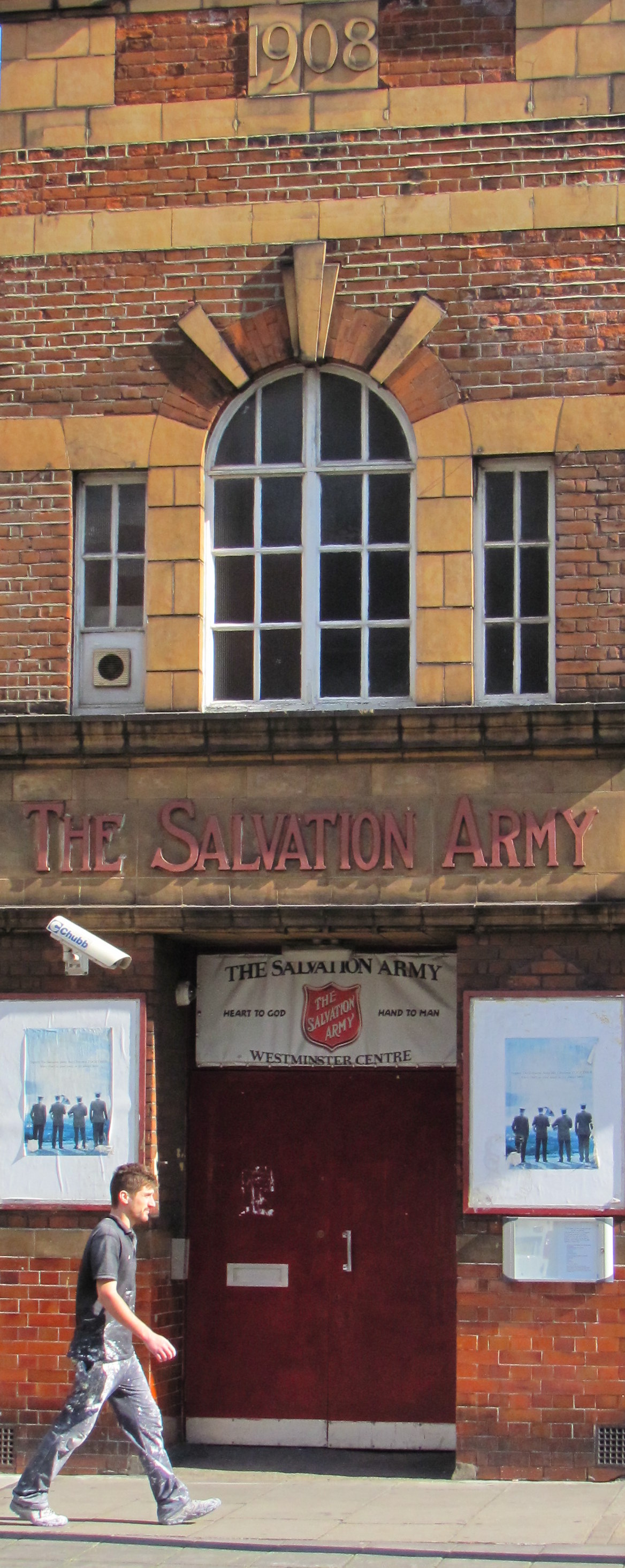
The Salvation Army and the Paulist Fathers: two interesting cases of missional diversity in the church

I’m switching gears now with my dissertation and moving into writing about two historical case studies: The Salvation Army and the Paulist Fathers.   While these two particular movements might seem like an odd pair, there are a number of reasons why I’m looking at them.

First of all, there are a number of similarities between their two founders, William Booth and Isaac Hecker.   They were near-contemporaries in age (Booth lived 1829-1912 and Hecker 1819-1888).  Both have Methodist roots, with Booth originally ordained in a Methodist tradition  and Hecker raised at Forsyth Street Church in New York City.  Both are, in many respects, men of their time, typifying the optimistic, industrious, world-encompassing spirit of the nineteenth century.  Both were “home missionaries,” who brought a missionary approach to ministry in their native countries, and each could be classified as “revivalists” in their respective traditions.  Both Booth and Hecker began their ministries in other movements – Booth the Methodist New Connexion, Hecker the Redemptorists – and both ended up branching out to found their own missionary societies because of conflicts with established leadership of those movements.  Finally, both eventually developed comprehensive visions for the worldwide mission of the Church.

I’m also interested in these two movements because they both raise interesting questions about unity and diversity in the church – questions I think might be addressed using the theology of ecclesial charisms.

The Salvation Army is an interesting case because of its original insistence that it was a missionary movement, and not a church, even while it remained independent of any formal ties to a church. Its members were not members of any other churches, creating the strange situation where Salvationists could claim to be Christians but to not be part of any church.  A decisive historical moment in the movement’s history came in 1882, when a series of serious discussions with the Church of England caused William Booth to ask himself if The Salvation Army should remain an independent mission or be placed under the auspices of the Church (if you’re interested in this episode see Roger Green, The Life and Ministry of William Booth, 140-145). The fact that such discussions took place shows that Booth was not completely sure whether or not he wanted the Army to remain autonomous.  The fact that they decided to remain independent was the result, I believe, of a lack of clarity regarding ecclesiological questions (noted by Green, p. 144-145).  The Army’s independence was of decisive significance for its future course, including its non-sacramental stance and its slow progression towards claiming “churchly” status.

The Paulists, on the other hand, were never outside of the Church’s fold, but rather press the question of unity and diversity from the side of the Church’s authoritative discernment.  First of all, very early in their history they were forced to make a compromise regarding their specific mission.  The founding members wanted to be an exclusively missionary society, but they could not find a Bishop who would support them unless they took on a parish.  This meant that they had to divert some of their energy to traditional parish concerns.  It seems that the bishops they approached did not recognize the particular gift of the Paulists, and so, in order to remain a part of the Catholic church, they were forced to compromise.  Another Paulist “gift” that wasn’t recognized was Hecker’s progressive ecclesiology, in which he saw the Spirit at work, adapting the Church to particular cultures and places, in concert with the providential developments in each society.  In Americathis meant making Catholicism more “American,” by becoming more democratic and embracing the separation of Church and state. This was not received well by a Catholic hierarchy which was struggling to ensure uniformity around the world, and had been marginalized by democratic governments throughout the nineteenth century.    After Hecker’s death, his ideas were taken out of context and twisted into the “phantom heresy” of “Americanism,” which was censured by Pope Leo XIII in Testem Benevolentiae, issued in 1899.

If the theology of charisms is in fact useful in helping us to understand reform movements as a legitimate form of diversity in the Church, then it should be able to be applied to these two cases.  My hope is that a study of their history and self-understanding, along with a sustained critical engagement with the theology of charisms in the context of the question of the church’s visible unity, will clarify some of the questions surrounding the limits of legitimate diversity in the church.

Fourth Annual Wesley Studies Symposium at Tyndale

On March 13, Tyndale Seminary will be hosting its Fourth Annual Wesley Studies Symposium, organized by Dr. Howard Snyder, Chair of Wesley Studies at Tyndale.

I’ve been privileged to be a part of the previous three events, and it has been exciting to see the Symposium grow from about a dozen participants in 2009 to well over 50 in 2011.   We’ve had some great presentations from established scholars, practitioners, and graduate students.

Most importantly, it has provided an opportunity for networking among people who are interested in Wesleyan history and theology.  The Wesley Chair is an interesting partnership between five Canadian denominations and Tyndale: the Brethren in Christ, the Church of the Nazarene, the Free Methodist Church, The Salvation Army, and the Wesleyan Church.  It has been wonderful to build connections, share resources, and encourage one another across denominational lines via these events.

This year’s program looks very interesting, and covers a wide variety of disciplines and topics (detailed schedule available here).  The papers to be presented are:

  • “Statistical Profile of the Wesleyan Community in Canada,” by Rick Hiemstra (Director of Research and Media Relations, Evangelical Fellowship of Canada)
  • “Graced Practices of the Salvation Army,” by Major Wendy Swan (ExL Program Director and Asst. Professor of Theology, Booth University College; PhD student, King’s College, London)
  • “Herbert E. Randall: From Canadian Holiness Missionary to Pentecostal Leader,” by  Dan Sheffield (Director, Intercultural and Global Ministries, Free Methodist Church in Canada)
  • “The Role of the Holy Spirit in the Theology of Jonathan Edwards and John Wesley”by Dr. Jeffrey McPherson (Asst. Professor of Theology, Roberts Wesleyan College)
  • “Toward a Wesleyan Holiness Homiletic,” by Mark Schnell (Ph.D. student, Emmanuel College, Toronto School of Theology)

In the evening, we’ll have a keynote lecture by Dr. Victor Shepherd, on the topic “Wesley as Theologian and Leader in the Universal Church.”  Dr. Shepherd is Professor of Theology at Tyndale Seminary, and was the first occupant of the Bastian Chair of Wesley Studies at Tyndale.

The Symposium will be held in the auditorium of Tyndale’s new Bayview Campus.  If you’re in the area and interested in Wesley Studies, please consider coming, and register here.   The event is free but we do need people to register so we can plan for meals.

Hope to see some of you there.

Jerusalem, my happy home

Try to get this song out of your head:

I first heard it in The Tudors, where it features in the final episode of season 2 – the episode where Anne Boleyn meets her end at the Tower.  This haunting melody was a great choice to accompany the story of those sad events.

Though I first watched the episode months ago, I’ve only gotten around to actually looking up the words today.  It seems like it could be a fitting text for Advent, because Advent is traditionally a time when we think about Christ’s future coming in glory.  This poem is all about the longing for the “New Jerusalem,” which Christians believe will be established with that second Advent of Christ.

According to Cyber Hymnal, the words are ascribed to “F.B.P.”, thought to have been a Catholic priest, and the original manuscript, dated ca. 1583, is housed in the British Museum.   It was published in Psalms and Hymns for Public or Pri­vate De­vo­tion (Shef­field, Eng­land: Brit­tan­ia Press, 1795).

In spite of her many faults, you can’t help feeling sorry for Anne Boleyn.  I imagine this song might echo some of the yearnings she felt during her final days.

The text is very long, and I had a hard time finding the verses sung by Anuna on this recording, so I’ve bolded them below (though they’ve altered the words a bit).

Jerusalem, my happy home,
When shall I come to thee?
When shall my sorrows have an end?
Thy joys when shall I see?

O happy harbor of the saints!
O sweet and pleasant soil!
In thee no sorrow may be found,
No grief, no care, no toil.

In thee no sickness may be seen,
No hurt, no ache, no sore;
There is no death nor ugly devil,
There is life for evermore.

No dampish mist is seen in thee,
No cold nor darksome night;
There every soul shines as the sun;
For God himself gives light.

There lust and lucre cannot dwell;
There envy bears no sway;
There is no hunger, heat, nor cold,
But pleasure every way.

Jerusalem, Jerusalem,
God grant that I may see
Thine endless joy, and of the same
Partaker ay may be!

Thy walls are made of precious stones,
Thy bulwarks diamonds square;
Thy gates are of right orient pearl;
Exceeding rich and rare;

Thy turrets and thy pinnacles
With carbuncles do shine;
Thy very streets are paved with gold,
Surpassing clear and fine;

Thy houses are of ivory,
Thy windows crystal clear;
Thy tiles are made of beaten gold—
O God that I were there!

Within thy gates nothing doth come
That is not passing clean,
No spider’s web, no dirt, no dust,
No filth may there be seen.

Aye, my sweet home, Jerusalem,
Would God I were in thee:
Would God my woes were at an end,
Thy joys that I might see.

Thy saints are crowned with glory great;
They see God face to face;
They triumph still, they still rejoice
Most happy is their case.

We that are here in banishment
Continually do mourn:
We sigh and sob, we weep and wail,
Perpetually we groan.

Our sweet is mixed with bitter gall,
Our pleasure is but pain:
Our joys scarce last the looking on,
Our sorrows still remain.

But there they live in such delight,
Such pleasure and such play,
As that to them a thousand years
Doth seem as yesterday.

Thy vineyards and thy orchards are
Most beautiful and fair,
Full furnished with trees and fruits,
Most wonderful and rare.

Thy gardens and thy gallant walks
Continually are green:
There grow such sweet and pleasant flowers
As nowhere else are seen.

There is nectar and ambrosia made,
There is musk and civet sweet;
There many a fair and dainty drug
Is trodden under feet.

There cinnamon, there sugar grows,
Here nard and balm abound.
What tongue can tell or heart conceive
The joys that there are found?

Quite through the streets with silver sound
The flood of life doth flow,
Upon whose banks on every side
The wood of life doth grow.

There trees for evermore bear fruit,
And evermore do spring;
There evermore the angels be,
And evermore do sing.

There David stands with harp in hand
As master of the choir:
Ten thousand times that man were blessed
That might this music hear.

Our Lady sings Magnificat
With tune surpassing sweet,
And all the virgins bear their part,
Sitting at her feet.

There Magdalen hath left her moan,
And cheerfully doth sing
With blessèd saints, whose harmony
In every street doth ring.

Jerusalem, my happy home,
Would God I were in thee!
Would God my woes were at an end
Thy joys that I might see!

What does it mean for the church to be one?

In John 17, Jesus prays the following prayer for the church:

I ask not only on behalf of these, but also on behalf of those who will believe in me through their word, that they may all be one. As you, Father, are in me and I am in you, may they also be in us, so that the world may believe that you have sent me. The glory that you have given me I have given them, so that they may be one, as we are one, I in them and you in me, that they may become completely one, so that the world may know that you have sent me and have loved them even as you have loved me.

This text has always been foundational for Christians who are concerned about the unity of Christ’s church.  But there are a broad variety of perspectives on what unity should be all about.  As a kind of follow up to my post on the limits of legitimate diversity, I’m going to summarize six dominant visions of unity that cut across the denominational spectrum.  They aren’t mutually exclusive, though some are definitely in tension with one another.

Spiritual unity:  Evangelicals in particular have often emphasized that Christian unity is primarily a spiritual reality.  This emphasis developed in response to the Catholic and Orthodox emphasis on “organic” unity as the goal toward which all churches should move, and also a way to bolster the legitimacy of protestant denominations as bona fide churches.  This is a basic concept underlying denominationalism – the idea that the existence of separate church bodies is not contrary to God’s will, but an acceptable form of diversity, because underneath all our divisions we are spiritually one in Jesus Christ.

Visible unity: the call for visible unity has been paramount in the ecumenical movement.   The call for unity to be “visible” stresses the fact that unity is not merely spiritual (i.e., “invisible”).  In other words, our unity should be something that can be seen by those outside the church (obviously there’s a clear connection to Jesus’ prayer here – “so that the world may believe”).  Some people equate visible unity with “structural” unity (below), or a denominational mega-merger, but that is not necessarily implied in the concept of visible unity.  But real, shared fellowship, worship, and ministry are certainly part of any concept of visible unity.

Structural unity: Catholic, Anglo-Catholic and Orthodox visions of unity typically include a structural component, although none of these traditions would want to emphasize the structural aspect of unity as paramount.   They would, however, insist on the idea that unity must include structures of authority, notably the historic episcopate.  Other protestant traditions might also envision some structures of unity as being highly expedient or functionally important for the maintaining of unity.

Doctrinal unity: The spiritual unity perspective is often accompanied with some sense that there needs to be a baseline agreement on doctrinal “essentials.”   For many, this means affirmation of the Apostles’ or Nicene Creed.  Others might draw up a list of basics – the Trinity, the divinity of Christ, inspiration of Scripture, and so on.  The flip side of this perspective is that anything that goes beyond the “essentials” is non-essential, and therefore disagreements on non-essentials are not church-dividing.

Unity in service: Another approach has tended to be characterized by the slogan “doctrine divides, service unites.”  People promoting this vision of unity are wary of doctrinal dialogue between churches, and would rather focus on working together on practical issues such as social justice.  The thought here is that most of our divisions are rooted in theological differences, and there isn’t much prospect of convergence on those differences.

Mutual Recognition: Some people feel that the church would be one if we could all recognize one another as legitimate Christian churches.  This might not seem like a big deal for some Christians, but historically many of our churches have condemned each other and declared one another to be outside the boundaries of the church (think Luther calling the Pope the anti-christ).  Some churches also have convictions about what it means to be the church which do not allow them to fully recognize other denominations as legitimate churches. Full recognition, of course, would involve recognizing one another’s ordinations and sacraments as valid.  Great strides have been made towards mutual recognition, but there are still many Christians who do not recognize one another.

Koinonia: A growing number of ecumenical thinkers are focusing on the concept of koinonia as  the best way to think about Christian unity.  This biblical term carries a rich breadth of meanings, including communion, fellowship, participation, and sharing.  The koinonia approach to unity begins with a conception of the Trinity as the divine koinonia, and stresses our koinonia as flowing from and being modeled on the divine kononia.  We participate in the triune communion of perfect love, as God the Father draws us to himself through the sending of Son and the Spirit.  The communion is therefore both “vertical” (between God and humanity) and “horizontal” (a communion that is shared with all who are in Christ).

This final concept has great ecumenical potential, first of all because it does not carry a lot of historical baggage.  It’s not a concept which is “owned” by one particular Christian tradition.  It also has great biblical foundations.

I wouldn’t want to exclude any of these concepts – the question is how they are related to one another, and where the priority lies.  For example, I would agree that unity is a spiritual reality, but I’m not comfortable with the spiritual unity perspective if it’s just used on its own, or as a way of justifying denominational divisions.   I’m still working through these issues now as I write my dissertation, so I don’t have any hard and fast answers, but I find it helpful as an analytic tool to lay out and compare these different visions of unity.

Signs that make me laugh: “Rose Computers and Antiques Enterprise”

Would you buy your computer from an antique dealer?  The odd combination of merchandise reminds me of Bakewell Auto Parts and Pet Supplies.

This place, which actually seems to do alright, is on Danforth between Woodbine and Coxwell.  I love that it’s an “enterprise”.    That really sets them apart from the computer-and-antique competition.

I wonder if you can get old Commodore 64s in there, or 5 inch floppy disks…

What makes somebody want to sell both antiques and computers?  Maybe it’s just really hard to make it in the antique market, because just around the corner is a place advertising “Hair Cutting & Antiques.”

Do you think they use antique scissors?  Straight razors?