Notes on Being “Missional” and the Church’s Particularity

Lately I’ve been thinking about the meaning of being “missional” as it relates to the church’s peculiarity as a community.  Often I hear people portraying the church’s communal life as the enemy of missional living, as if these were polar opposites.   On the other hand, the older evangelical “seeker-sensitive” paradigm was premised on the idea of removing any barriers to “belonging” by avoiding any kind of in-house Christian language.   Both of these trajectories are problematic.

The church is a particular, visible, historically continuous people, and so its mission must include the incorporation of persons into the visible, historical fellowship. It is not simply about “adapting” the gospel (as an idea or principle) in new contexts, though there must be some cultural adaptation as the church moves through time and space. The primary direction is not that of adapting an idea to the culture, but about adopting people into the community of faith, which is the bearer of the apostolic gospel.

Mission therefore is not simply about proclamation, but also about catechesis. Becoming a Christian is about learning a new language and a new way of life. The particularities of Christian practice and the inherited language of the faith cannot be stripped away in the name of cultural relevance.  If, in the effort to be seeker-sensitive, we always seek  to use language and practices that a non-believer would understand,  what kind of formation are the Christians in our own communities receiving?  However, we can assume that speaking in ways that are culturally relevant will be more important in the early days of a person’s “incorporation” into the church.

The church’s corporate life (worship, teaching, fellowship, mutual service) cannot be separated and played off against its missionary character. Sometimes discussions about being “missional” tend to devalue the “internal” life of the church, and emphasize the sending out of the church almost exclusively. The result is that the particularity of the church’s corporate life is watered down.

The church is missional precisely as a distinct people. The church exists for the world precisely as a distinct people. The two are not opposed. A Christian life is an ecclesial life, and this is a distinct, peculiar way of life, embodied in the historical people of God. In other words, the church is a community in mission (see Phil Needham’s book).

The church is both a means and an end (Newbigin, The Household of God). It is not merely a pragmatic instrument, as if the real goal is evangelization (or social transformation or some other goal) and the church is simply the tool for achieving this. Because it is also a foretaste of the coming kingdom, it is an end in its own right.

In short, the gospel is not simply an idea, but a story which must be embodied by a people. This requires that the people of God have a strong community life, complete with a unique language, and unique practices which are not easily disentangled from the gospel itself.  In other words, to take up Barth’s categories, the Spirit’s work includes not only the sending of the Christian community, but also its gathering and upbuilding.

Ecclesial homelessness

Some comments here from Stanley Hauerwas on “ecclesial homelessness,” an increasingly familiar situation for many people today.   What he means by describing himself as “ecclesially homeless” is that he isn’t clearly rooted in one particular Christian tradition.   As he says here, he considers himself to be a Methodist.  But, as he accounts in his memoir, he has attended a variety of churches over the years, including a Catholic church while he taught at Notre Dame, and the Anglican church where he worships today (and where his wife, a Methodist pastor, serves on the pastoral staff).   Here are his thoughts, from a Christianity Today interview last Fall:

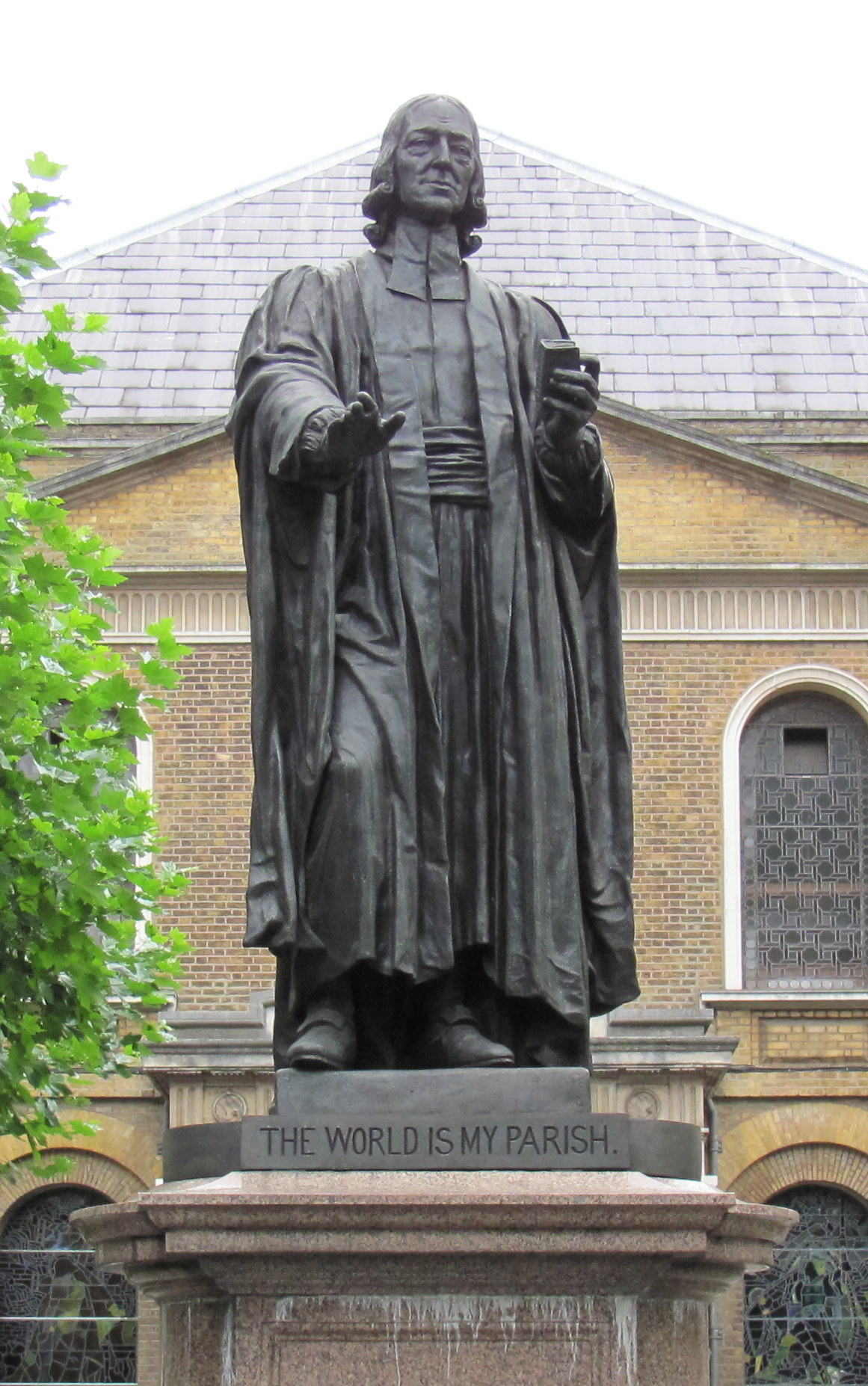
I call myself an ecclesial whore. I don’t know why God made some of us ecclesially homeless. I would like to think it has some ecumenical promise. Let me be clear: I am a Methodist. By that, I mean I think John Wesley was a recovery of Catholic Christianity through disciplined congregational life. Therefore, now that I am a communicant in the Church of the Holy Family [Episcopal Church], I understand myself still to be Methodist because I think the Episcopal Church is the embodiment of much that Wesley cared about. I think that’s true in much of Roman Catholicism. I don’t think any of us should look to Christian unity by thinking we can heal divisions of the past by some kind of artificial agreement. But by going forward, trying to live faithful to the charisms [gifts] within our ecclesial identifications, God hopefully will bring us into unity.

Hauerwas seems to suggest here that being Methodist doesn’t necessarily mean worshiping in a Methodist Church.   He can, as he says, live faithful to the charisms of his Methodist identity while being a communicant at Holy Family.

There are many today who find themselves in similar situations.  I personally know of Methodists worshiping at Presbyterian churches, Mennonites at Anglican churches, and Lutherans at Reformed churches.   I myself continue to identify as a Salvationist, though I presently worship at a Free Methodist church.

The lines of denominational demarcation are getting blurrier, but what does it all mean?  Are we entering a post-denominational landscape?  Do people even care about traditional differences of doctrine, worship, and polity, which were so divisive in the past?

With Hauerwas, I think this new situation has some ecumenical promise, although I also worry that it is due, at least in part, to cynical apathy regarding any kind of formal institutions.    The promising thing is that walls are coming down, and people are willing to worship, fellowship, and serve with people from another denominational background without thinking much about it.  In this sense, people on the ground are actually way ahead of their denominational institutions, which often remain relatively isolated.

The danger, of course, is that there are some real historical disagreements which should be aired out and discussed, rather than ignored through an easy ecumenism which treats differences as unimportant.

There’s something more to Hauerwas’ comment here, though, as it relates to the whole idea of ecclesial charisms.  He presumes that a Christian person can live out the charisms of one historic tradition while being part of a community that is based in another tradition (hence his status as a Methodist communicant in an Anglican parish).   I’m not sure how much he has thought about this, but it seems he presumes (as I am arguing in my dissertation) that charisms are personal, even when they are identified with a community like Methodism.

That is, properly speaking, the Methodist charisms are not borne by the Methodist community as a whole, but by the persons who call themselves Methodist.  The communal aspects of Methodism might encourage and cultivate those charisms, but at the end of the day, persons are the bearers of the diverse vocational charismata.

In that sense, it should be quite possible for a person to exercise one ecclesial charism in a context which is not normally identified with that charism.  Actually, I would say that this would make more sense than isolating large numbers of people with a particular charism from other parts of the church!

This is also why Methodism was intended in Wesley’s day to exist as a leaven in the Church of England, not as an independent church.   Though the Methodists were to have their own gatherings, which came in various forms, they were to remain within the church, worshiping alongside others in the C of E on Sundays, where the gifts that they brought could excite a renewal among the established structures.

This all might seem pretty far removed from the contemporary issue of “ecclesial homelessness,” but I think there could be a connection, and the changing denominational landscape of the twenty-first century just might make such a vision of the church more plausible than it was in the previous century.

Salvationists should read this

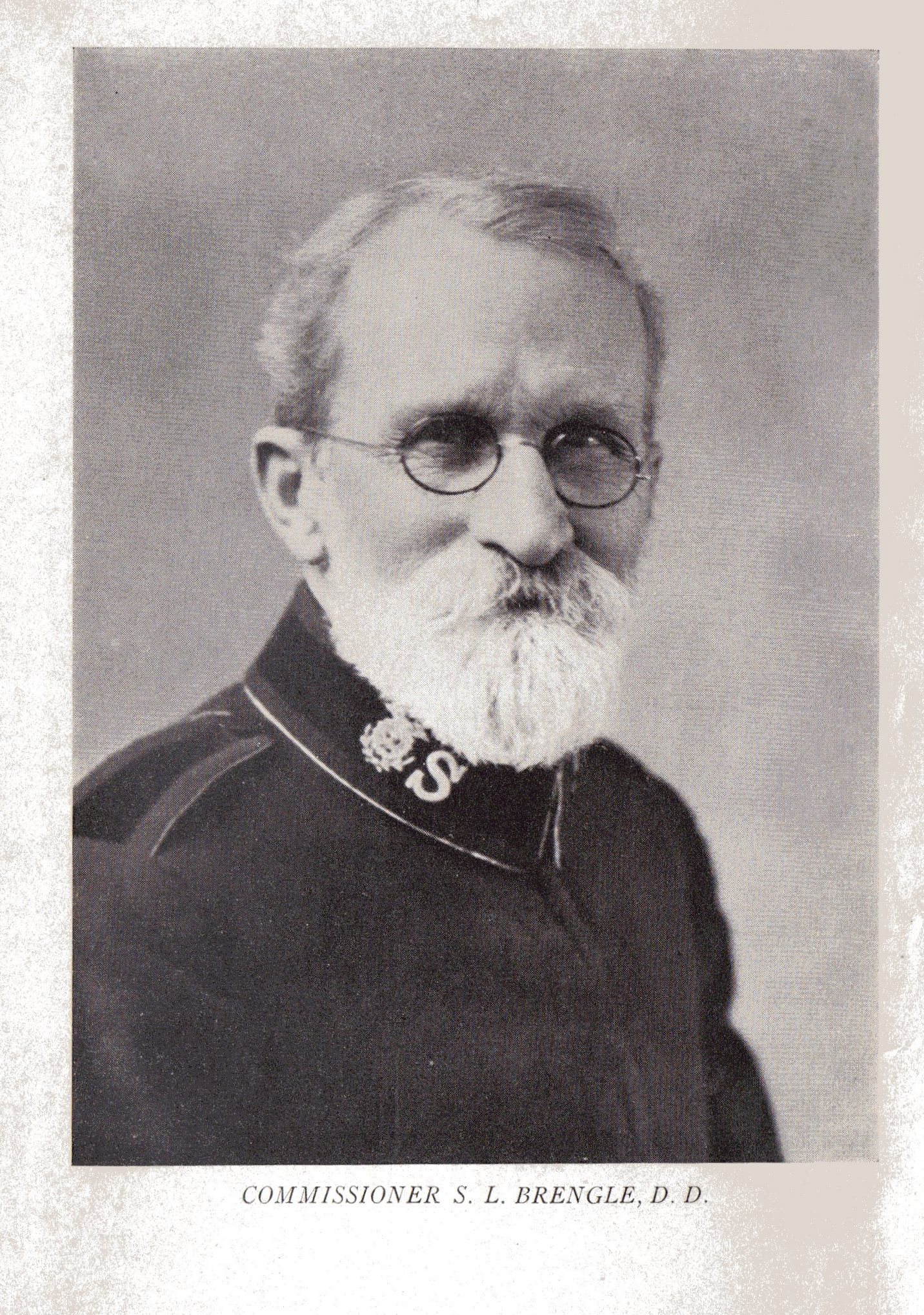
Australian Adam Couchman has just posted a review of one of Samuel Logan Brengle’s classic books, Helps to Holiness.   I think there is a real need for online reviews of old classics, so I’m glad to see Adam taking a look at this one by Brengle.

It’s a great review, acknowledging Brengle’s significant contribution, but also noting some of the shortfalls of his holiness theology – notably his approach to sin as a substance, his underestimation of the gracious and active pursuit of humanity by God, and the elevated role that experience plays in his theological method.

In spite of these shortcomings, Adam’s conclusion is that

Christians should read this book. Salvationists should read this book. But we should read it how Brengle intended it to be read; as a pastoral and devotional aid. Whilst Brengle had some training in academic theology he didn’t write academic theology. He wrote practical theology. It’s not perfect, but it is helpful.

This kind of critical appreciation for Brengle is sorely needed.  I find people either dismiss him, or put him on a pedastal.   I hope others will follow Adam’s lead on this.

Go here to read the review.

Notes on Spirit and Institution in the Church


How are we to describe the relationship between the Spirit and ecclesial institutions? Is it Spirit against institution?  Spirit in tension with institution?  Spirit enlivening institution?  Spirit in institution?  Some combination of these?  I’m wrestling through this question right now in my dissertation, and was blessed to have an opportunity to lecture on the topic last week at Wycliffe.  The following thoughts are taken from my my lecture notes.

The church is necessarily institutional.  An institution is simply a stable set of social relations practiced among an identifiable group of people.  In order for the church to persist in time and “take up space” in history, it must be institutional.  We must beware the cultural baggage we bring to the term “institution.”  We live in a time of extreme skepticism regarding social institutions.  We as Christians have been formed in a society which encourages us to believe the myth that we should, as autonomous individuals, resist all institutional authority.  This is, of course, impossible and impracticable.

We must avoid the errors of triumphalism and spiritualism.  A triumphalist church presumes upon the Spirit’s presence and blessing, identifying the church with the Spirit.  A spiritualist church denigrates the institutional reality of the church in favour of a disembodied “spiritual” church.

The Spirit and ecclesial institutions must be distinguished but not opposed, just as nature and grace must be distinguished but not opposed. As nature is the milieu of God’s gracious action, so also human institutions are the milieu for God’s pneumatic / charismatic action.

We cannot identify the Spirit with ecclesial institutions. The Spirit stands over and against ecclesial institutions, as Christ stands over and against the church as its Lord and judge.

We cannot oppose the Spirit to ecclesial institutions. There is no “non-institutional” place where the Spirit is “really” at work in people’s lives.  Ecclesial institutions are not the enemy of the Holy Spirit. The Spirit condescends to work in human institutions, as “earthen vessels” (2 Cor. 4:7).

The church can never presume upon the Spirit, but must always humbly call upon the Spirit, trusting in the promises of Christ (John 14:15ff) and the Father (Acts 1:4). The institutions in themselves are not endued with power; yet we know that Christ has promised the Spirit to the church, and we know that the church cannot avoid an institutional existence.

While ultimately the Spirit is not dependent upon institution, in the concrete life of the church in history, the two are inextricably interrelated (because the church is institutional in all aspects of its life).

As with human agents, the relationship between the Spirit and ecclesial institutions is not a zero-sum competitive game; the Spirit is the creator and animator of the Church’s institutions in such a way that they remain truly human institutions, while their institutional character is taken up and elevated into something more than a human institution – a sign, instrument, and foretaste of the kingdom of God.

In this way, all ecclesial institutions are charismatic. Just as humans were created in such a way that we cannot reach our divinely-ordered telos without divine grace, so the church as a visible, institutional reality is created in such a way that it cannot be what it has been created to be without concrete bestowal of grace.

Nevertheless, the gifts of the Spirit, which preserve, uphold, and elevate the Church’s institutional life are no guarantee of her faithfulness; the Spirit is not merely a stamp of approval, or a “divine positive energy”, but a divine Person, who carries out judgment  and brings conviction of sin (John 16:8-11), as well as giving life.

Because ecclesial institutions are truly human, they are caught up in the web of sin. Therefore the institutional character of the church can also be turned into something which it is not intended to be; it can become corrupted (and it often is).

In other words, the Spirit’s presence will include acts of both mercy and judgment, wrought in the historical life of the Church.  We can trust that the Spirit will be among us, but that should encourage a sure trust and confidence in God, and a humble watchfulness on our own part (rather than presumption on our part).

All the more reason to embrace the reformation call for a church which is reformed and always reforming. A constant repentance – an institutional turning away from sin and toward God – should mark the church’s corporate life.


Doctrine in The Salvation Army Tradition

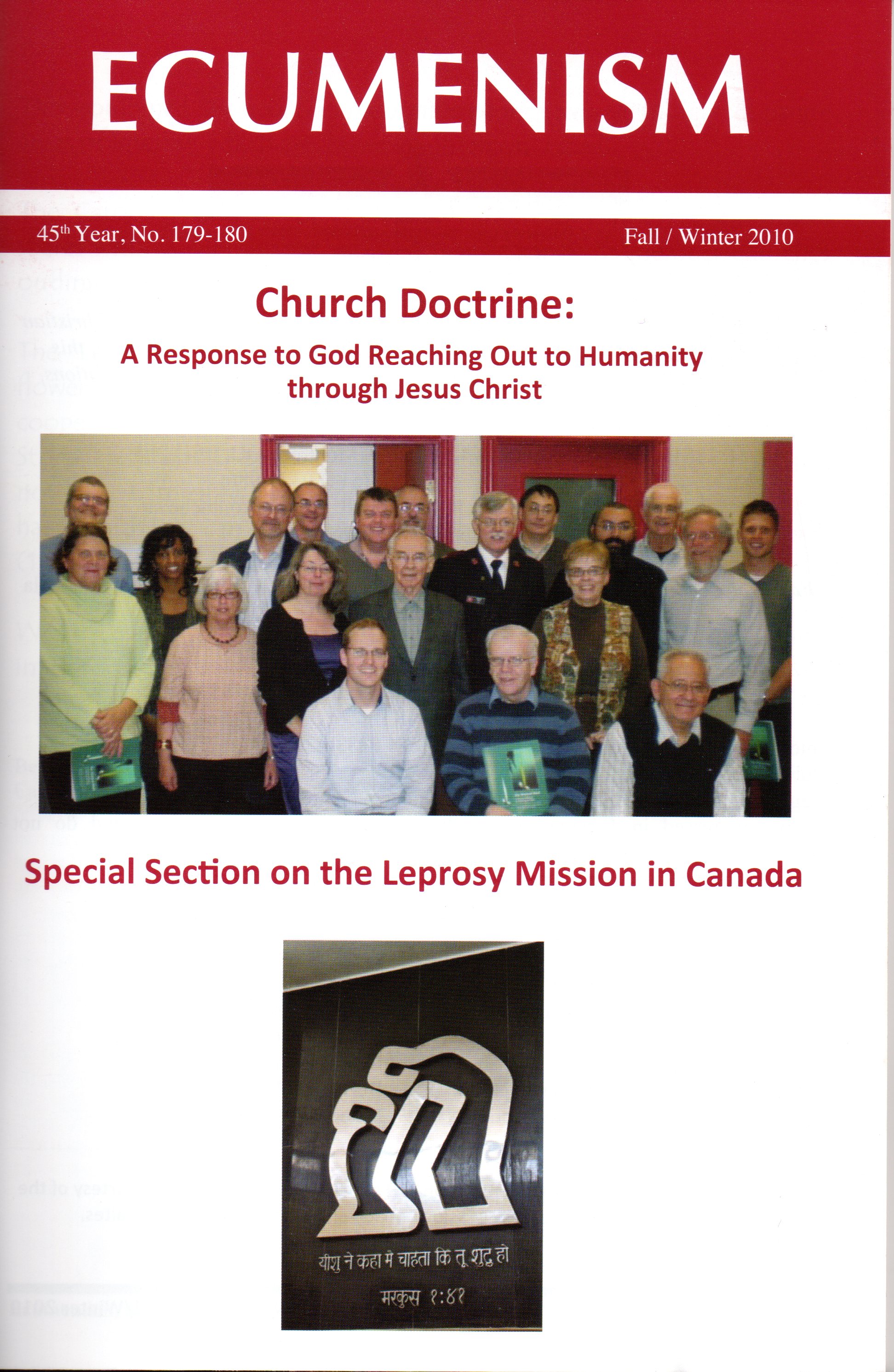
From 2007 to 2010, the Commission on Faith and Witness (Canadian Council of Churches) engaged its members in a dialogue regarding the role of doctrine in the life of the church.   The fruits of this dialogue are reported in the current issue of Ecumenism, published by the Canadian Centre for Ecumenism in Montreal.  Each commission member was asked to articulate their tradition’s answer to the following questions:

  1. What is dogma or doctrine in your tradition?
  2. What are considered to be doctrinal statements?
  3. Who can make doctrinal statements?
  4. What is the relation between doctrine and revelation?
  5. How does your tradition view the first seven ecumenical councils?
  6. How does your tradition understand the reliability of Scripture?
  7. What are those shared convictions without which the Church’s mission would be seriously impaired, or even become.

While ecumenical dialogues often aim at producing some sort of consensus statement, members reported that during this particular dialogue, it became clear at the outset that no consensus would be achieved.  The membership of the commission is very broad, including Catholics, Orthodox, historic Protestants, radical reformation, and evangelical traditions.  Some of these traditions are committed to holding fast to formal statements of  belief (creeds and confessions), while others have historically been opposed to creeds of any kind.

In an introductory article, Gilles Mongeau, Paul Ladouceur, and Arnold Neufeldt-Fast note the general commonalities that they identified in the process:

Every member Church holds to the necessity of some doctrine, explicit or implicit, as a reference point.   In all cases, one or more documents exist which lay out this doctrine, though the authority and form of these documents varies greatly. In all cases, Scripture, tradition, reason, and religious experience interact in some way in the emergence of doctrine.  Similarly, the role of some form of reception by the community of the faithful is a strong component of all of the traditions represented.  Finally, the presenters of the papers agree that the fullness of truth resides in God alone, and that the truth of doctrines is eschatological, that is, oriented to a future complete fulfillment or plenitude.
“Introduction to the Working Papers on Doctrine,” Ecumenism 179-180 (Fall/Winter 2010): 5-6.

While I wasn’t part of the actual discussion, I was able to participate by revising and expanding the Salvation Army contribution to this publication, originally written by Kester Trim, and entitled “Doctrine in the Salvation Army Tradition.”   It is interesting to consider doctrine in the SA’s life via a comparison with the role it plays in the life of other traditions.   Some of our observations that are relevant to the above:

The Salvation Army is not known for placing a particular emphasis on doctrine.  This is not because doctrine is unimportant for Salvationists, but because The Salvation Army has customarily emphasized evangelism and service, rather than theological scholarship.  Nevertheless, The Salvation Army’s official doctrines are viewed as essential to its corporate life and witness.
“Doctrine in the Salvation Army Tradition,” Ecumenism 179-180 (Fall/Winter 2010): 36.

The Army is an interesting ecumenical partner in this dialogue, as it is on many issues, because it treats doctrine as essential, but tries to avoid doctrinal controversy.  It wants its doctrine to be clear, but Salvationists haven’t wanted to spend much time developing their doctrinal tradition.  It envisioned its brief 11 articles as a minimalist list of essentials, which would allow the SA to be “an evangelisitic force free from the entanglements of doctrinal controversy” (Ibid., 37).

Of course, it is not easy to remain aloof from doctrinal controversy!  First of all, the Army’s doctrines are clearly Wesleyan, and therefore anti-Calvinist:

In these brief 11 articles of faith, one can see the seminal Wesleyan themes of total depravity (Article 5), universal atonement (Article 6), justification by faith (Article 8), assurance through the witness of the Spirit (Article 8), and a strong emphasis on sanctification (Articles 9 and 10) (Ibid., 37).

Secondly, from the perspective of “implicit doctrine,” the obvious point of controversy would be the sacraments.  Even here, a large part of Booth’s motivation was to avoid controversy.

The Army’s non-observant stance on the sacraments had its historical precedent in the tradition of the Society of Friends, but was also justified in part by the above-mentioned desire to avoid theological controversy (since the sacraments have often been a matter of theological dispute in Christian history).  It was not Booth’s intent to disrespect the practice of other traditions, nor to make it a matter of dispute. Moreover, Salvationists have never been prohibited from from partaking of the Lord’s Supper in other traditions where they are welcome, and are free to be baptized if they feel it to be of importance (Ibid., 37-38).

Avoiding controversy is a noble aim, but very difficult to achieve in practice.  I would suggest that recent sacramental statements of the Army have lost this early irenic tone and approach, and have become much more controversial than Booth would have liked.  Also, I think one needs to be careful that a desire to be non-controversial does not become a justification for avoiding deep theological discussion, and meaningful engagement with ecumenical partners.

Pentecost as a Firstfruits Festival

The Pauline teaching on charisms comes, canonically speaking, after the story of the outpouring of the Spirit at Pentecost, which occupies a key place in the biblical narrative, marking the fulfilment of the promise given by Christ (Acts 1:8, Luke 12:2; John 14-16), and harkening back explicitly to the prophesied eschatological outpouring of the Spirit in Joel 2:28-32.  Pentecost signifies the dawning of the age of the church, a new era in which the Spirit’s gifts, previously limited to particular people and situations, are distributed liberally to all the people of God, young and old, male and female, slave and free.

Lest one take this Lukan theme of “fullness” in too far, the canonical significance of the feast of Pentecost as an Israelite festival must not be forgotten.  I am indebted to Howard Snyder for pointing out the significance of Pentecost as a feast of first fruits.  You can find his discussion of this theme in his chapter on “The Pentecostal Renewal of the Church” in the forthcoming book, Yes in Christ: Wesleyan Reflections on Gospel, Mission, and Culture, Tyndale Studies in Wesleyan History and Theology 2 (Toronto: Clements Academic, 2011). Pentecost, or the Festival of Weeks, was one of the three great festivals in Israelite worship, coming between Passover and the Feast of Tabernacles, and in Jesus day it remained one of the three festivals which included pilgrimage to Jerusalem.  Pentecost concluded the Feast of Weeks, which began with a day for the offering of first fruits on the first Sabbath after Passover (Lev. 23:10-11), and ended fifty days later, with what came to be known as the primary celebration of firstfruits (Num. 28:26, Lev. 23:17).  Firstfruits were offered both as a thanksgiving for the faithfulness of God in the past, a celebration of God’s provision in the present, and as a promising sign of the future harvest which was to come.

While the New Testament writers do not explicitly link Pentecost with a harvest of first fruits, it is difficult not to see the significance of interpreting it as such.  First of all, there is the important eschatological harvest imagery which runs throughout the New Testament, and is particularly strong in the teaching of Christ concerning the final judgment.

Secondly, though the Feast of Weeks per se does not feature prominently in the New Testament, the concept of firstfruits is used a number of times. Paul refers to the resurrection of Christ itself as the first fruits of the coming general resurrection in 1 Corinthians 15:20-23. In Romans 8 he speaks of Christians having “the first fruits of the Spirit” (8:23) and thus joining with all creation in groaning for the fullness of the coming bodily redemption.  James 1:18 identifies those who have experienced the new birth as “a kind of first fruits” of God’s creatures, and Revelation 14:4 identifies the 144,000 as those who “have been redeemed from humankind as first fruits for God and for the Lamb.”

Finally, recalling the Johannine identification of the cross with the feast of Passover (John 13:1), Pentecost, as the first fruits festival which caps off fifty days of firstfruits celebration, evokes a sense of anticipatory harvest, looking toward the final reaping which is to come at the eschaton.  Christ’s resurrection, then, coming on the first Sunday after Passover, is the initial offering of first fruits, to be followed by the main celebration of firstfruits on the day of Pentecost fifty days later, when the firstfruits of the new creation are harvested in the outpouring of the Spirit.  As Ephraim Radner notes, the traditional Jewish understanding of this time in their liturgical calendar was that the fifty days in the Feast of Weeks marked the wanderings of the people in the desert, and the day of Pentecost was seen as the entry into the promised land, “where all that is enjoyed is given by God” (Leviticus, 247).

We see in Pentecost, the culmination of the Feast of Weeks, the celebration of the first fruits of the great and wonderful day of the Lord, prophesied in Joel 2:28-30.  The outpouring of the Spirit, then, on this day of first fruits, should be seen, not as a complete “fullness” of the Spirit, but as an anticipatory offering of young fruit which is to mature and yield a much greater harvest in the promised future.  The pneumatic firstfruits of Pentecost are a proleptic anticipation of the complete fulfillment of Joel 2, in which the Church experiences in itself the outpouring upon “all flesh,” which is to come, at the “great and terrible day of the Lord” (Joel 2:28, 31).

It is important to stress, then, that the charisms, as first fruits of the Spirit, are not to be seen merely as divine acts of “mercy” and “life,” bestowing blessings upon their recipients, but also as anticipatory acts of “judgment.”  This is consistent with Jesus own description of the work of the Spirit as convicting the world about sin, righteousness, and judgment – each of which finds its meaning in the saving work of Christ (John 16:8-12).  Divine mercy and judgment cannot be separated from one another, and this two-sided character of the Spirit’s work as seen in the Church in history ought to be a fundamental theme in the theology of charisms. For if the Spirit participates in God’s acts of judgment as well as God’s acts of mercy, then the Church, as people among whom the kingdom is already breaking in to the present age by the Spirit’s work, will manifest the eschatological judgment just as surely as they will manifest eschatological life and renewal. Judgment begins with the house of God (1 Peter. 4:7).

Charisms and sanctification

A classic question in the theology of charisms focuses on the relationship between spiritual gifts and sanctification. Are the charismata sanctifying gifts of grace?  In the history of interpretation, this question arises from Thomas Aquinas, who classified charisms as gratiae gratis datae (gratuitously given graces), as distinct from gratia gratum faciens – sanctifying grace. For Thomas, sanctifying grace effects our participation in the divine nature and brings us to union with God, gratuitous graces are ordered to sanctifying grace, in that they are given to enable others to receive sanctifying grace. This is summarized well by Serge-Thomas Bonino:

Sanctifying grace (or grace gratum faciens) is a created participation in the divine nature, as much at the level of being as of acting.  It brings about one’s union with the last end, which is God.  Graces gratuitously given (gratis datae) – or charisms – are given to some so that they may dispose others to receive sanctifying grace…Charisms are thus wholly ordered to sanctifying grace (from “Charisms, Forms, and States of Life (IIa IIae, qq. 171-189),” in The Ethics of Aquinas (Washington  D.C.: Georgetown University Press, 2002), 341).

The charisms, then, “pertain especially to certain men” (Summa Theologica, 2a 2ae, q. 171, prologue). Since they are given “for the utility of the Church,” their purpose is not to unite the soul of the bearer of the charism with God, hence they can exist “without goodness of conduct” – evidence that they are not sanctifying.

For prophecy like other gratuitous graces is given for the good of the Church, according to 1 Cor. 12:7, “The manifestation of the Spirit is given to every man unto profit”; and is not directly intended to unite man’s affections to God, which is the purpose of charity. Therefore prophecy can be without a good life, as regards the first root of this goodness (ST 2a 2ae q. 172, a. 4).

Karl Rahner suggests that this distinction, while not completely inappropriate in some cases, is foreign to Paul, who does not differentiate between gratuitous and sanctifying grace, but “only envisages the case where the charismata both sanctify the recipient and redound to the benefit of the whole Body of Christ simultaneously and reciprocally” (Rahner, The Dynamic Element in the Church, 55). Rahner rightly suggests that anyone truly fulfilling their function in the body of Christ must be doing so as the result of the Spirit’s sanctifying work, and that such service will surely further one’s sanctification.

For how else could one truly sanctify oneself except by unselfish service to others in the one Body of Christ by the power of the Spirit?  And how could one fail to be sanctified if one faithfully takes up and fulfils one’s real and true function in the body of Christ? (The Dynamic Element in the Church, 55).

In connection with this question, Gabriel Murphy makes the obvious point that the charismatic, as “a member of that Church which is built up by the Holy Spirit through the influence of His gifts,” will surely participate in the fruits of those gifts, even though the charisms “are not given primarily for the sanctification of the receiver, but rather for the good of his neighbour.” (Murphy, Charisms and Church Renewal, 56).

There are specific New Testament texts which lend support to the notion that charisms are not sanctifying gifts, in that they indicate the exercise of extraordinary gifts by those who are not in Christ. Chief among them, cited by Thomas, would be Matthew 7:22-23:

On that day many will say to me, “Lord, Lord, did we not prophesy in your name, and cast out demons in your name, and do many deeds of power in your name?” Then I will declare to them, “I never knew you; go away from me, you evildoers.”

We might also look to the question of discernment addressed in 1 Corinthians 12:1-3, noting that there would be no need for such a test if charismatic gifts were only given to the sanctified. For Rahner and Murphy, such cases should be treated as the exception, rather than the rule.

However, James Dunn raises some important questions about the potentially divisive character of charismata, notably, that in Corinth,

far from expressing the unity of the Spirit, charismatic phenomena in Corinth had in actual fact expressed lack of love, lack of faith, lack of hope; far from building up the Corinthian community, charismata constituted one of its chief threats (Jesus and the Spirit, 267).

Indeed, the attention that Paul gives to charisms in 1 Corinthians 12-14 indicates the extent of the challenge that proper exercise of these gifts was posing of the church in Corinth at that time.  While some might object that anything which destroys unity is necessarily not a genuine charism, Dunn points out that Paul does not question the genuineness of the Corinthian charisms, but rather notes the dangers inherent in the charismatic phenomena when exercised without love.

Paul does not dispute that the Corinthians experienced genuine charismata, including prophecy, faith, giving. But even genuine charismata of the most striking nature when exercised without love made for strife within the community and stunted the growth of the body (Jesus and the Spirit, 271).

The apparent immaturity of the Corinthian Christians, coupled with the fact that Paul treats their charisms as genuine, underlines the point that, while we might expect charisms, properly exercised, to be sanctifying, even genuine charisms provide no guarantee of sanctification.  Therefore, charisms should be taken as  potentially, but not necessarily sanctifying.  This has important implications for the recognition of ecclesial charisms: a claim to a charism by a particular group within the church should not be treated as equivalent to a claim to sanctity on the part of that group. 

Ladd’s chart of charisms

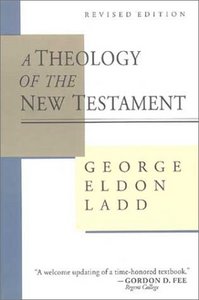
Ladd put together this handy chart comparing the ordering of charisms in five separate New Testament lists – three from 1 Corinthians 12, one from Romans and one from Ephesians.

From George Eldon Ladd, A Theology of the New Testament, Revised Edition, edited by Donald A. Hagner (Grand Rapids: Eerdmands, 1993), 579-580.

1 Cor 12:28 1 Cor 12:29-30 1 Cor 12:8-10 Rom 12:6-8 Eph 4:4
1 Apostle 1 1 1
2 Prophet 2 2 5 1 2
3 Discernment of spirits 6
4 Teacher 3 3 3 4
5 Word of wisdom-knowledge 1
6 Evangelists 3
7 Exhorters 4
8 Faith 2
9 Miracles 4 4 4
10 Healings 5 5 3
11 Tongues 8 6 7
12 Interpretation 7 8
13 Ministry 2
14 Administration 7
15 Rulers 6
16 Helpers 6
17 Mercy 7
18 Giving 5

The interesting thing, which I hadn’t noticed before, is that apostle is almost always mentioned first, followed by prophet and teacher, with the exception of Ephesians 4 which puts evangelist before teacher.   The list in 1 Cor. 12:8-10 is altogether different  from the other two lists, and the reason is because it comes in the context of Paul’s discussion of the “extraordinary” gifts which the Corinthians seemed so interested in.

I’m not suggesting Paul was sketching out some sort of hierarchy here, but it does not seem random that his normal ordering was apostle-prophet-teacher.

How does this apply in the post-apostolic church?

Well, I would suggest that, for us, the apostles and prophets continue to exercise authority in the church through the witness of scripture.  After all, it was common in the ancient church to refer to the scriptures as the witness of the apostles and prophets.   This is an entirely fitting description of the Bible for a Christian, since the New Testament is our record of the apostolic witness – the first-hand accounts of the people who knew Jesus – and the Old Testament is understood as characterized throughout by its prophetic anticipation of the coming of Jesus – even in books which are not explicitly called “prophetic.”   Of course, there is scriptural warrant for this, in the fact that both Moses and David are called prophets (Deut. 34:10 and 2 Sam. 23:1-2).

Therefore it would seem that the office of teacher remains a pre-eminent gift for the church, so long as it is remembered that it is less important than the apostles and prophets, that is, the scriptures.   The gift of teaching comes under the greater authority of the apostles and prophets, and derives its authority from them.  This fits with one of Paul’s main criteria for assessing the relative importance of charisms – do they build up the church (hence his prioritization of prophecy over tongues in1 Cor. 14:1-5).  It also lines up nicely with the description of scripture’s role in 2 Tim. 3:16-17:All Scripture is God-breathed and is useful for teaching, rebuking, correcting and training in righteousness, so that the man of God may be thoroughly equipped for every good work.”

Am I suggesting there are no apostles and prophets in the church today?  I would definitely say there are no apostles.  Though one could go back to the root meaning of the word and argue that apostle simply means “sent one,” therefore allowing that there are similar functions in the contemporary church, the scriptural concept can’t be understood simply on the basis of a breakdown of the Greek word.   The Christian apostles are those who knew Jesus in person and were commissioned by the resurrected Christ to be witnesses to his resurrection.  Of course this is extended to Paul, as the “one abnormally born” (1 Cor. 15:8).

With prophets I am willing to consider a bit more leeway, though I would still maintain that the word should be used sparingly, and also with a clear differentiation between scriptural prophets and contemporary prophets.  I do not doubt that there are persons whom God chooses to use as his mouthpiece today, giving them special insight into the times in which we live.  However, all such prophecy must be tested against the canonical prophetic witness of scripture, and that is the difference between prophets in the age of the Church and the prophets of scripture.  Even in Paul’s day, his message was that prophets needed to be tested and placed under authority (1 Cor. 14:29).  Today we have the benefit of the established canon of the apostles and prophets as our standard for such testing.

What is God’s Plan for Ecumenism?

That was the title of the episode of Perspectives: The Weekly Edition, which aired Firday night on Salt + Light TV.  Host Pedro Guevera Mann invited some representatives of the Canadian Council of Churches’ Commission on Faith & Witness to discuss the topic, and I was privileged to be interviewed along with my colleagues Dr. Mary Marrocco, and the Rev. Dr. Gilles Mongeau, SJ.

It is a huge topic, and we didn’t have nearly enough time, but it is wonderful that Salt + Light TV is showing an interest in ecumenism and trying to generate some discussion among their largely Catholic audience.

There isn’t an overwhelming interest in ecumenism on the grassroots level these days.  It was interesting to hear about why this is the case in Catholic circles.   In spite of clear teaching from Vatican II and subsequent magisterial documents like John Paul II’s Ut Unum Sint, many Catholics are still under the impression that ecumenism means bringing protestants “back to Rome.”    On the protestant side it would seem as if Christians are becoming more “ecumenical” in that denominational differences are no longer as signficant as they used to be.  Many people don’t really care at all about what denomination they belong to, as long as they feel at home in their local congregation.  But I think that it is precisely this dismissal of the significance of denominational differences that can undermine serious discussion about Christian unity.  If our differences don’t matter at all, then there is no reason to try to overcome them!

Still, the current situation is preferable to the hostilities of past generations.  And even if there is not an overwhelming interest in “official ecumenism” via bodies like the Canadian Council of Churches, there is, it seems to me, a lot of interest in “informal ecumenism,” as seen in some current trends in worship and spirituality (such as the growing interest in spiritual direction among evangelicals).

Salt + Light decided to do a show on ecumenism because this is the Week of Prayer for Christian Unity, which runs from January 18 to 25 each year.   This year, the week of prayer is focused on the church in Jerusalem, and the resources for the week (which can be found here) were prepared by Chrisitans from Jerusalem.   The theme is “One in the Apostles’ Teaching,” taken from Acts 2:42.

I’ll leave you with my favourite prayer from this year’s Week of Prayer service:

Merciful God,
may your life-giving Spirit
move in every human heart,
that the barriers that divide us may crumble,
suspicions disappear,
and hatreds cease,
and that, with divisions healed,
your people might live in justice and peace.
We pray to the Lord.


Methodism as religious society-become-church

Continuing on the theme I posted last week: In the quote below, Albert Outler reflects on the origins of Methodism as a religious society, with a view to the way this has evolved in Methodist history.  As with many such renewal movements, Methodism became a sort of hybrid of “movement” and “church,” and its peculiar structures, practices, and culture reflect this inherited tension.  While the tension can be fruitful, it sometimes produces a certain amount of confusion regarding the nature of the movement-church, both for the membership of the movement-church and for their fellow Christians.

It is interesting that this text comes from the same time as the Rupp essay on Wesley as prophet.  In the wake of Vatican II, there was great optimism regarding the possibilities of visible Christian union.  Both Rupp and Outler are keen to stress Wesley’s insistence on Methodism’s ecclesial location as a movement within the Church of England, raised up in “extraordinary” circumstances to meet a particular need.   From the perspective of “ecclesial charisms,” the vocation to “spread scriptural holiness throughout the land” through the “irregular” ministry of lay preachers could be seen as the particular Methodist charism.

What happens when the specialized movement takes on the character of a “church”?  The original charism and vocation cannot help but be hampered, because the Methodists are now focused on doing all the things that the church does, rather than the specific vocation around which they were formed.  The church at large also suffers the impoverishment of being cut off from the ministry of those with the particular Methodist charism.   Again, with Rupp, he wants to stress that Wesley only broke with the Church of England because it was necessary for the provision of the mission of the Church in America.

Here is the quote, from That the World May Believe: a study of Christian unity and what it means for Methodists (New York: Board of Missions of the Methodist Church, 1966), pp. 59-63.

Methodism is a religious society that became a church without the complete loss of its character as a religious society.  Methodists are not always mindful – and many non-Methodists are not even aware –  of this dual inheritance from both the Catholic and Protestant traditions in the Christian community, an experiment in the fusion of “justification by faith alone” with a disciplined ethic of “faith working by love.”  The history of this society-become-church is often confusing both to ourselves and to our neighbours.  We are usually reckoned among the pietists – but no typically pietist group ever had anything like our General Rules and Discipline.  We classify ourselves as Protestants, but none of the classical traditions of continental Protestantism had anything like the Wesleyan ideal of “Christian perfection” and the Wesleyan concept of evangelical morality.   And yet, if the quintessential formula for ecumenism is something like “consensus in faith, community in worship, unity in mission,” then it would be true to say that Methodism has been ecumenical from the beginning.  John Wesley was a rebel and a church reformer, a critic of the standing order, and a rude disturber of the false peace of Zion.  Because he was convinced that the regular ministries of the Church of England were failing in their mission to the nation, he felt authorized by the Holy Spirit to raise up an irregular ministry of gospel proclamation and to organize a network of religious societies in England, Wales, Ireland – and later, America.  To these he gave a distinctive set of “General Rules,” a peculiar pattern of organization (classes, bands, etc.), a novel principle of lay-leadership, and a communal ethos that marked off the Methodists from the Non-conformists as well as from the “High Churchmen.”

Despite all this, Wesley was no separatist. He never lifted a finger to overthrow the power structure of the Established Church nor even to invade it.  The Methodists were ill-treated, but Wesley held them in the church and kept them loyal to the sacraments.  The Anglican bishops reacted in varying degrees of distaste and bafflement, but they wisely refrained from any resort to formal excommunication in dealing with these Wesleyan irregulars.

This self-image of an evangelical order within an inclusive church was not effaced even when the Methodist societies developed into separate churches with sacramental ministries of their own.   Thus we learned – or might have learned – that wide diversity within an inclusive fellowship is not only tolerable but can actually be a vital service to the cause of authentic unity.  The early Methodists deliberately retained their distinct ties with the ancient and universal community but, quite as deliberately, they insisted on their freedom in Christian mission and nurture.  Wesley had no qualms in his use of laymen as preachers in the Revival and as leaders of the societies.  At the same time, he refused, on principle, to allow these laymen to administer the sacraments which were available in the Church of England.  He even forbade Methodist preaching services to be scheduled in competition with “church hours.”  Given the violent and divisive spirit of the age, this uneasy maintenance of the Methodist societies within the unity of “Mother Church” is one of the most remarkable incidents in Protestant church history.  When, however, the American Revolution had deprived the Methodists in the new republic of any ordained ministry for the sacraments, Wesley proceeded – by his ordinations of Richard Whatcoat, Thomas Vasey, and Thomas Coke – to remedy this defect himself rather than to approve the pattern of sectarian self-ordination by laymen begun by Philip Gatch and others at the Fluvanna Conference of 1779.

Where was Outler going with this?  His phrase at the start of the last paragraph is telling, where he speaks of Methodist “self-image” as that of “an evangelical order within an inclusive church.”   I believe Outler longed for this to be recaptured in some way, although he was clear that this would be costly: “We are, or ought to be, willing to risk our life as a separate church and to face death as a denomination in the sure and lively hope of our resurrection in the true community of the whole people of God” (p. 75).