Typology of Views of Charismatic Movements, Part 5 continued: Charismatic Enlivens Institutional

Within this perspective we can also include some of the literature on charisms and the religious life in the Roman Catholic tradition (a word of clarification for those who aren’t familiar with Catholic terminology: Catholics refer to the “orders” within Catholicism (Dominicans, Franciscans, Jesuits) as the “religious life”). Since Vatican II it has become increasingly common for religious to speak about their movements as having a particular charism which is to be preserved and cultivated for the good of the whole Church.  Vatican II didn’t specifically apply the term “charism” to religious life in this way, but Perfectae Caritatis §1 speaks of the various gifts (variis donis) that are evident in the variety of forms of religious life, and also exhorts the religious to preserve the “spirit of founders.” Subsequently, however, both Paul VI and John Paul II used the term specifically in relation to the religious life.  See Evangelica testificatio §11, 12; Mutuae relationes §11, 13; Redemptionis donum §15.

Surprisingly, there has been little in-depth critical theological reflection done on the implications of applying the biblical idea of charisms to religious life. The most extensive treatment can be found in a short book by John Lozano, a Claretian Father and theologian, entitled Foundresses, Founders, and their Religious Orders (1983). Lozano’s discussion of the role of religious life as charismatic reforming movement comports well with the more general framework provided by Snyder and Sullivan, that is, viewing charisms as an enlivening force which renews the institutional life of the Church, like “lava” pushing against the “hard crust” of established institutions.

But when these charisms erupt at the surface, from the interior where the Spirit of Pentecost is burning like lava, they must necessarily push against the hard crust which has been hardening for centuries.  The People of God are not just a charismatic reality (although they are a charismatic reality essentially), but also an institutional entity.  The Church has its firm structures and its ministers, people whom God certainly helps in their care for his people, but people who are likewise conditioned by a certain mentality (61).

However, Lozano specifically gives attention to how such charismatic activity becomes itself institutionalized in religious families, and specifically to the question of how a charism can be said to be “transmitted” via such an institution – a question which has not received sufficient attention. It should be noted, however, that Rahner does deal with this question in The Dynamic Element in the Church (58-62), as discussed in a previous post. Lozano argues that, strictly speaking, a charism cannot be transmitted, but must come directly from God.

The charism, as we have said, always comes directly from the Lord.  It is not given by the Church, by any member of the Church (including founders and foundresses), or by the religious community  The Lord, by means of his Spirit, gives it to each individual… (76)

In a broader sense, however, the charism is transmitted by the particular religious institute in that the community becomes a context where that particular charism is cultivated, deepened, and actualized by the stable structures (i.e., the rule, constitutions, spiritual theology and practices) of the institute.

The gift received by the father or mother, and directly from God by their followers, is collectively cultivated, proposed in spiritual doctrine to new generations, deepened and actualized.  Its principle elements, the aim of the Institute or the “primordial concern” of the community, are described in the Constitutions, the form of life and spiritual environment are also described in them, as a point of consideration and source of light and nourishment for successive generations.  In this less proper sense, the charism is transmitted (76).

Religious join a particular institute, then, “because we realize that our vocation essentially coincides with that of its members and with the aims which this institution pursues” (75).

The picture that emerges from this perspective, then, is that of a vocational diversity in the church, evidenced in the various movements of reform and renewal which have at their root a particular charism.  The fruitfulness, functionality, and vitality of the movements depends on their continual interpretation and actualization of that charism in their own institutional structures.

This in fact became the basis for a program of renewal of the religious life after Vatican II. Perfectae Caritatis §2b speaks of this in terms of “loyal recognition” and “safekeeping” of “the spirit of the founders,” which give the various communities “their own special character and purpose.” Elizabeth McDonough summarizes the relevant papal documents relating to this renewal, and drawing upon them, identifies a set of presuppositions which underlie this perspective. If religious communities are in fact based upon a particular charism given to the Church, then existing communities must ask themselves a) if they indeed have a charism; b) if they know what their charism is; and c) if they are prepared to strive to live accordingly.  If their answer to any of those questions is in the negative, the religious community will not survive. (McDonough, “Charisms and Religious Life,” in The Church and the Consecrated Life, 135).

How much of this thinking could be transferred to protestant reform movements?  Can we speak, for example, of  a Methodist charism, or a Salvation Army charism, or a Christian and Missionary Alliance charism?  I think, historically speaking, we can easily make the case that these movements all started out in a way similar to a Catholic order: they were not trying to be “churches,” but instead trying to live out a very specific vocation within the Church.   They brought their particular charism to the Church, and the reaction was, as Lozano describes it, somewhat volcanic.  But do these groups remain focused on their founding charism today?  Is this still a helpful way to understand their place in the universal Church?  To what extent can an independent protestant movement sustain a focus on a particular charism, once it starts to take on “churchly” functions (one or two generations down the road)?

The Salvation Army as an Order? An Early Catholic Comment

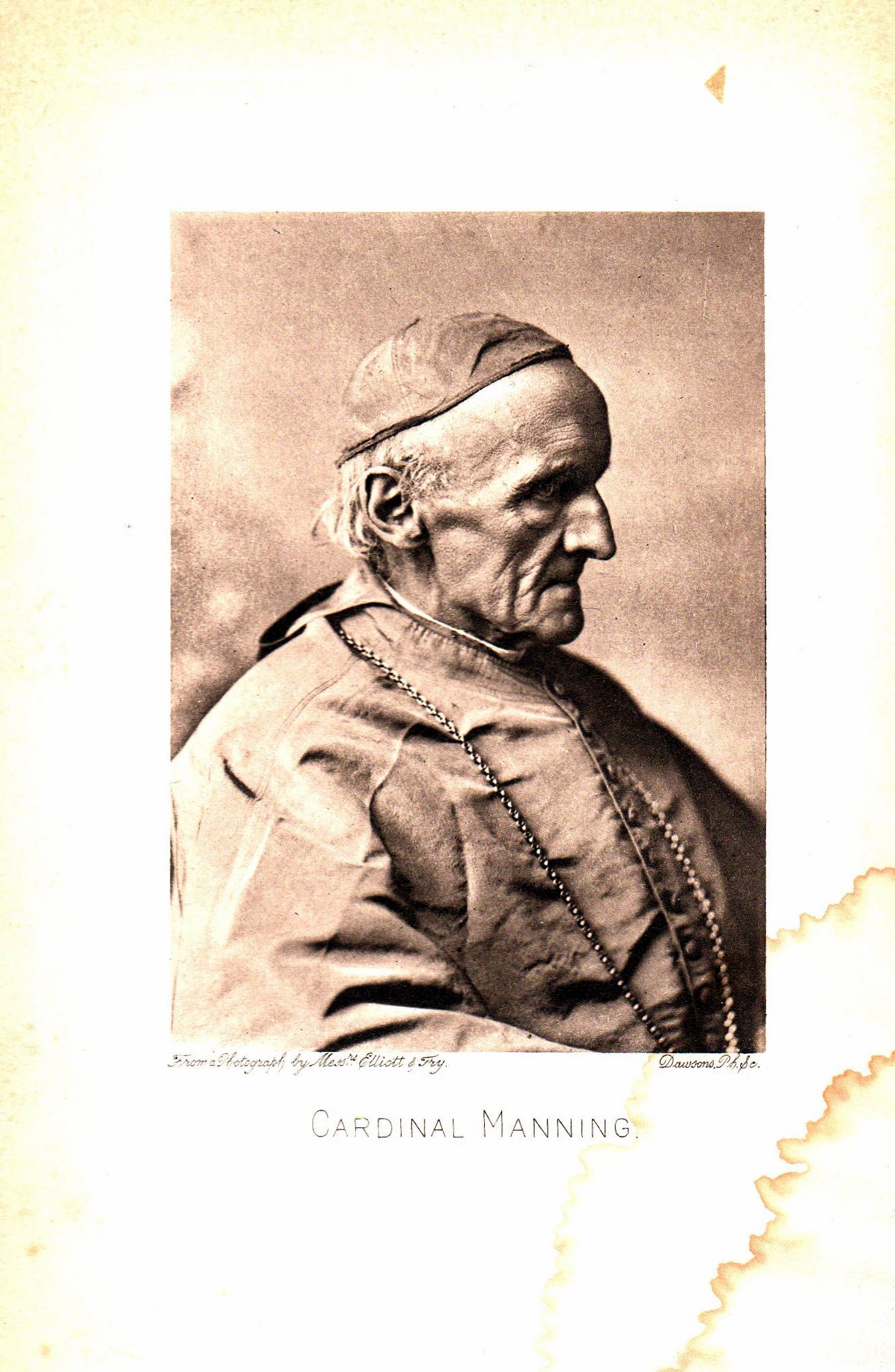
I stumbled upon a biography of Henry Cardinal Manning at the Regis College Library yesterday, published in 1892, the year of his death.  The book happened to be on their booksale shelf, for $2.   Many used book collectors are wary of library discards, because of the library marks, stamps, and stickers, as well as general wear and tear.  Personally I find these things endearing.  It adds the character of an old book when you can see the names of previous owners inscribed on the inside cover.

This bears the stamp of two previous libraries.  Obviously it was most recently part of the Regis College library’s collection, but prior to that, it found a home in the library of “J. & E. Stoneham Ltd., 51 Old Broad Street, London, E.C.2.”   Doesn’t that make you wonder how this book got from London to Regis College?

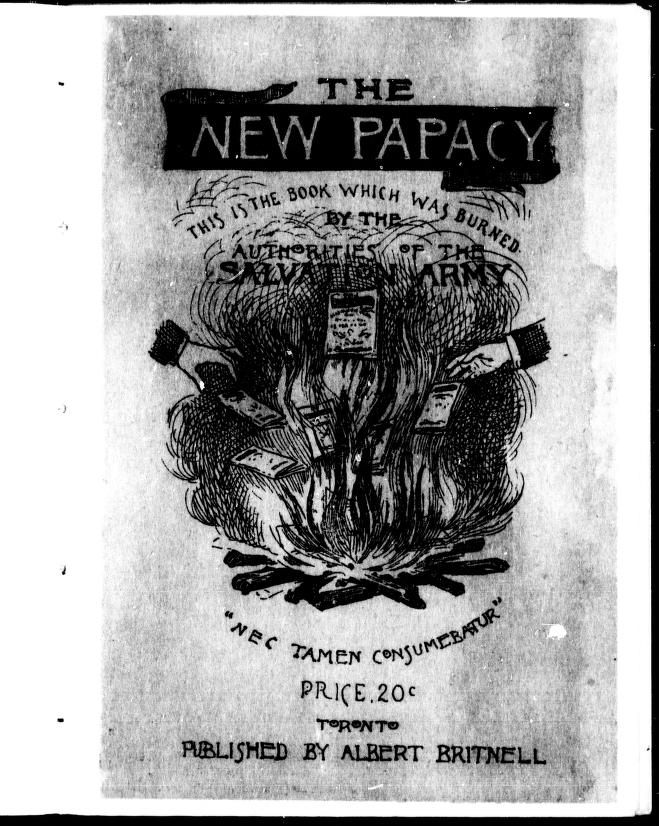
Manning is a towering figure in 19th century England, a high profile Anglo-catholic who converted to Catholicism and became Archbishop of Westminster in 1865.   Those who have read a bit of Salvation Army history will know that Manning was sympathetic to the work of the Army, but also willing to challenge the Booth on some of his presuppositions.  You can read an interesting comment from Manning on his appreciation for Army and his concerns with its teaching and practice in The Contemporary Review 41 (1882): 335-342.   Roger Green quotes from this passage in his recent biography of William Booth, specifically noting Manning’s astute on the Army’s claim that it was “not a sect,” in spite of the fact that it had no ties to the larger Church.

“The head of the Salvation Army is resolved that it shall never become a sect. In this he is wise. A sect is soon stereotyped. He seems to wish that it may not be a sect, but a spirit, which, like the four winds, may blow upon all the valley of dry bones—men, women, children, sects, communions, and, as he perhaps would say, Churches, quickening and raising them all to a higher life. So long as the Salvation Army teaches the three creeds in their true sense, and does not assail the Catholic faith or Church, it is so far doing a constructive, if it be only a fragmentary work… Nevertheless, we have a conviction that the Salvation Army will either become a sect, or it will melt away. This world is not the abode of disembodied spirits.” (341-342)

Manning was picking up on an ecclesiological ambiguity in the Army: they claimed that they were not a denomination or “sect,” yet they were a free standing Christian body, whose members were not members of other “churches.”  There is more work to be done on this question, and Salvationists need to reflect on its implications, and the degree to which Manning’s prediction came to fruition.

At the end of the biography of Manning I picked up yesterday, author Arthur Wollaston Hutton is speculating on what may come after Manning has passed the reigns of English Catholicism on to his successor.  Remarking on Manning’s emphasis on ministry to the poor, he writes:

“And indeed, if his spirit should survive in his successsor, there is one field – a very widely extended one – in which the Catholic Church in this country might hereafter reap a rich harvest.  Manning’s sympathy with the philanthropic work of “General” Booth was never disguised, and he was too much of an organizer himself not to look with admiration on the order and discipline of the “Salvation Army.”  The Army has a growing affinity with Catholicism, and its members, accustomed to an autocratic rule, might very well find in some future Archbishop of Westminster the successor who will surely one day be needed, if the organization is to be held together at all.  Of course these soldiers and salvation lasses are far enough from being Catholics at present; but they have accepted fully the fundamental principle of Catholicism – obedience; and in other was they are really nearer the Church than Dean Stanley’s “three men in green, whom your Lordship will find it difficult to put down.”  The ritualists, in spite of Catholic externals, are mostly liberals wearing blinkers, in accordance with the fashion introduced by Newman, and still much affected by polite society.  But the Salvation Army men are not theological liberals, and wear no blinkers, for they do not them any more than Manning did, believing with him that the straight road before them is the way revealed, and so caring to look neither to the right hand nor to the left.  A simple, certain faith is theirs, – belief in God, in sin, a Redeemer, the Bible, judgment, salvation, heaven and hell; and this simple faith is a far more serviceable basis on which to build a permanent structure of Catholicism, than the clever literary quibbles by which men better educated are able to persuade themselves that they hold to the old faith.  There is thus a promising field for an expansion of the Catholic Church – unless Catholics themselves shirk the opportunity – which should be further facilitated by the marked revival of credulity in recent times, and the growing popularity of ritual and outward show.”  – A. W. Hutton, Cardinal Manning. London: Methuen & Co., 1892, pp. 256-258.

Given the ecclesiological gulf that existed between 19th century Catholicism and the early Salvation Army, it is amazing to see a Catholic author publicly speculating about the possibility of a “Catholic Salvation Army.”  It is also interesting to notice those things which he thinks constitute an affinity between the Army and Catholicism: autocratic structures, conservative theology, and a lack of concern for “polite society.”   It seems counter-intuitive, but Hutton feels that these are “a more serviceable basis on which to build a permanent structure of Catholicism” than the sophisticated theological output of Ango-catholics.

This says a lot about the dominant characteristics of both the Army and Catholicism at the time!  We might wonder why Hutton doesn’t raise the ecumenical issues that loom large in the Army’s ecumenical relationships today: sacraments and ministry (in terms of the validity of “ordination”).  The reason is that people of the time (including Salvationists) didn’t look upon the Army as a “church.”  So a Catholic wouldn’t have related to the Army in the same way they would have related to the Church of England, or Lutherans, or Baptists.  They might think of the Army more along the lines of a irregular and unauthorized missionary order or congregation, one which was doing some good work, but was in danger of drifting from the apostolic faith over time, if not grounded in catholic soil.

Typology of Views on Charismatic Movements, Part 3: Charismatic in Legitimate Tension with Institutional

Karl Rahner provides a perspective on the place of charismatic movements which recognizes the tension that exists between the charismatic and institutional aspects of the church, without prioritizing the charismatic as more fundamental. In The Dynamic Element in the Church Rahner attempts to overcome the opposition between “charism” and “office” by reframing the question in terms of “the charisma of office” and “non-institutional charismata” (42-58).  The charisma of office must be affirmed, Rahner argues, if the Church is to be conceived as the one abiding historical entity which was has its foundation in the apostles, and continues to be “always the locus and visible manifestation of grace” by virtue of God’s promise (43). The church must be conceived of as charismatic, otherwise the Catholic affirmation of the Church’s visible continuity would be based on the juridical power of the institutions themselves.

“…because the grace of God is not only offered to mankind as a possibility, but is promised to the Church as a victorious grace more powerful than sin, it is certain from the outset from God’s side and from him alone, that ecclesiastical office in what most properly belongs to it, in its essence, will not, though it could, be used as a weapon against God.  To that extent, therefore, ecclesiastical office and ministry is charismatic in character, if we understand by charismatic, what is in contradistinction to what is purely institutional, administered by men, subject to calculation, expressible in laws and rules” (43-44).

For example, Papal infallibility must imply that, “in order to be what it is,” the papacy “passes into the charismatic sphere” (45).

However, in order to distinguish itself from totalitarianism, the Catholic church must affirm that the hierarchy is not the only vehicle through which the Spirit works, but that “there are charismata, that is, the impulsion and guidance of God’s Spirit for the Church, in addition to and outside her official ministry” (49).  Rahner posits that “a legitimate opposition of forces” arises as an unavoidable result of the “multiplicity of impulsions in the Church” (73). That is, these forces are felt and experienced by human beings on earth as disparate and opposed to one another, “precisely because they are unified by God alone.” (74)  This means that there will be conflict and tension in the Church, with both sides needing to be “protected” from the other:

“Now it is no doubt a rule, a normative principle and a law for the spiritual gifts themselves, that they should operate in an “orderly” way, that they are not permitted to depart from the order prescribed by authority…Yet this formal rule alone would not of itself guarantee the actual existence of harmony.  For although official authority might be sufficiently protected by the rule from merely apparent spiritual gifts, the charismata also need to be protected from the authorities” (52)

What is required for visible unity in the present Church is “the love which allows another to be different, even when it does not understand him” (74).

Rahner connects his perspective to the question of reform movements by speaking of “the possibility of institutional regulation of a gift of the Spirit” (58). Movements such as the Franciscans are examples of the “institutionally organized transmission and canalization” of the gift of their founder.

“Not only Francis but the Franciscans too are charismatics if they really live in a spirit of joyous poverty.  What would Francis mean to the Church if he not found disciples throughout the centuries?  He would not be the man of charismatic gifts in the sense we have in mind here, but a religious individual, an unfortunate crank, and the world, the Church and history would have dropped him and proceeded with their business” (59).

In this way the charismatic element in the church is passed on through institutional means, which are courageously received and approved by the Church, as the charismatic movement in question submits to her authority and law. This aspect of “regulation” of the Spirit is, for Rahner, an essential part of the reform movement’s vocation, in which the charismatic element of the Church shows that it truly belongs to the Church and its ministry. Speaking of submission to the Church’s regulation, Rahner writes, “It is precisely here that it is clear that the charismatic element belongs to the Church and to her very ministry as such” (59).
Rahner’s subtle argument has much to commend it from the perspective of the Church’s history, providing a way of affirming the essential place of both established structures and unpredictable movements of the Spirit that arise from outside the usual official ministries.   In particular, it is interesting to see how a Catholic thinker reflects on the role of a founder, and how the charismatic gift given to a founder can be institutionally preserved by the Church.  It is precisely this idea that I think needs to be looked at ecumenically, with particular reference to protestant charismatic movements.   How should such institutional regulation take place?  Could some protestant divisions have been avoided, if the establised church(es) had found a way to incorporate the movements in question (i.e., Methodism, The Salvation Army, the Christian and Missionary Alliance, Classical Pentecostalism), affirming their place and giving them a measure of autonomy while also maintaining structural ties?

I’ll come back to this in discussing the fifth perspective in my typology, “Charismatic enlivens institutional” – a view which is very similar to Rahner’s perspective, but goes further in specifically discussing the role of charismatic movements in bringing life and renewal to the Church as a whole.

Eight Theses on Authority in the Church

I’ve been reflecting theologically on the problem of authority in the Church for a number of years now.  It is a notoriously difficult topic.  Disagreements over authority have been at the heart of many of the divisions in the Church since the Reformation, and questions of authority remain among the most difficult issues discussed in ecumenical dialogue.  

I became interested in the topic mostly because my own tradition (Salvation Army) has such an extremely hierarchical authority structure, and it seemed to me that its hierarchical structure was out of line with the Army’s otherwise egalitarian view of redeemed humanity.   For my master’s thesis I investigated the development of the SA’s governance, and found that it was supported by basically a utilitarian argument: there is no biblical model for church structure, therefore we can use whatever is most “effective,” and what could be more effective than organizing ourselves as an Army?    I would suggest that the argument no longer holds even on its own terms (that is, that the military structure is no longer “effective” in the way it may have been in the 1880s), and also that the presupposition on which it is built (that we are free to use whatever is most effective) is questionable at best.   If you want to know more about that I’ll be happy to send you my thesis.

The following theses are posted here as food for thought.  They certainly aren’t comprehensive, but I offer them as some basic principles to be kept in mind when thinking about questions of authority in the Church.   If you read between the lines you can see how my experiences with the Army’s structure are acting as an invisible foil for much of what I’m writing here.  However, I’ve tried to formuate these ideas into constructive propositions which should be applicable in any ecclesial context.

  1. Authority in the Church is, first and foremost, a theological issue.  As the people of God, we must always keep the Truine God in view as we think about our life together, whether we are addressing issues of faith or practice.  The theological question of authority must provide the normative specification for the practice of excercising authority, i.e., the ins and outs of how authority is exercised in the church.  We cannot bracket out theological questions in our discussion of authority, blindly adopting practices from the world of business or elsewhere, without measuring them against the character of God as the authority to which all other authorities must answer. 
  2. Jesus Christ is the head of the church and the ultimate authority to which every Christian and the church as a whole must answer.  We all answer to one Lord, who is the embodiment of truly human and truly divine authority.  Christ, as truly God and truly human, shows us the character of God and the character of our new humanity as it is intended to be.  His humanity is the standard towards which we strive. However, as we are all pilgrims moving towards the realization of this fully redeemed humanity, it must be absolutely maintained that Christ’s authority is unique.  Jesus is the one head of the church, no one can presume to encroach upon his authority. In the Church, his voice must be allowed to speak in a singular way, and all nations, cultures, ideologies, and persons (including Church leaders) must place themselves under this authority.
  3. The Scriptures contain the authoritative witness to Jesus Christ, and as such must always be allowed to speak over and against human authorities in the Church. The Bible is the normative source of our knowledge of Christ, and the medium through which God has graciously chosen to preserve the record of his self-revealing acts in history.  As such, the Scriptures are the uniquely inspired standard against which all claims concerning Jesus Christ – and therefore all claims regarding authority in the Church – must be measured.  The place of Scripture, as the standard for Christian faith, must be maintained in any system of authority.  All human authorities in the church must be answerable to the unique witness of Scripture. 
  4. The structures of authority in the Church ought to reflect the character of the Christian life.  It is not enough that leaders themselves display lives of holiness and integrity.   The structures and processes of authority should also be marked off as different from the authority structures and processes of the world.   Authority structures are not “neutral” tools that can be used for either good or evil ends, depending on the persons who are using them.  The structures themselves should foster and reflect the new life of the Spirit that is ours through Christ.   To take an extreme example, a totalitarian structure demeans the dignity of the persons who are subject to its authorities, such that even a benign dictator in a totalitarian system participates in something which is a counter-witness to the gospel.  
  5. The Holy Spirit guides the whole community of believers in following Jesus Chist as Lord. The Spirit enlivens, guides, and empowers the church in every aspect of its existence.  The Spirit was sent forth from the Father to the whole people of God, so that his people might have fellowship with him, as they are united in fellowship with one another.  Through worship, prayer, and the reading of Scripture together, the people of God are taught by the Spirit.  This gives the Church a fundamentally egalitarian character, but it does not mean that individual believers can disregard the voice of others. It is not an individualistic egalitarianism, but a communal egalitarianism, in which each member is dependent upon the others.  Precisely because God speaks to all believers through the Spirit, we must be wary of ‘lone ranger’ discernments of the Spirit’s voice.  Through their common fellowship of the Spirit, believers are able to test and determine what the Spirit is saying to the Church.
  6. Human authorities in the Church are guided by that same Spirit. Those set in positions of authority in the church are guided by this same Spirit, who is given to the whole Church.  Leaders must never presume that they have special access to God’s voice.  As they are enabled by the Spirit to lead the people, they must remember that they are part of the assembly that gathers before God’s throne to hear him speak. They do have a status that sets them apart from this assembly.  This is not to say that there is no distinction whatsoever between members of the Church.  However, it must always be remembered that the distinctions are matters of function, not status.  Church leaders have specific roles to play in the life of the congregation, and not everyone can fill those roles.  But they do not have a higher status in relation to their brothers and sisters.
  7. Human authority the Church must always be open to reform. The above should establish that human authorities in the church must approach their task with an attitude of humility and a constant openness to reform.  As no leader can perfectly discern the voice of the Spirit, no leader can ever fulfil their role in isolation from the discernment and reception of the people.  Neither can any body of Christians perfectly discern and embody God’s will on this side of the eschaton.  There will always be need for reform in the Church, and authorities must bear that need in mind at all times, remaining open to challenge and critique.
  8. Human authority in the church is not an end in itself, but is ordered towards its goal – the mission of God.   If authority in the church is primarily a function and not a status, then authorities must not presume that their authority is an end in itself – that simply protecting and preserving their authority is God’s work.  Human authority in the Church is a means to an end, and the end is the furtherance of the mission of God.   This is not the same as saying we should use “any means necessary,” because the means themselves are part of the Church’s witness to the gospel.  Rather, in saying that authority in the Church is ordered toward the mission of God, we put authority in its proper place, among the people of God, serving the mission of God.  An authority which sets itself up as an end in itself can become idolatrous.