Methodist Influence on Isaac Hecker

One of the reasons I chose to study the Paulist Fathers alongside The Salvation Army in my dissertation is because the Paulist Founder, Isaac Hecker, had connections to the Methodist tradition.  Hecker’s Methodist grounding was tenuous, and nothing like William Booth’s ardent devotion to all things Wesleyan.  Booth is famously quoted as describing his early commitment to Methodism in the following terms: “To me there was one God, and John Wesley was his prophet.” (Booth-Tucker, Life of Catherine Booth, I: 52). Hecker had a fairly negative view of all the Protestant denominations, and spoke very negatively of his religious upbringing.  However, some have suggested that Methodism had more of an influence on Hecker than he himself might have wanted to acknowledge.

Issac Hecker was born in New York, the son of German immigrants, in 1819.  His parents married in the Dutch Reformed Church, but his mother Caroline soon joined the Methodist Church, and was a faithful member of Forsythe Street Church for the remainder of her life, even though most of her family members had no association with Methodism.  Of the four Hecker children, only one, Elizabeth, joined her mother’s church.  Caroline Hecker seems to have maintained a remarkably tolerant attitude in matters of religion, and was quite content to let her sons worship in other traditions.

Although not a great deal is known of Isaac Hecker’s involvement with the Methodists, it seems clear that he did have at least some exposure to Methodism as a child, and he had his first job working for a Methodist publishing house.  Vincent Holden, one of his biographers, claims Hecker “became acquainted with fundamental Methodist doctrine and with the Methodist form of worship.”  (The Yankee Paulp. 7)

Indeed, it has been argued that some of the Methodist ethos remained with Hecker in subtle ways throughout his life.  The point is made by John Farina, both in his Introduction to Isaac T. Hecker, The Diary: Romantic Religion in Ante-Bellum America, as well as in chapter 2 of his book, An American Experience of God.

Farina highlights several features of Methodism that would have been formative to Hecker’s early religious instruction, and which remained prominent in his own thinking and experience throughout his life:

  • The ideal of Christian community
  • A doctrine of God’s special providence
  • The doctrine of Christian perfection
  • A focus on personal experience
  • An emphasis on free will and human agency

Anyone picking up Hecker’s own writings, or reading the story of his life, can see how these emphases remained an important part of his spirituality after he became a Catholic.

Hecker was surely exaggerating when he later claimed, “no positive religious instructions were imparted to me in my youth.” (The Paulist Vocation, 49).  By the time he had reached adolescence, however, he seems to have decided that Methodism was not sufficient for the spiritual desires he felt had been placed in his own heart.  He started off on a circuitous spiritual quest that led him through political action and Transcendentalism, before he came back to the Christian Church, and eventually entered the Roman Catholic church.

Hecker was an enthusiastic Catholic, and had some strong criticisms for the Protestant traditions. In a document submitted to his spiritual directors in Rome as part of his petition for permission to found the Paulists (1858), Hecker recalled that he considered the various protestant bodies but “none answered the demands of my reason or proved satisfactory to my conscience.” In The Paulist Vocation, 52.

More specifically, regarding Methodism, Hecker commented in 1887: “…in our time it had no stated intellectual basis.  It was founded totally on emotional “conversion,” with the notorious exclusion of the intellect.” See “Dr. Brownson and Catholicity,” The Catholic World 46 (November 1887): 231.

Farina suggests that his critique of the “intellectual basis” of Methodism (and other protestant traditions) was aimed not at the internal coherence of protestant doctrine, but more fundamental questions about the nature of religious faith, and the correspondence between inner religious experience and the external world (Farina, An American Experience of God, 29).

In spite of his criticisms of the Methodism he had known as a child, I think Farina is correct in suggesting that Methodist influence can be seen in Hecker’s own thought.  I hope that at some point in my future writing I will have a chance to take up this question and provide a thorough scholarly demonstration the Methodist influence on Hecker.

Signs that make me laugh: Ha Ha Cemetery

Following up on this post from a couple weeks ago, I’ve found another place that takes “ha ha” as its name.   Strangely enough, I saw both of these signs on the same road trip.  This one was somewhere on route 915, near New Horton, NB.

I take it naming a cemetery “Ha Ha” wasn’t seen as odd in 1800.  According to this page and this historical map, the nearby bay was once called “Haw Haw Bay.”  This page, meanwhile (copied from a plaque on the site I think) says that the name comes from a first nations word for the call of a loon.  Apparently New Horton Lake was also once called “Ha Ha Lake,” but at some point they realized the name needed to change.

[re-post] The Salvation Army as an Order? An Early Catholic Comment

I’m on vacation this week, so I thought I’d pull this post out of the archives from April 2010:

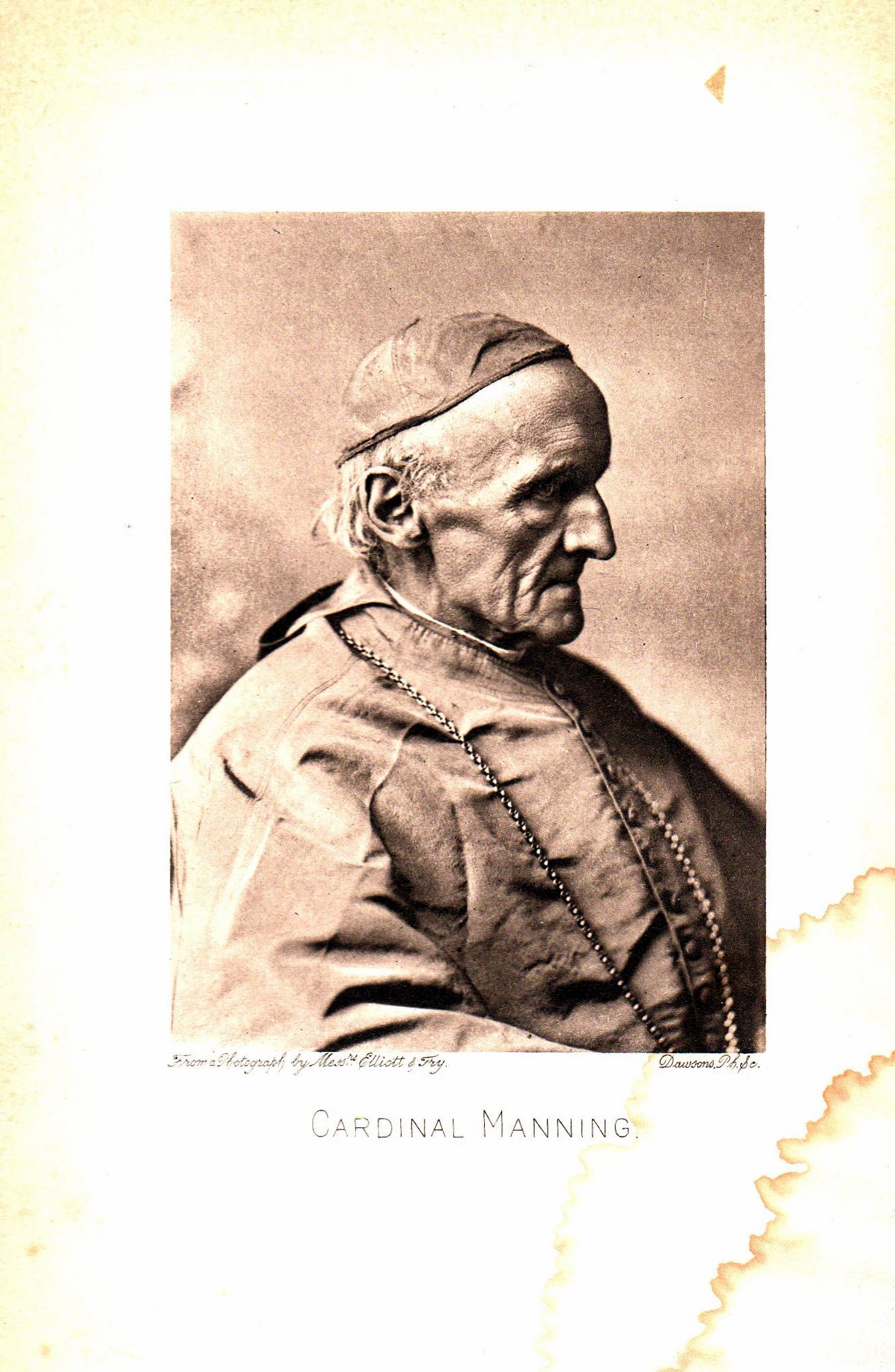
I stumbled upon a biography of Henry Cardinal Manning at the Regis College Library yesterday, published in 1892, the year of his death.  The book happened to be on their booksale shelf, for $2.   Many used book collectors are wary of library discards, because of the library marks, stamps, and stickers, as well as general wear and tear.  Personally I find these things endearing.  It adds the character of an old book when you can see the names of previous owners inscribed on the inside cover.

This bears the stamp of two previous libraries.  Obviously it was most recently part of the Regis College library’s collection, but prior to that, it found a home in the library of “J. & E. Stoneham Ltd., 51 Old Broad Street, London, E.C.2.”   Doesn’t that make you wonder how this book got from London to Regis College?

Manning is a towering figure in 19th century England, a high profile Anglo-catholic who converted to Catholicism and became Archbishop of Westminster in 1865.   Those who have read a bit of Salvation Army history will know that Manning was sympathetic to the work of the Army, but also willing to challenge the Booth on some of his presuppositions.  You can read an interesting comment from Manning on his appreciation for Army and his concerns with its teaching and practice in The Contemporary Review 41 (1882): 335-342.   Roger Green quotes from this passage in hisrecent biography of William Booth, specifically noting Manning’s astute on the Army’s claim that it was “not a sect,” in spite of the fact that it had no ties to the larger Church.

“The head of the Salvation Army is resolved that it shall never become a sect. In this he is wise. A sect is soon stereotyped. He seems to wish that it may not be a sect, but a spirit, which, like the four winds, may blow upon all the valley of dry bones—men, women, children, sects, communions, and, as he perhaps would say, Churches, quickening and raising them all to a higher life. So long as the Salvation Army teaches the three creeds in their true sense, and does not assail the Catholic faith or Church, it is so far doing a constructive, if it be only a fragmentary work… Nevertheless, we have a conviction that the Salvation Army will either become a sect, or it will melt away. This world is not the abode of disembodied spirits.” (341-342)

Manning was picking up on an ecclesiological ambiguity in the Army: they claimed that they were not a denomination or “sect,” yet they were a free standing Christian body, whose members were not members of other “churches.”  There is more work to be done on this question, and Salvationists need to reflect on its implications, and the degree to which Manning’s prediction came to fruition.

At the end of the biography of Manning I picked up yesterday, author Arthur Wollaston Hutton is speculating on what may come after Manning has passed the reigns of English Catholicism on to his successor.  Remarking on Manning’s emphasis on ministry to the poor, he writes:

“And indeed, if his spirit should survive in his successsor, there is one field – a very widely extended one – in which the Catholic Church in this country might hereafter reap a rich harvest.  Manning’s sympathy with the philanthropic work of “General” Booth was never disguised, and he was too much of an organizer himself not to look with admiration on the order and discipline of the “Salvation Army.”  The Army has a growing affinity with Catholicism, and its members, accustomed to an autocratic rule, might very well find in some future Archbishop of Westminster the successor who will surely one day be needed, if the organization is to be held together at all.  Of course these soldiers and salvation lasses are far enough from being Catholics at present; but they have accepted fully the fundamental principle of Catholicism – obedience; and in other was they are really nearer the Church than Dean Stanley’s “three men in green, whom your Lordship will find it difficult to put down.”  The ritualists, in spite of Catholic externals, are mostly liberals wearing blinkers, in accordance with the fashion introduced by Newman, and still much affected by polite society.  But the Salvation Army men are not theological liberals, and wear no blinkers, for they do not them any more than Manning did, believing with him that the straight road before them is the way revealed, and so caring to look neither to the right hand nor to the left.  A simple, certain faith is theirs, – belief in God, in sin, a Redeemer, the Bible, judgment, salvation, heaven and hell; and this simple faith is a far more serviceable basis on which to build a permanent structure of Catholicism, than the clever literary quibbles by which men better educated are able to persuade themselves that they hold to the old faith.  There is thus a promising field for an expansion of the Catholic Church – unless Catholics themselves shirk the opportunity – which should be further facilitated by the marked revival of credulity in recent times, and the growing popularity of ritual and outward show.”  – A. W. Hutton, Cardinal Manning. London: Methuen & Co., 1892, pp. 256-258.

Given the ecclesiological gulf that existed between 19th century Catholicism and the early Salvation Army, it is amazing to see a Catholic author publicly speculating about the possibility of a “Catholic Salvation Army.”  It is also interesting to notice those things which he thinks constitute an affinity between the Army and Catholicism: autocratic structures, conservative theology, and a lack of concern for “polite society.”   It seems counter-intuitive, but Hutton feels that these are “a more serviceable basis on which to build a permanent structure of Catholicism” than the sophisticated theological output of Ango-catholics.

This says a lot about the dominant characteristics of both the Army and Catholicism at the time!  We might wonder why Hutton doesn’t raise the ecumenical issues that loom large in the Army’s ecumenical relationships today: sacraments and ministry (in terms of the validity of “ordination”).  The reason is that people of the time (including Salvationists) didn’t look upon the Army as a “church.”  So a Catholic wouldn’t have related to the Army in the same way they would have related to the Church of England, or Lutherans, or Baptists.  They might think of the Army more along the lines of a irregular and unauthorized missionary order or congregation, one which was doing some good work, but was in danger of drifting from the apostolic faith over time, if not grounded in catholic soil.

Can charisms change? Insights from the examples of William Booth and Isaac Hecker

My research on the charism of William Booth and Isaac Hecker is raising some interesting questions in relation to the relative permanence or provisionality of charisms.   Are charisms a permanent endowment given to a person, or can they change, or even come and go, depending on the specific situations faced by the church in various times and places?

The issue is particularly important as it relates the charisms of ordained ministry, because traditions with a “high” view of ordination often believe it bestows a permanent character on the ordained person.

The report on Ministry from the Anglican-Roman Catholic International Commission (1973) provides an example of this kind of thinking:

In this sacramental act, the gift of God is bestowed upon the ministers, with the promise of divine grace for their work and for their sanctification; the ministry of Christ is presented to them as a model for their own; and the Spirit seals those whom he has chosen and consecrated. just as Christ has united the church inseparably with himself, and as God calls all the faithful to life-long discipleship so the gifts and calling of God to the ministers are irrevocable. For this reason, ordination is unrepeatable in both our Churches (#15).

On the other hand, Miroslav Volf, in his After our Likeness, while not discounting the possibility of lifelong charisms, suggests that charisms may come and go:

In contrast to calling, charismata in the theological sense of a combination of calling and endowment for a specific ministry in church and world are not “irrevocable” (Rom. 11:29). Various charismata can replace one another over time, something implied by the interactional model of their bestowal.  Over the history of the congregation and of its individual members, the charismata with which these members serve in the congregation can also change; certain charismata come to the fore at certain times, while others become unimportant (either for the congregation itself of for the bearers of these charismata). This does not mean that the divine calling and endowment for a certain ministry cannot be a lifelong affair; but it is not necessarily such.  In any case, there is no correlation between the permanence of a particular charism and its divine origin.  The Spirit of God is the Spirit of life, adn the Spirit’s gifts are accordingly as varied as is ecclesial life itself (233).

William Booth and Isaac Hecker are interesting case studies in relation to this question, because both experienced what could be called a “broadening” of their respective vocations.

For Booth, the broadening related to his theology of redemption.  This is the development traced in Roger Green’s War on Two Fronts, in which Booth’s understanding of redemption expanded to include efforts at social reform.   Whereas early in his ministry Booth was strictly a revivalist who engaged in some social ministry as a means to and end (the end being evangelism), by 1890 he had come to see efforts at social reform as part of the church’s mission.  Booth came to see salvation as social as well as personal, and therefore solidified and extended the mission of The Salvation Army to include organized efforts at social redemption.

Does this shift in missional thinking and practice signify a change in Booth’s personal charism, or did his charism remain the same, while he gained a broader understanding of its vocational direction?   The answer, of course, depends on how Booth’s charism prior to 1890 is understood.   Was his ministry to the poor and marginalized an essential aspect of his charism, or did he simply have the charism of an evangelist?  Is it possible to have a charism of “evangelist to the marginalized”?

I’m working these questions through right now, but I’m leaning toward suggesting that it wasn’t Booth’s charism that changed, but simply his understanding of where that gift ought to take him and the ways he ought to exercise it in his own context.   If salvation includes the social as well as the spiritual, then being an evangelist ought to include social action, since the good news of the gospel itself has social implications.

For Isaac Hecker, the change came in terms of the scope of his personal mission.   At the time of the founding of the Paulist Fathers (1858), Hecker was captivated by a strong belief that he should be a missionary to America.  He felt that his experience as a native-born American, his acquaintance with the culture, desires, and values of the American people, and his familiarity with a class of Americans who were already on a spiritual quest had placed him in a unique position to reach out to the American people as a Catholic evangelist.  This required, he believed, the founding of a religious society that was specifically adapted to the American culture, since the established religious orders were all of European origin, and thus unsuited to the task of reaching Americans.

Starting in the 1870s, however, Hecker began to broaden his vision, and now felt that the Paulists should not confine themselves to America, but should expand into Europe.  This was supported by his view of America’s providential place in the world – he felt that the American culture, and the experiences of the Catholic Church in America, would provide the solutions for the Church’s troubles in Europe.   He thought the Paulists should take what they had learned in America and come to the aid of the European Church.

Writing in 1875 along these lines, Hecker seems to suggest something like a “provisionality of charisms”:

One may be engaged in a good work, but of an inferior order, more on the circumference; but as it is a good work, and he sees no better, he should act where he is and be contented. Suppose, however, it is given to a soul the light to see a good of a much higher order, more essential, more efficacious, more general, more universal, including the former; and this light draws him from the former, all his interest as such in it has expired, and he lives in this higher and more universal light; can he do no otherwise than follow it? (The Paulist Vocation, Revised and Expanded Edition, p. 96)

As with Booth, I’m not entirely sure where to come down on this issue.  Hecker clearly believed his vocation, and that of the Paulists, had expanded – does this imply a change of charism?  Again, I’m leaning toward the idea that his personal charism did not change; rather his sense of vocation was expanded, based on his growing familiarity with the challenges facing the Church in Europe.

Why Arminian theology is neither Pelagian nor Semi-Pelagian

Critics sometimes charge that Arminian theology (including its Wesleyan articulation) is Pelagian or Semi-Pelagian.   The charge usually comes from those who are strict monergists, meaning that the believe salvation is effectually accomplished by God without the cooperation of the human person.   For the most strident monergists, any doctrine of salvation which is not monergistic ought to be labelled “Pelagian,” or “Semi-Pelagian,” or perhaps identified as the start of a slippery slope that leads to Pelagianism.  If you are looking for examples of writers to make this charge against Arminian theology, a good place to start is Roger Olson’s Arminian Theology: Myths and Realities

However, this charge can be easily dismissed by offering clear accounts of Pelagianism and Semi-Pelagianism.

Several times in Augustine’s Confessions we find Augustine praying: “Give me the grace to do as you command, and command me to do what you will.” In this prayer, Augustine is admitting that he needs God’s grace in a radical way—not only to know what God commands, but also to do what God commands. He is saying that he cannot obey God in his own power; he needs divine assistance.

Pelagius disagreed with Augustine’s assertion that human beings were incapable of obeying God in their own strength. He thought this idea might lead people to avoid personal moral responsibility. So Pelagius taught that human beings have complete freedom of the will, meaning that we inherently possess the freedom to obey God in every situation. Therefore, he said, we do not need divine grace to overcome sin. For Pelagius, we are all inherently capable of pleasing God, and therefore we are all obligated to offer God perfect obedience.

In a nutshell, Pelagianism denies original sin, and claims that human nature has not been corrupted and humans are capable of choosing good and avoiding sin without any special divine aid.  In other words, human beings are capable of meriting salvation on their own without God’s grace.

Pelagius felt that Christians do receive grace from God, but the only kind of grace he felt that humans needed was the grace of illumination – knowing what God would have us to do. The only barrier to obedience would be our ignorance of God’s will. So the ten commandments, then, would be divine grace, offering us everything we need to live a life that is pleasing to God.

Augustine agreed that we need grace to illuminate our understanding, but disagreed that we have the inherent ability to obey. Sin has so infected and bound us that we are dependent upon grace for any good that we might do.

Salvation, then, in the Pelagian perspective comes through obedience; we are justified on the basis of our merits, which we gain through our obedience to God. Augustine taught that salvation comes through divine grace. Our only claim on salvation is the promise of grace through Christ. Even our good works are dependent upon grace, and therefore are not meritorious.  This is the basis for the classic doctrine of total depravity.

It is quite clear that Arminians are not Pelagian, because Arminans affirm the doctrines of original sin and total depravity.   Human salvation is completely dependent upon God’s grace, without which we would be helpless.  While Arminians do hold that God’s prevenient grace provides fallen humanity with a measure of freedom so that we can respond to God, this freedom is not an inherent human quality.  Rather, it is a gift of grace, without which we would be helpless.

Semi-Pelagianism is a mediating position between Augustine and Pelagius which was  proposed later.  In Semi-Pelagianism, the initial step towards salvation is made by the unaided human free will.  In other words, the human person is capable of deciding to turn to Christ in faith, without any divine assistance.   After that initial step is made, the Semi-Pelagian position proposes, divine grace is then poured out for the “increase of faith.” Semi-Pelagianism was condemned at the Council of Orange in 529.

Again, any responsible account of Arminian soteriology will make it clear that Arminians are not Semi-Pelagian.  Arminians do not believe that human beings decide to exercise faith in Christ by an unaided act of the will.  On the contrary, they affirm that, without divine grace, the fallen human person is incapable of turning to God.  Prevenient grace frees the person so that such a response is possible.

What is distinctive about the Arminian position (as opposed to monergistic Reformed accounts) is that God’s grace is resistible, meaning that we can refuse his gracious offer of salvation.  However, that hardly means that our acceptance of that offer is some kind of Pelagian or Semi-Pelagian meritorious “work.”

The influence of “non-theological factors” on the rise of Montanism

“Non-theological factors” always play a role in the rise of reform movements in the church.  By “non-theological factors,” I mean social, economic, political, and cultural elements that are not directly derived from received interpretations of the truth of the Gospel.   Political, cultural, and economic factors can play a very significant role in shaping the direction a given movement takes, as well as the way the movement is received by the church.

Sometimes interpretations of popular movements which lean heavily on the importance of these non-theological factors can be dismissive of substantive Christian convictions.  However, this need not be the case.  We should expect that reform movements are influenced by social forces, and indeed that they should form their particular Christian convictions in dialogue with social forces at play in their time.

This is an important part of the church’s missionary engagement with the world.  There are no “purely” theological convictions, because theology is always worked out in the course of the church’s life in history, and it is bound to be affected by social, political, and cultural factors.  Therefore, we should not fall into the trap of assuming that non-theological factors determine of the rise and shape of reform movements, but we should examine the way that Christian convictions interact with non-theological factors in the history of particular movements, and evaluate the role of non-theological factors on the basis of this interaction.  It is the interaction of specifically Christian convictions with non-theological influences that produces the vitality and volatility of the reform and renewal movements.

Montanism, a popular second century movement which upheld a rigorous vision of Christian discipleship, and was marked by prophetic spiritual gifts, is an interesting case-in-point.

A number of non-theological factors played a role in the history of the Montanist movement. The movement took root in Phrygia in the late second century, where it would seem that the tradition of prophecy had continued to exist alongside the priestly office (Eusebius, Eccl. Hist. V.17).   The continuing existence of a prophetic office made it difficult for the bishops and clergy of that region to deny the Montanist prophecies, in spite of the eccentricities and excesses of the Montanists.  W. H. C. Frend suggests that the Montanists were a threat to the clergy, and as such the rivalry between priest and prophet caused the Montanists to be resented, and contributed toward their rejection by the established church (Saints and Sinners in the Early Church, 69).  No doubt the prominent role played by women would have also created concern among clerics.

It seems that the Montanists raised no serious doctrinal challenge to the established church, but their somewhat strange and extreme positions and their threat to established leadership led the church to push them out of its fellowship. While it is difficult, on the basis of the evidence, to evaluate the established church’s decision, it does seem that the church might have benefited from the continuing vitality of Montanism, and its excesses might have been kept in check, had the Montanists been given a continuing place in the established church’s life.

After the movement was officially rejected by the clergy, it continued to flourish in the Phrygian countryside, but also spread to North Africa.  This move was aided by the fact that the movement found fertile soil for a rigorist morality in that context.  A significant political factor inNorth Africawas the persecution of Christians, which led to a spirit of defiance and apocalyptic hope among the Christians there, even before the spread of Montanism.  The persecutions inNorth Africaled to an anti-imperial protest ethic among the Christians, with martyrdom and confession being valued above all else.  In this political environment the strict Montanist discipline appealed to Christians like Tertullian, who had faced the prospect of dying for their faith.  The rigorist morality also reinforced the social distinctions between the Montanists and the rest of North African society, distinctions which again were made quite apparent during times of persecution.

Thus we can see that some non-theological factors influenced the Montanist movement in various ways.  The tension between prophetic and priestly roles in the Church caused difficulties with the clergy which influenced the rejection of Montanism.  The rural regions ofPhrygiaproved more fertile soil culturally for the rigorist morality of Montanism, and the persecutions inNorth Africaalso supported the rigorist and apocalyptic currents of the movement, leading Montanism to grow specifically in those regions.

However, it is also obvious that such non-theological factors alone cannot be credited with bringing about the rise or Montanism, or determining its character.  Ultimately the Christian convictions of the Montanists themselves were more significant in shaping the movement’s existence.

First of all, the conviction that the Spirit was speaking directly through the Montanist prophets led members of the movement to embrace a radical obedience and adherence to the discipline that was derived from their prophetic utterances.  So Tertullian ridicules the Catholic criticism of Montanist fasting by noting that Catholics will fast at the request of the Bishop, yet the Montanists fast at the direction of the Spirit (On Fasting, XIII).  Further, after the movement was rejected by the church, one can understand why many members continued to adhere loyally to their leaders, since they believed that the church had rejected the Spirit in rejecting the Montanists.  Likewise, the apocalyptic anticipation of living on the cusp of a new age would encourage radical adherence to the movement and generate a significant following.

Finally, we can note that a strong conviction concerning the holiness of the church shaped the Montanist relation to other Christians.  In On Modesty, Tertullian is enraged that the “Pontifex Maximus” has issued an edict indicating that the sins of adultery and fornication could be forgiven with proper repentance.

“But it is in the church that this (edict) is read, and in the church that it is pronounced; and (the church) is a virgin!  Far, far from Christ’s betrothed be such a proclamation!” (On Modesty I).

The pardoning of adulterers is parallel to the pardoning of idolaters in Tertullian’s mind.  The Church’s holiness is seen in the integrity of her discipline, and it is this conviction concerning the Church’s holiness that drives Tertullian’s adherence to Montanism.

I would argue that, while the non-theological factors certainly played a supporting role in Montanism’s rise, the leading role in shaping the movement came from the central theological convictions that its members embraced.  More specifically in North Africa, it was the encounter of these strong convictions about the divine origin of Montanist discipline and the integrity of the Church with the political condition of government persecution which produced the enthusiasm and vitality of the Montanist movement.

Sermon: The Rest of the Story (Acts 1:1-11)

Below is the audio from a sermon I preached a couple weeks ago at Wesley Chapel in Toronto.  The text is Acts 1:1-11, and the sermon focuses specifically on the disciples’ question in 1:6 and Jesus answer in 1:7-8.

 “Lord, are you at this time going to restore the kingdom to Israel?”

“It is not for you to know the times or dates the Father has set by his own authority. But you will receive power when the Holy Spirit comes on you; and you will be my witnesses in Jerusalem, and in all Judea and Samaria, and to the ends of the earth.”

Here is the recording (or download it here):

[audio http://ia601202.us.archive.org/8/items/SermonTheRestOfTheStoryacts1/10Sermon_TheRestOfTheStoryac.mp3]


Leaving revivalism behind?

Christianity Today has posted a fascinating article by Gordon T. Smith, excerpted from his essay on “Conversion and Redemption” in the Oxford Handbook of Evangelical Theology.  The Handbook itself is a fantastic resource, though it is terribly expensive.  Thankfully the libraries I have access to have bought the electronic version.   Included in the Handbook are articles by my dissertation director, Ephraim Radner, on the church, and a chapter on spiritual gifts by Howard Snyder, who has been a mentor to me and many other Canadian Wesleyan theological students during his tenure as Chair of Wesley Studies at Tyndale Seminary.

Smith’s article argues that evangelical understandings of conversion are changing dramatically, and that a common feature that can be seen in the wide variety of changes in this regard is that, across the board, revivalism is being left behind:

It is not be an overstatement to say that evangelicals are experiencing a “sea change”—a paradigm shift—in their understanding of conversion and redemption, a shift that includes the way in which they think about the salvation of God, the nature and mission of the church, and the character of religious experience. Although there is no one word to capture where evangelicals are going in this regard, there is a word that captures what they are leaving behind: revivalism.

Smith offers a sketch of the ways that revivalism has impacted evangelicalism’s understanding of conversion: the focus on a dramatic one-time experience, often crystallized in the the saying of the “sinner’s prayer”; the emphasis on the afterlife; the practical distinction between “evangelism” and “disciple-making,” the emphasis on numeric growth, and so on.

He then traces how developments in evangelical thinking in a number of different fields have challenged the revivalistic assumptions which characterized much of 20th century evangelicalism.  New ideas in biblical studies, new approaches to religious experience, ecumenical influences, the changing face of global Christianity, and an increased interest in learning from Christian history have all combined to undermine the revivalist understanding of conversion.

Increasingly, there is appreciation that conversion is a complex experience by which a person is initiated into a common life with the people of God who together seek the in-breaking of the kingdom, both in this life and in the world to come. This experience is mediated by the church and thus necessarily includes baptism as a rite of initiation. The power or energy of this experience is one of immediate encounter with the risen Christ—rather than principles or laws—and this experience is choreographed by the Spirit rather than evangelistic techniques. Evangelicals are reappropriating the heritage of the Reformation with its emphasis on the means of grace, and thereby affirming the priority of the Spirit’s work in religious experience.

The excerpt ends with Smith pointing to the deeper issues that this sea-change will raise for evangelical thinking about the church.

The only question that remains, then, is whether evangelicals will trust these instincts and devote themselves to Christ-centered worship and kingdom-oriented mission. Will this be evident in deep trust that God will do God’s work in God’s time? To trust the work of God is to trust the Spirit and this necessarily means that the church trusts the Word—the Scriptures preached—as the essential means of grace and conversion.

This begs the question of what it means to be the church. The evangelical tradition is at a fork in the road and, given this sea change in the understanding of conversion and redemption, the most crucial issue at stake is what it means to be a congregation. Evangelicals will only be able to navigate these waters if they can formulate a dynamic theology of the church that reflects the Triune character of God, the means of grace—Spirit and Word—and a radical orientation in mission toward the kingdom of God.

The article is well worth a read.   I think it helpfully draws together and summarizes some of the important developments that are taking place in contemporary evangelical thinking.  While revivalism’s legacy includes many positive things, some aspects of revivalist thinking are deeply suspect, and a critical re-evaluation of its influence is most certainly needed.   This was, in part, what I was trying to do in my article “Five Ways to Improve SA Worship” –  I was highlighting the way in which Salvationist worship has been shaped by a kind of “routinized revivalism,” and arguing that there are aspects of this heritage that need to be jettisoned.  The same kind of thing is happening on a much larger scale, and in relation to a broad range of topics.  It is hard to say where any of this is going to end up, but I think this change in thinking about conversion certainly has potential to bear fruit in a genuine renewal of evangelical mission and theology.

Eschatological tensions and the question of the millennium

The mainstream theological tradition has been amillennial since Augustine, and therefore the question of the “millennium” (Rev. 20) has not been a matter of major concern for most major theologians.  Evangelical theology, however, has typically been very focused on this question.  So Donald Bloesch writes,

 “Apart from biblical inerrancy no doctrine has caused greater division in evangelical Christianity in the present day than the millennium.  Though the biblical references to a millennial kingdom are minimal, they have given rise to elaborate theologies based on the reality of such a kingdom.  Because the millennial hope has been a source of inspiration to Christians throughout the history of the church, impelling many toward a missionary vocation, it merits serious consideration.” Donald Bloesch, Essentials of Evangelical Theology (New York: Harper & Row, 1978), II: 189.

There are three basic positions on the millennium, along with one important variant on the premillennial position.

Amilliennialism: Revelation 20 is symbolic, not literal, so there will be no 1000 year reign of Christ on earth.  The millennium refers to Christ’s present rule during the church age. Christ has already bound Satan in the resurrection, though it is a relative binding.  Christ will return and the final judgment will follow.

Premillennialism: Christ returns before a literal 1000 year reign on earth in which he reigns directly over the world.  Tends to be pessimistic about the possibility of any cosmic or social redemption before Christ’s return – in fact, things will get worse and worse before the parousia.

Premillennial dispesationalism: divides salvation history into different “dispensations” in which God relates to people in different ways.  There are two parousias: the first at “the rapture” when Christ returns to remove the church from the world; then he returns again at the start of the millennium seven years later.

Postmillennialism: Christ will return after a millennial period in which his reign is exercised triumphantly on earth through the church.  The gospel will be taken to all nations, and will hold sway over the world.  Evil will still be present, but will be subdued by Christian influence during this golden age of the church.

I was lecturing on this topic a couple weeks ago, and in an attempt to help students get a handle on these debates I proposed six different sets of tensions that are at work in eschatological debates. These could be seen as differing emphases within the various eschatological visions that have exercised influence in the church over the centuries. Each of these is a set of “poles” which could be seen as existing on a continuum, and any given theologian might tend more towards one pole or the other.

First, there is a tension between personal and corporate eschatologies. Any full-orbed eschatology will deal with both personal and corporate dimensions, but some tend to push more in one direction or the other. That is, some eschatologies focus more on the fate of the individual: the eternal destiny of the saved and unsaved; questions of how we will be judged; what the resurrection body will be like, and so on. On the other hand, some eschatologies are focused more on the corporate dimensions of God’s plan for the eschaton: the future kingdom of God; visions of social justice, the overcoming of inequalities; the reconciliation of different people-groups, and so on.

Secondly, there is a tension between otherworldly and this-worldly eschatologies. Those eschatologies which are more otherworldly will focus on the radical difference between the future kingdom and the present life. They will stress discontinuities between the world as we know it and the future which God has planned for us. On the other hand, this-worldly eschatologies will tend toward a more “realized” eschatology, and see the kingdom being formed here and now in various ways. They might be uncomfortable with heavenly visions and prophecies, and seek ways for eschatology to have impact in the world here and now.

Thirdly, there is a tension between theocentric and anthropocentric eschatologies. Eschatologies with more theocentric tendencies will emphasize God’s decisive intervention in world history, both in present anticipations of the kingdom and in its final consummation. Human beings are likely portrayed as having little real agency in ushering in God’s kingdom. Theocentric-tending eschatologies might also tend towards more deterministic views of history, stressing God’s control over world events. Those with more anthropocentric tendencies will stress the role of human agents in bringing the future kingdom to realization. Human beings, with God’s help, will be seen as capable of moving history toward its proper goal and the purpose for which God created it.

Fourthly, a related consideration would be the tension between sudden and gradual eschatologies. Some theologians emphasize a sudden and dramatic change that will take place at the end. In this view, we may not see any real “progress” towards the kingdom prior to that sudden, cataclysmic event. In fact, things might get worse before God suddenly intervenes to bring about the final consummation. On the other hand, others might emphasize gradual change and growth, leading to the kingdom. In extreme cases, some have supposed that there would be no dramatic change at the end at all, but a gradual development and progress until one day God’s kingdom is established on earth.

Fifthly we could talk about pessimistic and optimistic eschatologies. Here the optimism or pessimism relates to the degree to which the eschaton is breaking into the world today. Some have little hope for present realization of the eschatological kingdom, and instead look upon the world around us as a discouraging place which is wasting away. Others see signs of the kingdom and are optimistic that things really can improve here and now. Obviously those who have otherworldly, theocentric, and sudden eschatologies will likely tend towards pessimism, whereas those with this-worldly, anthropocentric, and gradual eschatologies will tend towards optimism.

Finally, there are futurist and realized eschatologies. Obviously, echatologies with more futuristic orientations will orient there hope to the coming consummation of the eschaton, and be less hopeful about the present age, whereas those whose eschatologies tend towards a more realized perspective might have less focus on the future hope, and more focus on hope for present transformation.

Using these sets of “tensions,” I’ve developed the following analysis of the millennial positions, with my suggestions regarding how potential strengths of each view could be integrated.  This probably needs further explanation in a separate post, but I’ll leave it here for now – comments and suggestions would be welcome.